Blab AI
AI System Outperforms Radiologists in Detecting Hard-to-Spot Femoral Neck Fractures
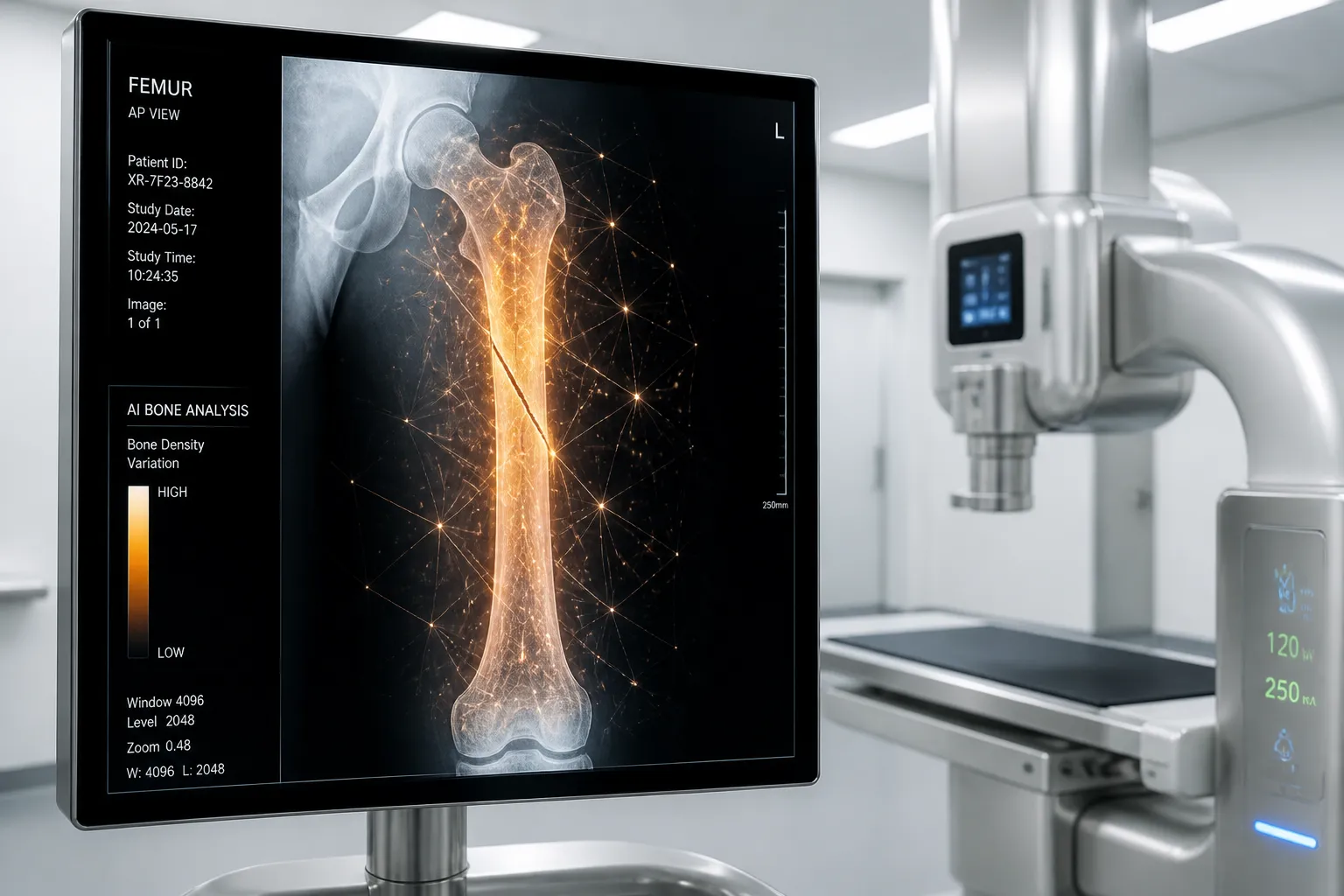
When an X‑ray shows a faint break in the hip, a seasoned eye can miss it, but a machine may not.
A new study published in the September 2026 issue of Radiology demonstrates exactly that. The AI program, called OccuNet, outperformed both musculoskeletal radiologists and emergency‑medicine physicians at spotting femoral neck fractures on plain radiographs.
OccuNet was built by a team led by Dr. Nai‑Feng Tian of the Zhejiang Spine Research Center. The developers employed a two‑stage training pipeline: first, they pre‑trained the model with contrastive learning on pairs of original and artifact‑augmented radiographs; next, they fine‑tuned it specifically for fracture detection.
The researchers tested the system on 2,576 adult patients who presented with suspected hip trauma and received pelvic or hip X‑rays followed by CT or MRI scans at four hospitals between 2009 and 2025. In a pooled test set of 1,766 patients, OccuNet correctly identified 913 of 936 fractures, yielding a sensitivity of 97.5 %. Its specificity was 98.8 %, accurately classifying 820 of 830 patients without fractures.
The most striking results came from a challenging subgroup of 189 patients whose fractures had initially been reported as negative or indeterminate on plain radiographs. OccuNet detected 94.7 % of these fractures, outperforming five musculoskeletal radiologists (86.2 %) and five emergency‑medicine physicians (68.8 %). Moreover, the AI reduced reading time by 14.9 % for radiologists and 18.9 % for emergency‑medicine physicians.
Femoral neck fractures are a frequent type of hip fracture, especially among older adults, and can be elusive on X‑ray images. Prior studies have shown that up to 10 % of these fractures are missed on initial imaging, potentially leading to complications that require more extensive treatment.
The authors argue that AI can serve as an additional safety net by highlighting subtle abnormalities that might otherwise be overlooked. The high sensitivity and specificity reported in the study suggest that the system could enhance diagnostic accuracy in routine clinical workflows.
While the results are promising, the authors caution against hasty integration. They emphasize that AI should complement, not replace, expert interpretation, and that further studies are needed to assess real‑world impact on patient outcomes.
In summary, OccuNet achieved a sensitivity of 97.5 % and a specificity of 98.8 % in detecting femoral neck fractures on radiographs. It outperformed both radiologists and emergency‑medicine physicians in a subset of indeterminate cases and reduced reading time for clinicians. The findings support the potential role of AI as an adjunct tool for improving fracture detection and reducing missed diagnoses in emergency and radiology settings.
A new study published in the September 2026 issue of Radiology demonstrates exactly that. The AI program, called OccuNet, outperformed both musculoskeletal radiologists and emergency‑medicine physicians at spotting femoral neck fractures on plain radiographs.
OccuNet was built by a team led by Dr. Nai‑Feng Tian of the Zhejiang Spine Research Center. The developers employed a two‑stage training pipeline: first, they pre‑trained the model with contrastive learning on pairs of original and artifact‑augmented radiographs; next, they fine‑tuned it specifically for fracture detection.
The researchers tested the system on 2,576 adult patients who presented with suspected hip trauma and received pelvic or hip X‑rays followed by CT or MRI scans at four hospitals between 2009 and 2025. In a pooled test set of 1,766 patients, OccuNet correctly identified 913 of 936 fractures, yielding a sensitivity of 97.5 %. Its specificity was 98.8 %, accurately classifying 820 of 830 patients without fractures.
The most striking results came from a challenging subgroup of 189 patients whose fractures had initially been reported as negative or indeterminate on plain radiographs. OccuNet detected 94.7 % of these fractures, outperforming five musculoskeletal radiologists (86.2 %) and five emergency‑medicine physicians (68.8 %). Moreover, the AI reduced reading time by 14.9 % for radiologists and 18.9 % for emergency‑medicine physicians.
Femoral neck fractures are a frequent type of hip fracture, especially among older adults, and can be elusive on X‑ray images. Prior studies have shown that up to 10 % of these fractures are missed on initial imaging, potentially leading to complications that require more extensive treatment.
The authors argue that AI can serve as an additional safety net by highlighting subtle abnormalities that might otherwise be overlooked. The high sensitivity and specificity reported in the study suggest that the system could enhance diagnostic accuracy in routine clinical workflows.
While the results are promising, the authors caution against hasty integration. They emphasize that AI should complement, not replace, expert interpretation, and that further studies are needed to assess real‑world impact on patient outcomes.
In summary, OccuNet achieved a sensitivity of 97.5 % and a specificity of 98.8 % in detecting femoral neck fractures on radiographs. It outperformed both radiologists and emergency‑medicine physicians in a subset of indeterminate cases and reduced reading time for clinicians. The findings support the potential role of AI as an adjunct tool for improving fracture detection and reducing missed diagnoses in emergency and radiology settings.





