Blab AI
New AI Assistant, SlideChat, Improves Whole-Slide Pathology Analysis
A team of researchers from China has introduced SlideChat, a multimodal generative AI assistant that can read and describe gigapixel whole‑slide images (WSIs) used in cancer diagnostics. The study, published in Nature Cancer on 1 September 2026, shows that SlideChat outperforms existing models on a range of diagnostic tasks across 31 cancer types.
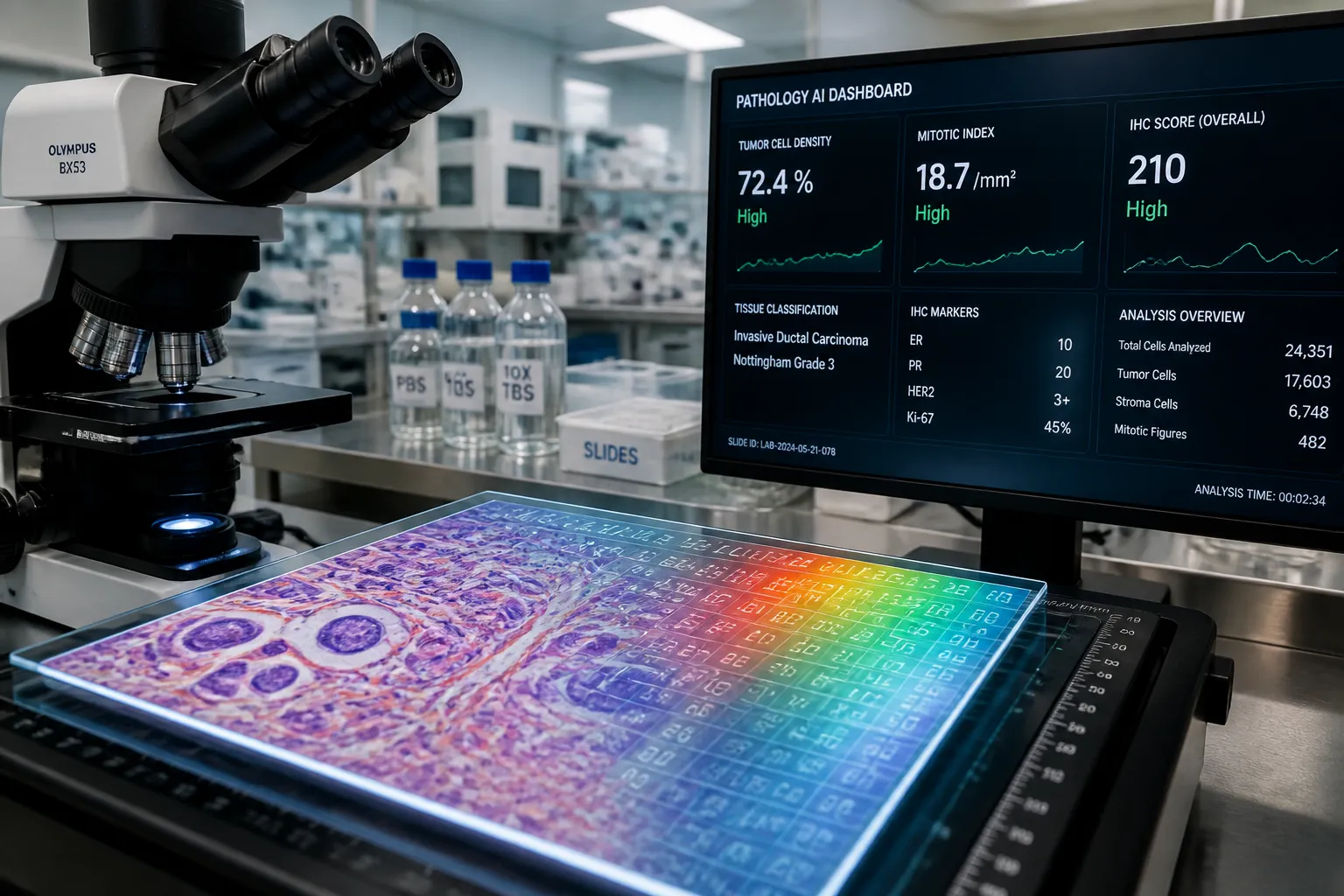
SlideChat blends a patch‑level encoder, a slide‑level encoder, and a large language model (LLM). WSIs are first divided into 224 × 224‑pixel patches, each transformed into visual embeddings. The slide‑level encoder then aggregates these embeddings to capture global context, while the LLM produces text that answers clinical questions or generates full pathology reports. The system was trained on 274,233 multimodal instruction samples that pair WSIs with concise, instruction‑style captions derived from real clinical reports.
The authors evaluated SlideChat on five independent cohorts: The Cancer Genome Atlas (TCGA), the Clinical Proteomic Tumor Analysis Consortium (CPTAC), the Breast Cancer National Bank (BCNB), the HISTAI dataset, and a retrospective cohort from the Eastern Hepatobiliary Surgery Hospital (MOP). The benchmark, called SlideBench, contains 8,836 closed‑ended questions, 129 open‑ended questions, and 3,149 WSI reports.
On closed‑ended questions, SlideChat achieved an accuracy of 86.4 %, a 19.1 % lift over the best competing model. For report generation, the model scored 0.76 on the METEOR‑based Metric for Evaluation of Translation with Explicit Ordering (METEOR‑ME), representing a 7.7 % improvement over the baseline. In open‑ended question answering, expert pathologists rated SlideChat highest across five dimensions, including correctness, relevance, and clinical usefulness.
Ablation experiments highlighted the necessity of both the patch‑level and slide‑level encoders; removing either component lowered accuracy by more than 10 %. The authors have released the full dataset, model weights, and inference code on Hugging Face and GitHub, enabling researchers to replicate and extend the work.
The study also acknowledges that the model can still produce hallucinations or inconsistencies in multi‑turn conversations. The team plans to investigate retrieval‑augmented generation and stronger alignment techniques to mitigate these issues.
SlideChat’s release marks a step toward practical AI assistants for pathology. By delivering accurate, context‑aware interpretations of whole‑slide images, the system could support diagnostic workflows, medical education, and clinical decision‑making. The open‑source nature of the project may accelerate further research and eventual clinical deployment.
Future work will focus on expanding the model’s knowledge of rare cancers, improving robustness to image artifacts, and integrating the assistant into existing pathology information systems. The authors also intend to evaluate the system in prospective clinical trials to assess its impact on diagnostic accuracy and workflow efficiency.
The study demonstrates that combining large‑scale vision‑language training with domain‑specific instruction data can bridge the gap between patch‑level analysis and whole‑slide understanding, a key challenge in computational pathology.
SlideChat blends a patch‑level encoder, a slide‑level encoder, and a large language model (LLM). WSIs are first divided into 224 × 224‑pixel patches, each transformed into visual embeddings. The slide‑level encoder then aggregates these embeddings to capture global context, while the LLM produces text that answers clinical questions or generates full pathology reports. The system was trained on 274,233 multimodal instruction samples that pair WSIs with concise, instruction‑style captions derived from real clinical reports.
The authors evaluated SlideChat on five independent cohorts: The Cancer Genome Atlas (TCGA), the Clinical Proteomic Tumor Analysis Consortium (CPTAC), the Breast Cancer National Bank (BCNB), the HISTAI dataset, and a retrospective cohort from the Eastern Hepatobiliary Surgery Hospital (MOP). The benchmark, called SlideBench, contains 8,836 closed‑ended questions, 129 open‑ended questions, and 3,149 WSI reports.
On closed‑ended questions, SlideChat achieved an accuracy of 86.4 %, a 19.1 % lift over the best competing model. For report generation, the model scored 0.76 on the METEOR‑based Metric for Evaluation of Translation with Explicit Ordering (METEOR‑ME), representing a 7.7 % improvement over the baseline. In open‑ended question answering, expert pathologists rated SlideChat highest across five dimensions, including correctness, relevance, and clinical usefulness.
Ablation experiments highlighted the necessity of both the patch‑level and slide‑level encoders; removing either component lowered accuracy by more than 10 %. The authors have released the full dataset, model weights, and inference code on Hugging Face and GitHub, enabling researchers to replicate and extend the work.
The study also acknowledges that the model can still produce hallucinations or inconsistencies in multi‑turn conversations. The team plans to investigate retrieval‑augmented generation and stronger alignment techniques to mitigate these issues.
SlideChat’s release marks a step toward practical AI assistants for pathology. By delivering accurate, context‑aware interpretations of whole‑slide images, the system could support diagnostic workflows, medical education, and clinical decision‑making. The open‑source nature of the project may accelerate further research and eventual clinical deployment.
Future work will focus on expanding the model’s knowledge of rare cancers, improving robustness to image artifacts, and integrating the assistant into existing pathology information systems. The authors also intend to evaluate the system in prospective clinical trials to assess its impact on diagnostic accuracy and workflow efficiency.
The study demonstrates that combining large‑scale vision‑language training with domain‑specific instruction data can bridge the gap between patch‑level analysis and whole‑slide understanding, a key challenge in computational pathology.





