Blab AI
Northern Ireland Draft AI Strategy Aims to Automate Routine Public-Sector Tasks While Building Local Compute Capacity
Northern Ireland is drafting a roadmap that lets artificial intelligence take over the paperwork while civil servants focus on people. The Stormont Executive Office, working with the Department for the Economy, has released a provisional plan that outlines how AI could be woven into the public sector to free staff from routine administrative work.
The strategy, still in draft form, identifies a handful of core functions for AI support: document processing, data entry, minute‑taking and basic query handling. It says that staff should be "freed up for human interactions by automating routine public‑facing tasks" and that "basic technologies should be rolled out as a priority to increase efficiency in routine office tasks." The draft also notes that AI could speed up public consultations, shorten the passage of policy, and accelerate the processing of planning applications. In addition, it proposes using AI to analyse large public datasets to inform policy decisions.
Recognising that a wholesale transformation is impractical, the plan recommends a phased rollout of "readily comprehensible projects with a clear emphasis on value and impact," paired with training and a "space for experimentation." Each department would set up a human‑oversight team that blends technical expertise with critical thinking, tasked with monitoring AI systems.
Human oversight is one of eight principles highlighted in the accompanying consultation. The strategy also promotes a "smart second‑mover" approach: instead of building bespoke tools from scratch, the public sector should adopt proven, off‑the‑shelf technologies that have succeeded elsewhere.
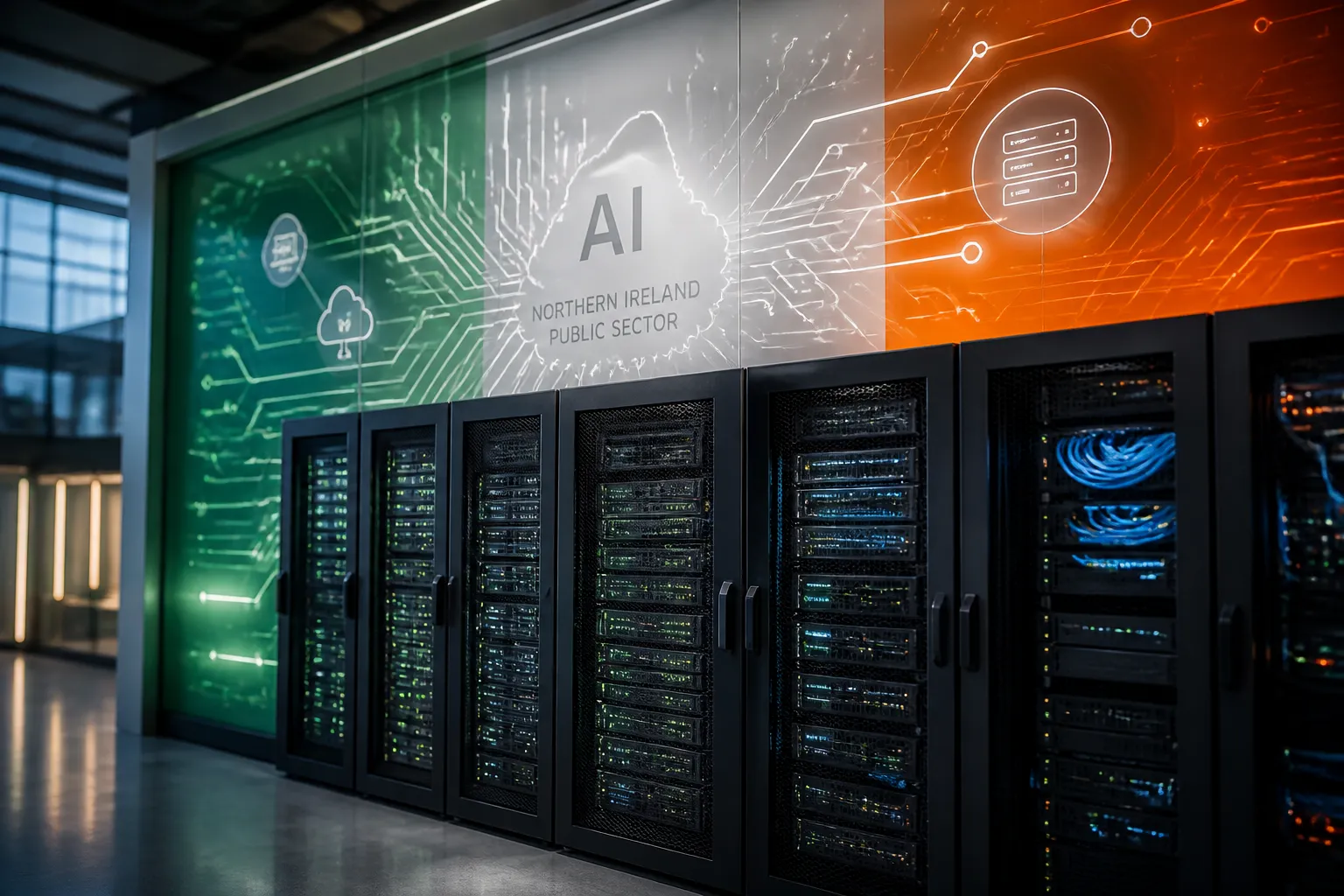
Infrastructure is a key concern. The draft notes that data centres consume significant amounts of electricity and, depending on design, water. In the Republic of Ireland, data centres now account for a quarter of all electricity consumption, a fact that has sparked political debate. To avoid reliance on external cloud providers such as Amazon Web Services, the strategy urges Northern Ireland to develop its own compute infrastructure. It argues that cloud services are too expensive for training new AI models, for experimentation, or for deep research and development. The draft therefore calls for sovereign, green, high‑performance computing facilities.
The strategy does not mention job cuts. Instead, it focuses on changing how civil servants work and on creating new roles that blend technical knowledge with oversight responsibilities. The draft also stresses the importance of training and experimentation as part of the transformation.
At present, the strategy remains a proposal. Stakeholders are invited to provide feedback on the draft, and the Executive Office will consider the input before moving toward a final policy. The plan reflects a cautious, incremental approach to AI adoption that prioritises efficiency, oversight, and local infrastructure development.
In sum, the draft outlines a roadmap that balances the benefits of AI automation with the need for governance, local capacity building, and environmental considerations. Its next steps will determine how quickly and effectively Northern Ireland can integrate AI into its public‑sector operations.
The strategy, still in draft form, identifies a handful of core functions for AI support: document processing, data entry, minute‑taking and basic query handling. It says that staff should be "freed up for human interactions by automating routine public‑facing tasks" and that "basic technologies should be rolled out as a priority to increase efficiency in routine office tasks." The draft also notes that AI could speed up public consultations, shorten the passage of policy, and accelerate the processing of planning applications. In addition, it proposes using AI to analyse large public datasets to inform policy decisions.
Recognising that a wholesale transformation is impractical, the plan recommends a phased rollout of "readily comprehensible projects with a clear emphasis on value and impact," paired with training and a "space for experimentation." Each department would set up a human‑oversight team that blends technical expertise with critical thinking, tasked with monitoring AI systems.
Human oversight is one of eight principles highlighted in the accompanying consultation. The strategy also promotes a "smart second‑mover" approach: instead of building bespoke tools from scratch, the public sector should adopt proven, off‑the‑shelf technologies that have succeeded elsewhere.
Infrastructure is a key concern. The draft notes that data centres consume significant amounts of electricity and, depending on design, water. In the Republic of Ireland, data centres now account for a quarter of all electricity consumption, a fact that has sparked political debate. To avoid reliance on external cloud providers such as Amazon Web Services, the strategy urges Northern Ireland to develop its own compute infrastructure. It argues that cloud services are too expensive for training new AI models, for experimentation, or for deep research and development. The draft therefore calls for sovereign, green, high‑performance computing facilities.
The strategy does not mention job cuts. Instead, it focuses on changing how civil servants work and on creating new roles that blend technical knowledge with oversight responsibilities. The draft also stresses the importance of training and experimentation as part of the transformation.
At present, the strategy remains a proposal. Stakeholders are invited to provide feedback on the draft, and the Executive Office will consider the input before moving toward a final policy. The plan reflects a cautious, incremental approach to AI adoption that prioritises efficiency, oversight, and local infrastructure development.
In sum, the draft outlines a roadmap that balances the benefits of AI automation with the need for governance, local capacity building, and environmental considerations. Its next steps will determine how quickly and effectively Northern Ireland can integrate AI into its public‑sector operations.





