Blab AI
HOPPR Launches Chest-CT Narrative Foundation Model for AI-Enabled Radiology
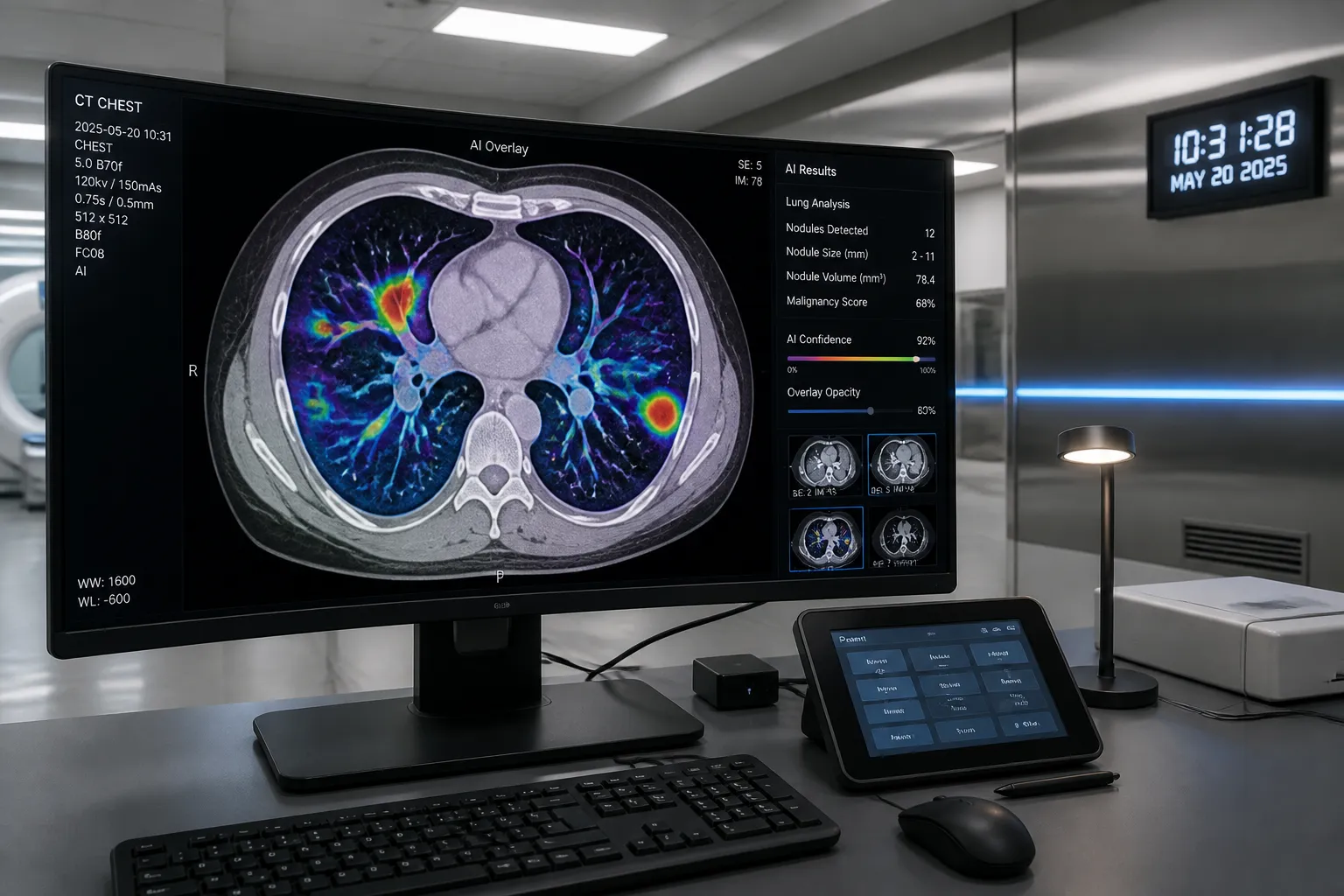
In a move that could reshape routine radiology reporting, Chicago‑based HOPPR announced on July 23 2026 the release of its HOPPR EF Chest CT Narrative Model. The new foundation model, housed in the company’s AI Foundry platform, turns three‑dimensional chest CT volumes into concise narrative language that covers pulmonary, mediastinal, cardiac, upper‑abdominal, osseous and soft‑tissue findings.
The model can automatically generate lung‑nodule characterizations, aortic measurements and other observations that are routinely included in a standard chest‑CT report. It was trained on a large proprietary dataset collected from multiple U.S. clinical sites. HOPPR deliberately added rare but serious conditions—such as aortic injury, pulmonary embolism, rib fractures and pneumothorax—to ensure the model can handle the full spectrum of findings clinicians encounter. According to the company’s press release, this approach reflects a focus on building tools that are useful across realistic clinical scenarios, not just the most common cases.
Partners can access the model through HOPPR’s Forward Deployed Services (FDS) without building in‑house machine‑learning infrastructure. The model can be evaluated on a partner’s own data, fine‑tuned for specific workflows, and integrated into existing radiology systems. The AI Foundry provides secure, HIPAA‑ready infrastructure that is SOC 2 Type II and HITRUST e1 certified. It also offers curated datasets and traceable development workflows to support responsible AI deployment in regulated healthcare environments.
With the chest‑CT model, HOPPR’s foundation‑model portfolio now spans three imaging modalities—chest X‑ray, mammography and chest CT. The models support both classification tasks and narrative‑generation tasks, and they are available alongside third‑party models from NVIDIA, Google, Microsoft, Stanford AIMI and others. The Foundry’s infrastructure and governance framework is designed to lower the cost and complexity of building AI solutions for medical imaging.
HOPPR co‑founder and CEO Khan Siddiqui said the company is “pleased with what this model can do” and emphasized that the model is only one component of a broader offering that includes secure infrastructure, curated data and clinical‑technical expertise. RadiologyOne COO Kevin Kadakia noted that the Forward Deployed Services team allowed his organization to evaluate the chest‑CT narrative model against its own data “without needing to build that capability internally,” and that the ability to adapt the model to specific workflows was a key benefit.
The release underscores HOPPR’s strategy of providing purpose‑built foundation models that can be quickly adapted by partners. The company’s AI Foundry platform is positioned to accelerate the development of transparent, scalable AI for medical imaging while maintaining compliance with industry‑wide security and privacy standards. As of now, the chest‑CT narrative model is available to partners through the Foundry, and HOPPR continues to expand its portfolio and support services.
The model can automatically generate lung‑nodule characterizations, aortic measurements and other observations that are routinely included in a standard chest‑CT report. It was trained on a large proprietary dataset collected from multiple U.S. clinical sites. HOPPR deliberately added rare but serious conditions—such as aortic injury, pulmonary embolism, rib fractures and pneumothorax—to ensure the model can handle the full spectrum of findings clinicians encounter. According to the company’s press release, this approach reflects a focus on building tools that are useful across realistic clinical scenarios, not just the most common cases.
Partners can access the model through HOPPR’s Forward Deployed Services (FDS) without building in‑house machine‑learning infrastructure. The model can be evaluated on a partner’s own data, fine‑tuned for specific workflows, and integrated into existing radiology systems. The AI Foundry provides secure, HIPAA‑ready infrastructure that is SOC 2 Type II and HITRUST e1 certified. It also offers curated datasets and traceable development workflows to support responsible AI deployment in regulated healthcare environments.
With the chest‑CT model, HOPPR’s foundation‑model portfolio now spans three imaging modalities—chest X‑ray, mammography and chest CT. The models support both classification tasks and narrative‑generation tasks, and they are available alongside third‑party models from NVIDIA, Google, Microsoft, Stanford AIMI and others. The Foundry’s infrastructure and governance framework is designed to lower the cost and complexity of building AI solutions for medical imaging.
HOPPR co‑founder and CEO Khan Siddiqui said the company is “pleased with what this model can do” and emphasized that the model is only one component of a broader offering that includes secure infrastructure, curated data and clinical‑technical expertise. RadiologyOne COO Kevin Kadakia noted that the Forward Deployed Services team allowed his organization to evaluate the chest‑CT narrative model against its own data “without needing to build that capability internally,” and that the ability to adapt the model to specific workflows was a key benefit.
The release underscores HOPPR’s strategy of providing purpose‑built foundation models that can be quickly adapted by partners. The company’s AI Foundry platform is positioned to accelerate the development of transparent, scalable AI for medical imaging while maintaining compliance with industry‑wide security and privacy standards. As of now, the chest‑CT narrative model is available to partners through the Foundry, and HOPPR continues to expand its portfolio and support services.





