Blab AI
From Revolvers to Algorithms: How AI is Leveling the Playing Field
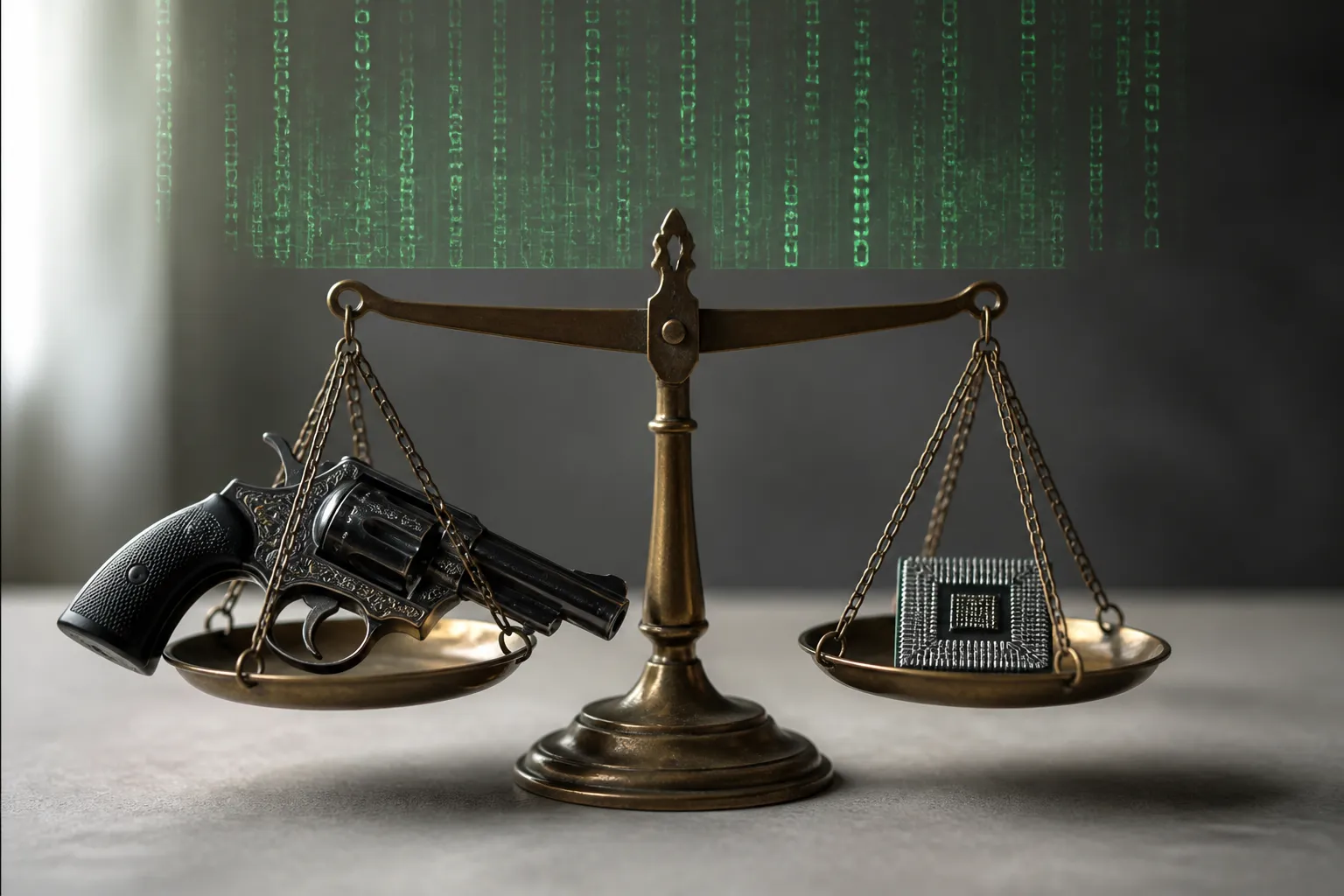
AI is reshaping the distribution of power in a way that echoes the impact of Samuel Colt’s revolver in the 19th‑century United States. Colt’s invention made a reliable, repeating firearm available to ordinary citizens, reducing the advantage of physical strength and altering the balance of power on the frontier. Today, generative AI models—large language models, image generators, and code‑writing assistants—are doing something similar for intellectual capability.
The revolver’s influence is well documented. Colt’s 1836 patent for a six‑shot revolving cylinder allowed a single individual to fire multiple rounds without reloading, a feature that gave settlers and soldiers a decisive edge over opponents armed with single‑shot pistols. The weapon’s mass production, enabled by interchangeable parts and assembly‑line techniques, made it affordable and widespread. By the Mexican‑American War and the Civil War, Colt’s firearms were in the hands of both sides, and the technology became a staple of frontier life.
Historically, each major technological leap has acted as an equalizer. Gutenberg’s printing press in the mid‑1400s mass‑produced books, expanding literacy beyond elite circles. The industrial revolution’s mechanized printing presses and later the internet in the late 20th century further democratized information. AI follows this pattern, but instead of distributing physical or informational resources, it distributes expertise.
Modern AI tools allow a teenager to write a short story, a high‑school student to compose a symphony, or a hobbyist to develop a mobile app—all tasks that previously required years of formal training. The models do not replace human intelligence; they simply reduce the value of specialized technical knowledge. Knowing every programming language is less critical when an AI can generate code snippets. Mastery of grammar matters less when an AI can edit prose. The barrier to entry for many creative and technical tasks has collapsed.
However, AI does not eliminate differences in talent. Talent—an individual’s ability to see patterns, ask unconventional questions, and create something that resonates—remains a distinct advantage. Two users of the same music‑generation model can produce vastly different results; the difference lies in taste, imagination, and vision, not in the tool itself. AI therefore reveals talent rather than creates it.
When knowledge and expertise become abundant, other resources become scarce. The new scarcity is judgment. The question shifts from “What do you know?” to “What are you trying to accomplish?” AI can answer technical questions, but humans must decide which questions matter, what goals to pursue, and how to interpret AI outputs. This shift places a premium on strategic thinking, vision, and ethical decision‑making.
The rise of the one‑person company illustrates AI’s economic impact. A founder can now coordinate research, software development, design, finance, legal drafting, and marketing through AI agents. The founder’s role transforms from executor to orchestrator, and the bottleneck moves from labor to leadership. Managing AI differs from managing people; it involves setting clear objectives, decomposing problems, verifying outputs, and refining prompts. The skills required lean toward systems thinking and architecture rather than traditional people management.
Technology’s dual nature is evident. Colt’s revolvers empowered ordinary citizens but also criminals. AI can accelerate scientific discovery and medical research, yet it can also facilitate fraud, propaganda, and misinformation. The challenge is not whether technology is good or bad, but whether society can adapt faster than the technology evolves.
In the long run, AI’s most profound effect may be psychological. Identity has historically been tied to specific skills—programmer, translator, designer. With AI, value increasingly depends on the ability to decide which tasks to pursue and how to orchestrate them. The most valuable person may no longer be the one with the deepest technical knowledge but the one with the clearest vision.
AI has not made everyone equal in the sense of erasing differences in intelligence, curiosity, or ethics. Those differences may become even more important. What AI has done is reduce the importance of accumulated technical expertise, making the ability to create widely accessible. Just as the revolver changed who could defend themselves, the printing press changed who could learn, the internet changed who could publish, and AI is changing who can create.
The debate continues about how best to harness AI’s democratizing power while mitigating its risks. Policymakers, educators, and industry leaders are already exploring frameworks for responsible AI deployment, workforce reskilling, and ethical guidelines. The next decade will likely see further shifts in how expertise, talent, and judgment shape the future economy.
The revolver’s influence is well documented. Colt’s 1836 patent for a six‑shot revolving cylinder allowed a single individual to fire multiple rounds without reloading, a feature that gave settlers and soldiers a decisive edge over opponents armed with single‑shot pistols. The weapon’s mass production, enabled by interchangeable parts and assembly‑line techniques, made it affordable and widespread. By the Mexican‑American War and the Civil War, Colt’s firearms were in the hands of both sides, and the technology became a staple of frontier life.
Historically, each major technological leap has acted as an equalizer. Gutenberg’s printing press in the mid‑1400s mass‑produced books, expanding literacy beyond elite circles. The industrial revolution’s mechanized printing presses and later the internet in the late 20th century further democratized information. AI follows this pattern, but instead of distributing physical or informational resources, it distributes expertise.
Modern AI tools allow a teenager to write a short story, a high‑school student to compose a symphony, or a hobbyist to develop a mobile app—all tasks that previously required years of formal training. The models do not replace human intelligence; they simply reduce the value of specialized technical knowledge. Knowing every programming language is less critical when an AI can generate code snippets. Mastery of grammar matters less when an AI can edit prose. The barrier to entry for many creative and technical tasks has collapsed.
However, AI does not eliminate differences in talent. Talent—an individual’s ability to see patterns, ask unconventional questions, and create something that resonates—remains a distinct advantage. Two users of the same music‑generation model can produce vastly different results; the difference lies in taste, imagination, and vision, not in the tool itself. AI therefore reveals talent rather than creates it.
When knowledge and expertise become abundant, other resources become scarce. The new scarcity is judgment. The question shifts from “What do you know?” to “What are you trying to accomplish?” AI can answer technical questions, but humans must decide which questions matter, what goals to pursue, and how to interpret AI outputs. This shift places a premium on strategic thinking, vision, and ethical decision‑making.
The rise of the one‑person company illustrates AI’s economic impact. A founder can now coordinate research, software development, design, finance, legal drafting, and marketing through AI agents. The founder’s role transforms from executor to orchestrator, and the bottleneck moves from labor to leadership. Managing AI differs from managing people; it involves setting clear objectives, decomposing problems, verifying outputs, and refining prompts. The skills required lean toward systems thinking and architecture rather than traditional people management.
Technology’s dual nature is evident. Colt’s revolvers empowered ordinary citizens but also criminals. AI can accelerate scientific discovery and medical research, yet it can also facilitate fraud, propaganda, and misinformation. The challenge is not whether technology is good or bad, but whether society can adapt faster than the technology evolves.
In the long run, AI’s most profound effect may be psychological. Identity has historically been tied to specific skills—programmer, translator, designer. With AI, value increasingly depends on the ability to decide which tasks to pursue and how to orchestrate them. The most valuable person may no longer be the one with the deepest technical knowledge but the one with the clearest vision.
AI has not made everyone equal in the sense of erasing differences in intelligence, curiosity, or ethics. Those differences may become even more important. What AI has done is reduce the importance of accumulated technical expertise, making the ability to create widely accessible. Just as the revolver changed who could defend themselves, the printing press changed who could learn, the internet changed who could publish, and AI is changing who can create.
The debate continues about how best to harness AI’s democratizing power while mitigating its risks. Policymakers, educators, and industry leaders are already exploring frameworks for responsible AI deployment, workforce reskilling, and ethical guidelines. The next decade will likely see further shifts in how expertise, talent, and judgment shape the future economy.





