Blab AI
Palm Beach County Halts New AI Data Center Applications Under Moratorium
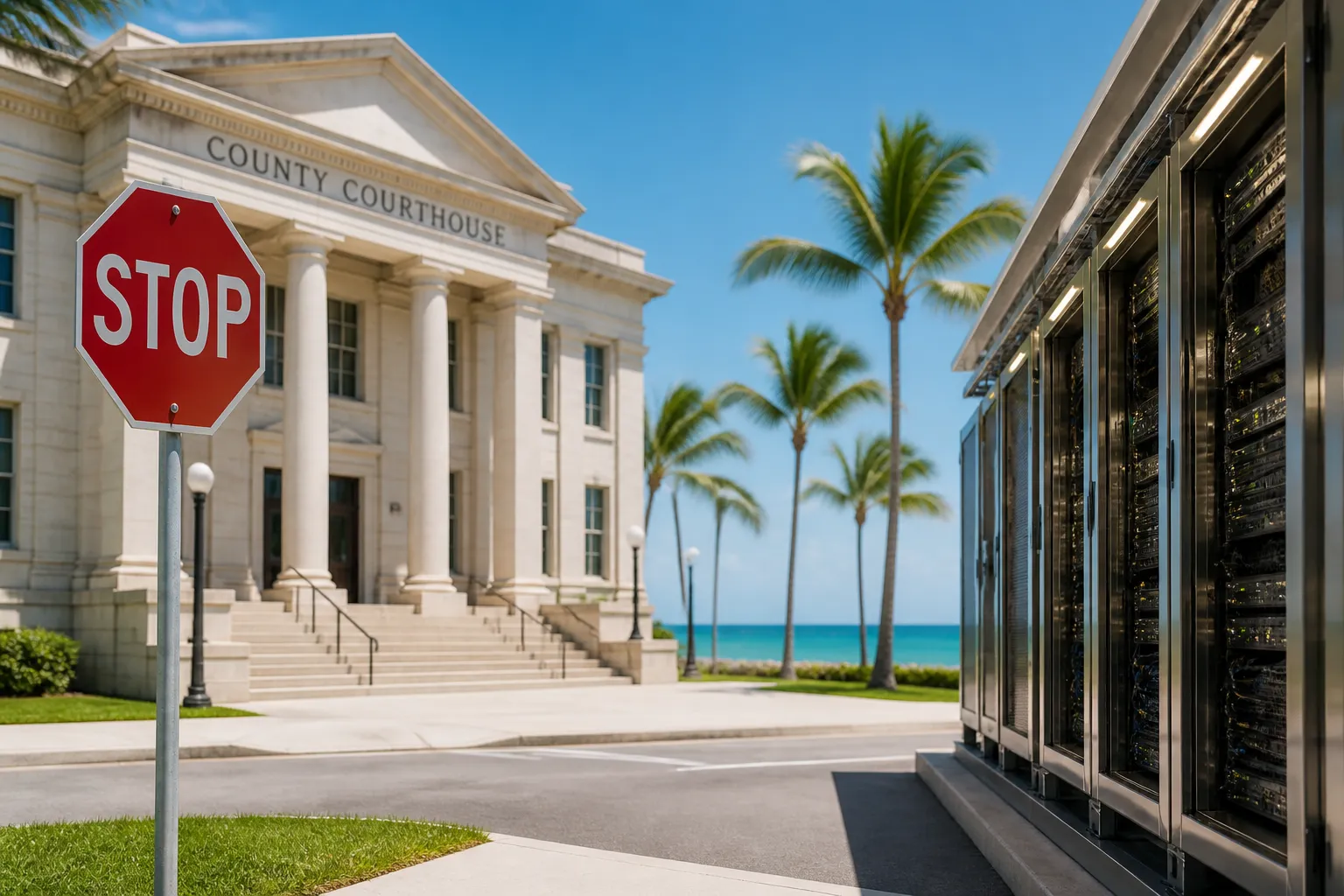
Palm Beach County has put the AI data‑center boom on pause. On Tuesday, commissioners voted 6‑1 to suspend all new applications for artificial‑intelligence (AI) data centers, giving the county time to craft clear rules for the industry. The moratorium leaves the already‑filed Project Tango—an ambitious, but controversial, proposal—untouched until next week’s vote.
The decision comes amid a growing chorus of residents who fear that large data centers will strain local resources and alter neighborhoods. Mayor Sara Baxter said she was driven by repeated complaints that such facilities could harm communities. "I’ve been hearing residents who say constantly, we do not want data centers. We don’t want this data center. It’s going to be detrimental to us," she told reporters.
Commissioner Maria Sachs was the lone dissenting voice, warning that excluding Project Tango from the pause might be premature. "It’s a great idea; I would like to examine it. But I would like to get through that tough vote next week and see how it lays out," Sachs said.
Baxter, who has recused herself from the upcoming Project Tango vote, explained that the moratorium will help the county define key parameters for future AI data centers. She said the county will determine what counts as a hyperscale facility, how close such centers can be to homes and schools, and what rules should govern water and energy use. "That’s exactly why we’re doing the moratorium, to get those parameters nailed down," she said.
The ordinance is slated to take effect in August. Until then, all zoning actions have been frozen and new applications are on hold. The move aligns with a broader trend in which local governments are scrutinizing the rapid expansion of AI‑focused data centers.
According to Wikipedia, an AI data center is a specialized facility designed for the computationally intensive tasks of training and running AI and machine‑learning models. These centers typically use hardware such as GPUs, TPUs, and high‑speed interconnects. They consume about six times more electricity per server rack than general‑purpose data centers, and they can draw significant amounts of water for cooling.
The AI boom of the 2020s has accelerated the construction of such facilities, with global demand for high‑bandwidth memory and semiconductor chips rising sharply. In 2026, major tech companies are estimated to spend $650 billion on AI data centers, and about 70 % of memory production is reserved for these projects.
Local opposition has already led to delays and cancellations. A report by Data Center Watch noted that between May 2024 and March 2025, community resistance blocked or delayed $64 billion in projects, with six projects halted entirely and ten delayed.
The moratorium gives Palm Beach County a chance to balance the economic benefits of AI infrastructure with residents’ concerns about energy consumption, water use, and proximity to schools and homes. The county’s next steps will include drafting detailed zoning regulations and environmental guidelines that reflect the unique demands of hyperscale AI facilities.
The outcome of the upcoming Project Tango vote will be closely watched, as it could set a precedent for how the county manages large‑scale technology projects while addressing community concerns. For now, the moratorium provides a pause that may allow the county to craft a more comprehensive regulatory framework before new AI data centers are approved.
The county’s decision underscores the growing need for local governments to develop clear policies around AI infrastructure—a sector that is expanding rapidly and has significant environmental footprints. As the AI industry continues to grow, other jurisdictions may look to Palm Beach County’s approach as a model for balancing innovation with community interests.
The decision comes amid a growing chorus of residents who fear that large data centers will strain local resources and alter neighborhoods. Mayor Sara Baxter said she was driven by repeated complaints that such facilities could harm communities. "I’ve been hearing residents who say constantly, we do not want data centers. We don’t want this data center. It’s going to be detrimental to us," she told reporters.
Commissioner Maria Sachs was the lone dissenting voice, warning that excluding Project Tango from the pause might be premature. "It’s a great idea; I would like to examine it. But I would like to get through that tough vote next week and see how it lays out," Sachs said.
Baxter, who has recused herself from the upcoming Project Tango vote, explained that the moratorium will help the county define key parameters for future AI data centers. She said the county will determine what counts as a hyperscale facility, how close such centers can be to homes and schools, and what rules should govern water and energy use. "That’s exactly why we’re doing the moratorium, to get those parameters nailed down," she said.
The ordinance is slated to take effect in August. Until then, all zoning actions have been frozen and new applications are on hold. The move aligns with a broader trend in which local governments are scrutinizing the rapid expansion of AI‑focused data centers.
According to Wikipedia, an AI data center is a specialized facility designed for the computationally intensive tasks of training and running AI and machine‑learning models. These centers typically use hardware such as GPUs, TPUs, and high‑speed interconnects. They consume about six times more electricity per server rack than general‑purpose data centers, and they can draw significant amounts of water for cooling.
The AI boom of the 2020s has accelerated the construction of such facilities, with global demand for high‑bandwidth memory and semiconductor chips rising sharply. In 2026, major tech companies are estimated to spend $650 billion on AI data centers, and about 70 % of memory production is reserved for these projects.
Local opposition has already led to delays and cancellations. A report by Data Center Watch noted that between May 2024 and March 2025, community resistance blocked or delayed $64 billion in projects, with six projects halted entirely and ten delayed.
The moratorium gives Palm Beach County a chance to balance the economic benefits of AI infrastructure with residents’ concerns about energy consumption, water use, and proximity to schools and homes. The county’s next steps will include drafting detailed zoning regulations and environmental guidelines that reflect the unique demands of hyperscale AI facilities.
The outcome of the upcoming Project Tango vote will be closely watched, as it could set a precedent for how the county manages large‑scale technology projects while addressing community concerns. For now, the moratorium provides a pause that may allow the county to craft a more comprehensive regulatory framework before new AI data centers are approved.
The county’s decision underscores the growing need for local governments to develop clear policies around AI infrastructure—a sector that is expanding rapidly and has significant environmental footprints. As the AI industry continues to grow, other jurisdictions may look to Palm Beach County’s approach as a model for balancing innovation with community interests.





