Blab AI
Army Reserve Soldiers Showcase AI-Powered Solutions in Austin Code-a-Thon
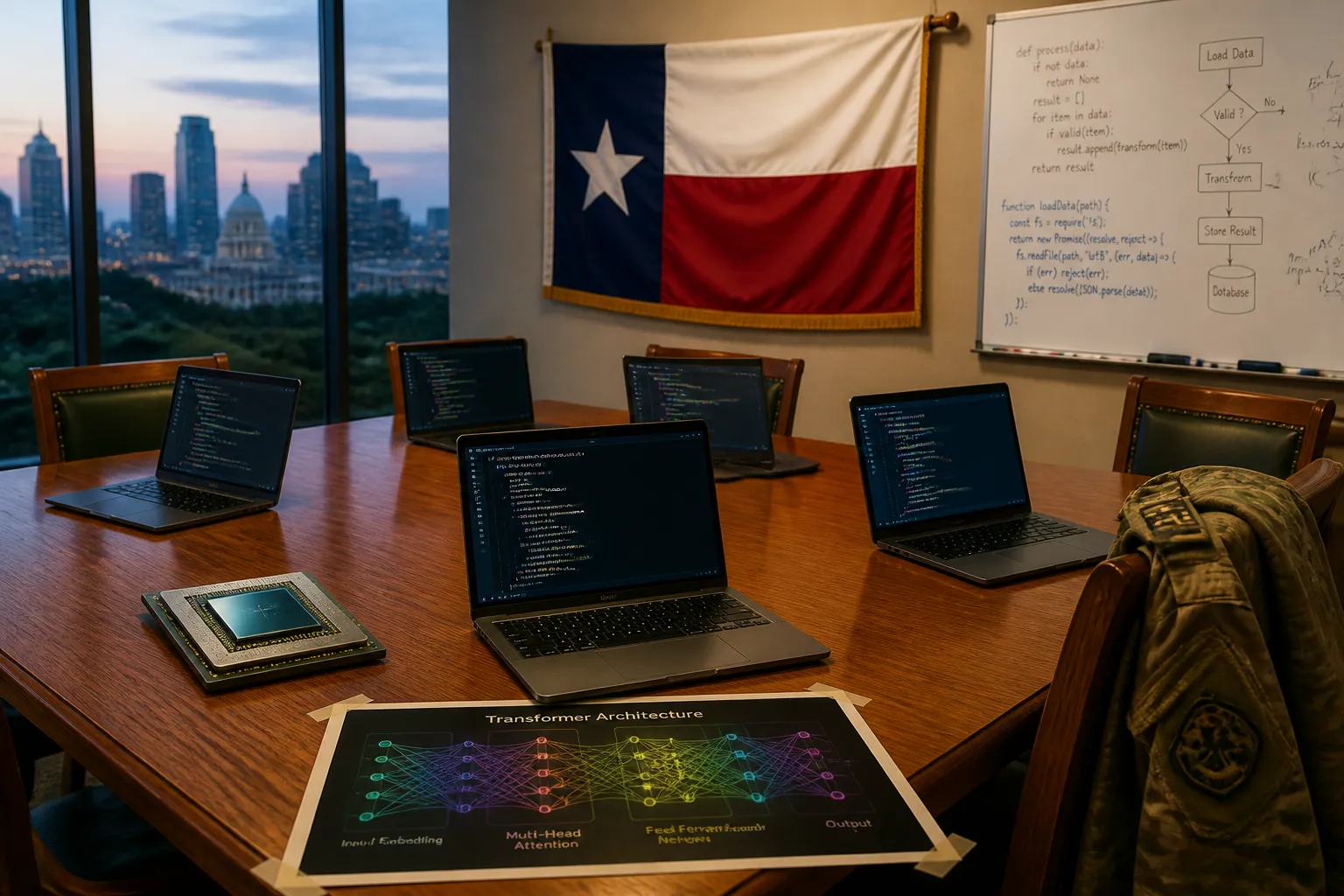
On May 14, 2026, the city of Austin became the backdrop for a high‑stakes experiment in rapid‑prototyping AI. The 75th U.S. Army Reserve Innovation Command (75th USARIC) staged its fourth code‑a‑thon at a leading search‑engine and generative‑AI company, inviting Reserve soldiers, civilian data scientists, and product managers to turn raw ideas into working demos.
The two‑week sprint was shepherded by Lt. Col. Jason Kim, the deputy commander of the Army Reserve Applications Group (AAG) and a civilian director of data science and analytics. Kim framed the event as a way to keep technically skilled soldiers engaged and to prove that the Reserve can deliver operationally relevant AI in a fraction of the time that traditional acquisition cycles would take. He stressed that the code‑a‑thon’s purpose was twofold: to retain elite technical talent by assigning them meaningful, mission‑focused problems, and to demonstrate the Reserve’s capacity to generate tangible value quickly.
Participants built a handful of prototypes that addressed both administrative and tactical challenges. The standout was MP Sentinel‑Video RAG, a retrieval‑augmented generation system that pulls relevant video footage to aid military police (MP) decision‑making on the battlefield. Other projects included a TA‑50 computer‑vision tool designed to trim inventory overload, and a “Soldier Passport” application that speeds up administrative readiness checks. The teams worked in a secure, open‑internet environment that granted them direct access to commercial‑grade AI models, allowing them to experiment with state‑of‑the‑art generative and vision technologies.
Leadership at the event underscored the broader significance of the exercise. Maj. Eric Metzler, an innovation team lead and Army civilian data scientist, highlighted how the code‑a‑thon revealed the depth of technical expertise within the Reserve and reinforced the mission to leverage new technology to stay ahead of future conflicts. Col. Christopher Christian, commander of the AAG and the 75th USARIC OSJ 26 Task Force, praised the teams’ rapid preparation and the quality of the demos, noting that the work would help senior leaders understand how AI can directly support MP operations.
The sprint also served as a rehearsal for Operation Sentinel Justice 26 (OSJ 26), the largest training exercise in U.S. Army Reserve history. Scheduled for June 7–20, OSJ 26 will bring more than 12,000 soldiers from multiple states into a large‑scale training environment. The MP Sentinel‑Video RAG prototype was refined during the code‑a‑thon and will be presented to the 200th MP Command and 75th USARIC leadership during OSJ 26. The demonstration is intended to validate the system’s operational value and to illustrate how AI‑driven tools can be integrated into large‑scale training scenarios.
In summary, the Austin code‑a‑thon proved that the 75th USARIC can rapidly develop and field AI solutions that address both administrative and tactical challenges. The event highlighted the Reserve’s capacity to retain technical talent, accelerate innovation, and prepare for large‑scale exercises such as OSJ 26. The prototypes built during the sprint—particularly MP Sentinel‑Video RAG—are poised to influence future Army Reserve training and operational planning, while the event itself underscores the growing role of generative AI and retrieval‑augmented generation in defense applications.
The two‑week sprint was shepherded by Lt. Col. Jason Kim, the deputy commander of the Army Reserve Applications Group (AAG) and a civilian director of data science and analytics. Kim framed the event as a way to keep technically skilled soldiers engaged and to prove that the Reserve can deliver operationally relevant AI in a fraction of the time that traditional acquisition cycles would take. He stressed that the code‑a‑thon’s purpose was twofold: to retain elite technical talent by assigning them meaningful, mission‑focused problems, and to demonstrate the Reserve’s capacity to generate tangible value quickly.
Participants built a handful of prototypes that addressed both administrative and tactical challenges. The standout was MP Sentinel‑Video RAG, a retrieval‑augmented generation system that pulls relevant video footage to aid military police (MP) decision‑making on the battlefield. Other projects included a TA‑50 computer‑vision tool designed to trim inventory overload, and a “Soldier Passport” application that speeds up administrative readiness checks. The teams worked in a secure, open‑internet environment that granted them direct access to commercial‑grade AI models, allowing them to experiment with state‑of‑the‑art generative and vision technologies.
Leadership at the event underscored the broader significance of the exercise. Maj. Eric Metzler, an innovation team lead and Army civilian data scientist, highlighted how the code‑a‑thon revealed the depth of technical expertise within the Reserve and reinforced the mission to leverage new technology to stay ahead of future conflicts. Col. Christopher Christian, commander of the AAG and the 75th USARIC OSJ 26 Task Force, praised the teams’ rapid preparation and the quality of the demos, noting that the work would help senior leaders understand how AI can directly support MP operations.
The sprint also served as a rehearsal for Operation Sentinel Justice 26 (OSJ 26), the largest training exercise in U.S. Army Reserve history. Scheduled for June 7–20, OSJ 26 will bring more than 12,000 soldiers from multiple states into a large‑scale training environment. The MP Sentinel‑Video RAG prototype was refined during the code‑a‑thon and will be presented to the 200th MP Command and 75th USARIC leadership during OSJ 26. The demonstration is intended to validate the system’s operational value and to illustrate how AI‑driven tools can be integrated into large‑scale training scenarios.
In summary, the Austin code‑a‑thon proved that the 75th USARIC can rapidly develop and field AI solutions that address both administrative and tactical challenges. The event highlighted the Reserve’s capacity to retain technical talent, accelerate innovation, and prepare for large‑scale exercises such as OSJ 26. The prototypes built during the sprint—particularly MP Sentinel‑Video RAG—are poised to influence future Army Reserve training and operational planning, while the event itself underscores the growing role of generative AI and retrieval‑augmented generation in defense applications.





