Blab AI
AIs Growing Footprint: Energy, Water, and the Need for Resource Governance
When a student asks an AI to generate a playful image of a dog in a World Cup jersey, the electricity that lights the server racks and the water that cools the processors are hidden behind the screen.
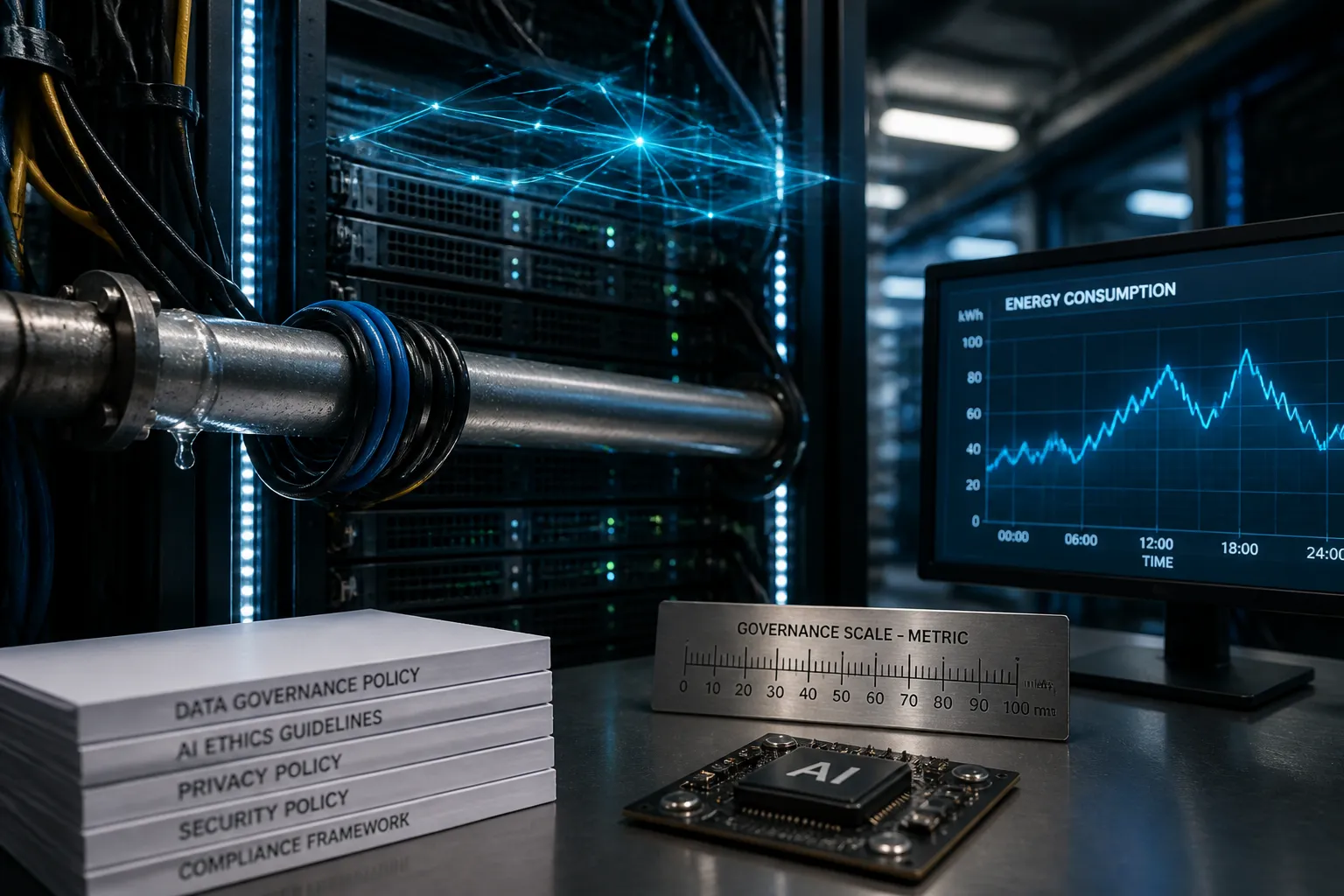
A 2025 International Energy Agency report shows that global data‑center electricity consumption jumped from 415 TWh in 2024 to an estimated 945 TWh by 2030. AI accelerator workloads are the main driver of that rise.
In a 2026 analysis by Presenc AI, the company projects that AI‑specific data centers will consume roughly 1,000 TWh of electricity—about the same amount Japan uses in a year. The same study notes that a single year of ChatGPT usage could account for 29 TWh, a figure comparable to Ireland’s total electricity consumption.
Water usage is a growing concern. Seven Seas Water Group reports that cooling towers, pumps, chillers, and fire‑suppression systems in data centers consume large volumes of water. A LinkedIn article on “Reshaping Water Usage in Data Centers” highlights that evaporative cooling, common in AI facilities, can require thousands of gallons per day. The National Interest adds that data centers that rely on evaporative cooling effectively “exchange heat with the atmosphere by evaporating water,” a process that can strain local water supplies.
The essay that prompted this report points out that the environmental costs of AI are often invisible to users. It cites the example of a student generating a humorous image of a dog in a World Cup jersey, a task that may have used a significant amount of electricity and water without the user’s awareness. The author also references the difficulty of quantifying AI’s impact on climate change, noting that estimates vary widely and that “information sources on AI’s contributions to climate change are incomplete and contradictory.”
Beyond environmental impact, the essay raises concerns about how AI’s resource demands intersect with public policy. It cites the 1995 Chicago summer blackout, which killed 739 people, as a reminder that power grids can fail under extreme load. The author questions whether current regulations give enough weight to human needs when data‑center electricity is diverted for AI workloads. The essay calls for “laws to prioritize power and water for human consumption, with explicit definitions, before using these resources for machine technologies.” It also suggests that grid‑management decisions should not be delegated to AI systems during emergencies.
These concerns align with recent regulatory developments. The European Union’s Artificial Intelligence Act, which entered into force on 1 August 2024, establishes a framework for AI systems that includes transparency and safety obligations. While the Act does not directly regulate data‑center resource use, it creates a precedent for regulating AI’s broader societal impact. The essay’s author argues that “humans must be at least equal shareholders with corporations when it comes to resources,” a stance that could inform future policy.
The educational sector is also feeling the pressure. The essay recounts how high‑school and college students worry about deepfakes and academic integrity, concerns that have been echoed in surveys of educators. The author notes that past technologies—spell‑check, synonym finders, word processors—were once feared to degrade writing quality, and that many of those fears proved valid. The current generation’s heavy reliance on short‑form text and social media is described as a “linguistic paradox” where students read more words but use a narrower vocabulary.
In sum, the data‑center energy and water statistics, coupled with the essay’s discussion of resource governance and educational impacts, paint a picture of an AI ecosystem that is expanding rapidly but also raising significant environmental, regulatory, and societal questions. Policymakers, industry leaders, and educators are now tasked with balancing the benefits of AI innovation against the finite resources that sustain human life.
The next few years will likely see increased scrutiny of data‑center efficiency, new water‑usage regulations, and possibly the extension of AI‑specific rules to include resource allocation. Until then, the industry must continue to disclose its environmental footprint and engage with regulators to ensure that AI’s growth does not come at the expense of essential human needs.
A 2025 International Energy Agency report shows that global data‑center electricity consumption jumped from 415 TWh in 2024 to an estimated 945 TWh by 2030. AI accelerator workloads are the main driver of that rise.
In a 2026 analysis by Presenc AI, the company projects that AI‑specific data centers will consume roughly 1,000 TWh of electricity—about the same amount Japan uses in a year. The same study notes that a single year of ChatGPT usage could account for 29 TWh, a figure comparable to Ireland’s total electricity consumption.
Water usage is a growing concern. Seven Seas Water Group reports that cooling towers, pumps, chillers, and fire‑suppression systems in data centers consume large volumes of water. A LinkedIn article on “Reshaping Water Usage in Data Centers” highlights that evaporative cooling, common in AI facilities, can require thousands of gallons per day. The National Interest adds that data centers that rely on evaporative cooling effectively “exchange heat with the atmosphere by evaporating water,” a process that can strain local water supplies.
The essay that prompted this report points out that the environmental costs of AI are often invisible to users. It cites the example of a student generating a humorous image of a dog in a World Cup jersey, a task that may have used a significant amount of electricity and water without the user’s awareness. The author also references the difficulty of quantifying AI’s impact on climate change, noting that estimates vary widely and that “information sources on AI’s contributions to climate change are incomplete and contradictory.”
Beyond environmental impact, the essay raises concerns about how AI’s resource demands intersect with public policy. It cites the 1995 Chicago summer blackout, which killed 739 people, as a reminder that power grids can fail under extreme load. The author questions whether current regulations give enough weight to human needs when data‑center electricity is diverted for AI workloads. The essay calls for “laws to prioritize power and water for human consumption, with explicit definitions, before using these resources for machine technologies.” It also suggests that grid‑management decisions should not be delegated to AI systems during emergencies.
These concerns align with recent regulatory developments. The European Union’s Artificial Intelligence Act, which entered into force on 1 August 2024, establishes a framework for AI systems that includes transparency and safety obligations. While the Act does not directly regulate data‑center resource use, it creates a precedent for regulating AI’s broader societal impact. The essay’s author argues that “humans must be at least equal shareholders with corporations when it comes to resources,” a stance that could inform future policy.
The educational sector is also feeling the pressure. The essay recounts how high‑school and college students worry about deepfakes and academic integrity, concerns that have been echoed in surveys of educators. The author notes that past technologies—spell‑check, synonym finders, word processors—were once feared to degrade writing quality, and that many of those fears proved valid. The current generation’s heavy reliance on short‑form text and social media is described as a “linguistic paradox” where students read more words but use a narrower vocabulary.
In sum, the data‑center energy and water statistics, coupled with the essay’s discussion of resource governance and educational impacts, paint a picture of an AI ecosystem that is expanding rapidly but also raising significant environmental, regulatory, and societal questions. Policymakers, industry leaders, and educators are now tasked with balancing the benefits of AI innovation against the finite resources that sustain human life.
The next few years will likely see increased scrutiny of data‑center efficiency, new water‑usage regulations, and possibly the extension of AI‑specific rules to include resource allocation. Until then, the industry must continue to disclose its environmental footprint and engage with regulators to ensure that AI’s growth does not come at the expense of essential human needs.





