Blab AI
Karnataka AI City Project Faces Farmers Land-Acquisition Protest
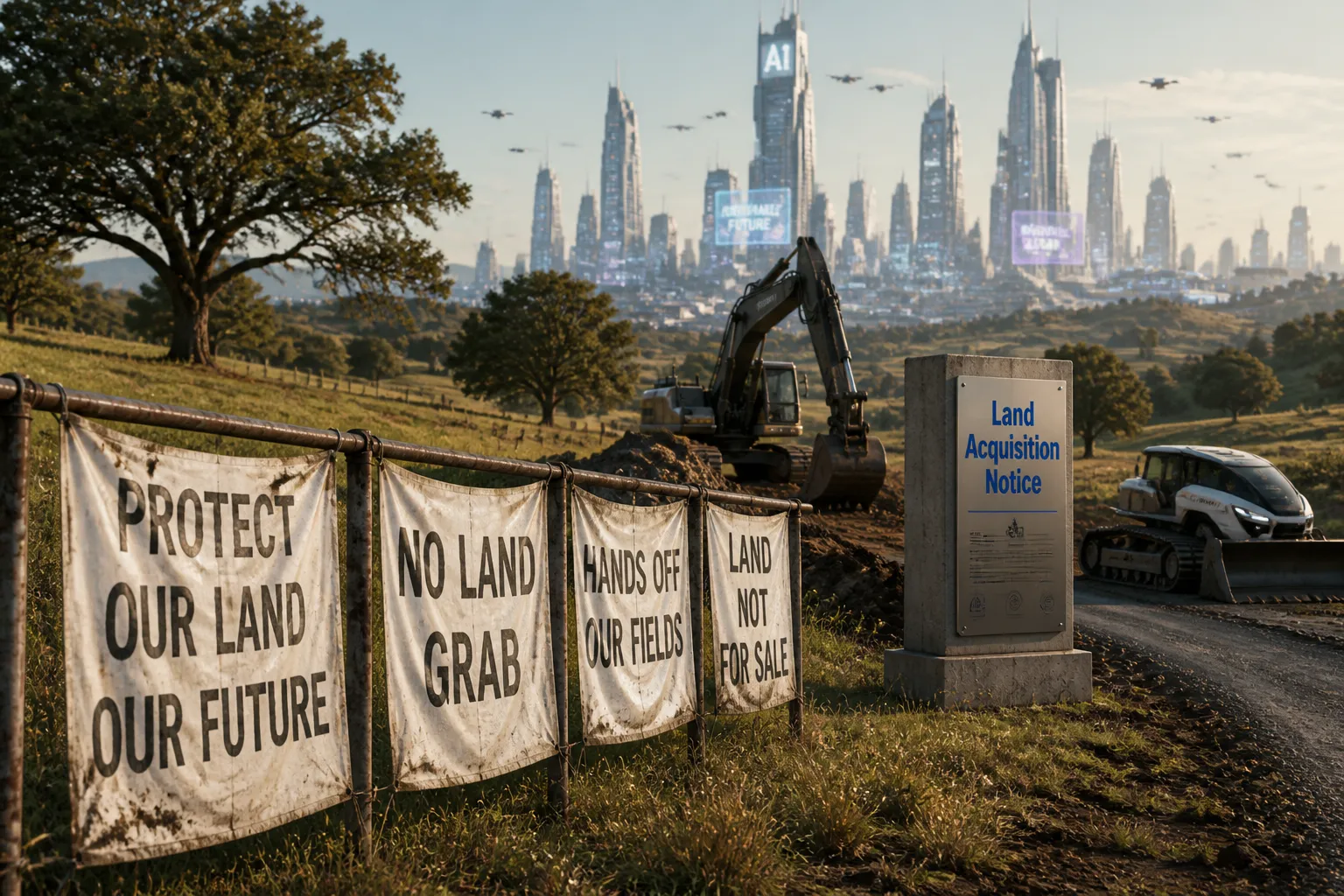
Farmer protests block Karnataka’s ambitious AI city. In the outskirts of Bengaluru, a planned artificial‑intelligence powered township near Bidadi—45 km from the state capital—has become the epicenter of a heated land‑acquisition dispute. Thousands of farmers are rallying against the government’s intent to transform 9,000 acres into India’s first AI‑powered city.
The project, known as the Greater Bengaluru Integrated Township (GBIT), is budgeted at more than ₹18,000 crore. It promises a central business district and a “work, live, play” environment that places robotics, automation, and IoT sensor networks at its core. The plan envisions AI‑powered governance, real‑time monitoring of water, energy, and traffic, and a walk‑to‑work ecosystem that could reshape the region’s infrastructure.
However, the land acquisition has drawn sharp opposition from farmers in 26 villages across two gram panchayats, nine of which are revenue villages. A final notification covering 500 acres in three villages marked the start of a formal offer: compensation of up to ₹2 crore per acre or 50 percent of the value of developed residential land. “This is my ancestral land and my identity, and this is all that I have,” a farmer from Byramangala said. He added that the wet, fertile land supports over 300,000 trees, providing income for more than 5,000 families.
A teacher from Kuruvalli village echoed the sentiment: “We are here because we saw similar acquisition attempts in our village. We lodged a strong protest and the proposal was taken back.” The protests, which began 470 days ago, intensified after the government floated a ₹26 crore tender to hire a consultant for the masterplan. Five days before this article was written, a farmer named Raja Prabhu reported that the protest group had blocked the entire road to draw attention from authorities.
Only about 20 percent of the farmers have accepted the compensation offer, according to Byrappa, a local farmer. He noted that some supporters or those who accepted the offer are being offered jobs as security guards or helpers in the new hub, but the majority insist on retaining ownership of their land.
An RTI reply from the horticulture department, first published by The Hindu, lists the trees that would be affected: 83,536 arecanut trees, 87,903 coconut trees, 12,550 mango trees, 306,506 banana plants, 2,344 chikoo trees and about 2,500 rose plants. The reply also highlights that ragi cultivation, spread across 231 acres, would be heavily impacted. Mapping by the Indian Institute of Science shows that Bengaluru has lost 93 percent of its forest and lake cover since the 1970s.
The government maintains that the project will create a future‑ready infrastructure, but environmentalists and farmers argue that the plan prioritises urban development over rural livelihoods. Vijay Nishant, an environmentalist based in Bengaluru, said, “When they think about planning, it is all urban at the cost of rural. There’s a huge mismatch.”
The township is part of Karnataka’s broader strategy to become an AI hub and to attract investment and jobs. Deputy Chief Minister D K Shivakumar has promoted the project as a flagship infrastructure initiative. Yet the ongoing protests have stalled land acquisition and raised questions about the balance between development and the rights of small farmers.
At present, the government continues to offer compensation and is negotiating with farmers, while the protest movement remains active. The outcome of these negotiations will determine whether the 9,000‑acre AI city can proceed as planned or whether further adjustments will be required to address the concerns of the affected communities.
The project, known as the Greater Bengaluru Integrated Township (GBIT), is budgeted at more than ₹18,000 crore. It promises a central business district and a “work, live, play” environment that places robotics, automation, and IoT sensor networks at its core. The plan envisions AI‑powered governance, real‑time monitoring of water, energy, and traffic, and a walk‑to‑work ecosystem that could reshape the region’s infrastructure.
However, the land acquisition has drawn sharp opposition from farmers in 26 villages across two gram panchayats, nine of which are revenue villages. A final notification covering 500 acres in three villages marked the start of a formal offer: compensation of up to ₹2 crore per acre or 50 percent of the value of developed residential land. “This is my ancestral land and my identity, and this is all that I have,” a farmer from Byramangala said. He added that the wet, fertile land supports over 300,000 trees, providing income for more than 5,000 families.
A teacher from Kuruvalli village echoed the sentiment: “We are here because we saw similar acquisition attempts in our village. We lodged a strong protest and the proposal was taken back.” The protests, which began 470 days ago, intensified after the government floated a ₹26 crore tender to hire a consultant for the masterplan. Five days before this article was written, a farmer named Raja Prabhu reported that the protest group had blocked the entire road to draw attention from authorities.
Only about 20 percent of the farmers have accepted the compensation offer, according to Byrappa, a local farmer. He noted that some supporters or those who accepted the offer are being offered jobs as security guards or helpers in the new hub, but the majority insist on retaining ownership of their land.
An RTI reply from the horticulture department, first published by The Hindu, lists the trees that would be affected: 83,536 arecanut trees, 87,903 coconut trees, 12,550 mango trees, 306,506 banana plants, 2,344 chikoo trees and about 2,500 rose plants. The reply also highlights that ragi cultivation, spread across 231 acres, would be heavily impacted. Mapping by the Indian Institute of Science shows that Bengaluru has lost 93 percent of its forest and lake cover since the 1970s.
The government maintains that the project will create a future‑ready infrastructure, but environmentalists and farmers argue that the plan prioritises urban development over rural livelihoods. Vijay Nishant, an environmentalist based in Bengaluru, said, “When they think about planning, it is all urban at the cost of rural. There’s a huge mismatch.”
The township is part of Karnataka’s broader strategy to become an AI hub and to attract investment and jobs. Deputy Chief Minister D K Shivakumar has promoted the project as a flagship infrastructure initiative. Yet the ongoing protests have stalled land acquisition and raised questions about the balance between development and the rights of small farmers.
At present, the government continues to offer compensation and is negotiating with farmers, while the protest movement remains active. The outcome of these negotiations will determine whether the 9,000‑acre AI city can proceed as planned or whether further adjustments will be required to address the concerns of the affected communities.





