Blab AI
Vancouver Protesters Block AI Data Centre Plans Amid Water and Energy Concerns
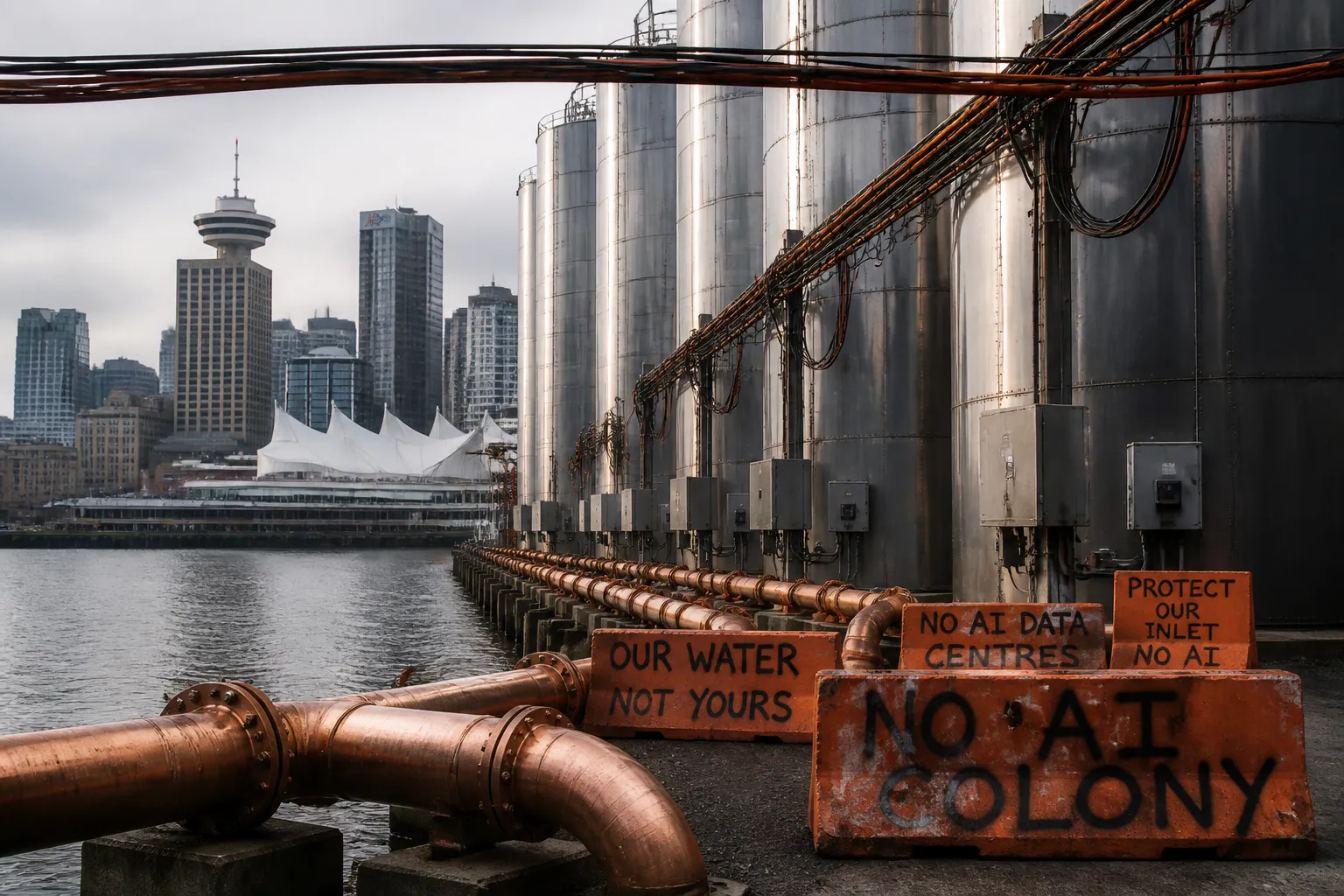
On Saturday, a crowd of hundreds gathered outside the Vancouver Art Gallery to oppose the federal government and Telus’s plan to build three artificial‑intelligence (AI) data centres in British Columbia. The demonstration followed a similar march in late May and joined a growing network of protests that have already taken place in Victoria, Kamloops, Calgary, Toronto and Halifax.
The three proposed sites include two downtown Vancouver facilities—one at 150 West Georgia St. and another at 111 East 5th Ave.—and a third near Kamloops. Telus says the centres will draw 150 megawatts (MW) of power by 2032, roughly 12‑14 % of the output of the province’s 1,100 MW John Horgan (Site C) dam. The company also claims the facilities will use 90 % less water than conventional data centres and will create an estimated $9 billion in Canadian economic activity.
Protesters cited the province’s ongoing water restrictions and the strain on the electrical grid as key reasons to block the projects. "Data centres bring a lot of pollution and shortages of power and water," said one demonstrator. Another added, "We are already going through water restrictions and data centres would only add to that…there’s also the strain that it puts on just energy in general."
BC Green leader Emily Lowan, who attended the march, warned that the data centres pose a risk to the environment and called for AI regulation. She noted that British Columbia has become a net importer of coal‑fired electricity from the United States because of extreme droughts.
Premier David Eby defended the plans, arguing that BC Hydro’s low energy costs and clean output give the province an advantage. BC Hydro, a Crown corporation, operates 32 hydroelectric facilities and two natural‑gas‑fueled plants, with a nameplate capacity of 12,049 MW.
The protest also highlighted concerns about noise and air pollution. A protester said, "There’s also the air and noise pollution to be considered. It’s just overall not a good idea for the environment."
In addition to the street demonstrations, a petition titled "STOP the Vancouver AI Data Centre from being built" has gathered more than 15,000 signatures. Grace Barrett, the petition’s initiator, said she is worried about the water usage of the facilities. "It will affect our region as a whole; it’s not just a city‑based issue," she told 1130 NewsRadio.
Barrett noted a lack of communication with British Columbians about changes to the water supply as the province moves into restrictions. "It feels hypocritical to tell us that we can’t water our lawn and that we could face a fine while something that will require so many thousands of litres of water a week is going ahead without outward communication," she said.
The protests have drawn attention to the broader debate over the environmental footprint of AI infrastructure. Telus’s own statements claim the new centres will use significantly less water than typical data centres, but the protestors argue that even reduced consumption could still strain the province’s limited water resources.
The federal government’s involvement is part of a national strategy to build a "sovereign AI backbone". Telus’s plans are supported by the federal government, which has pledged to invest in AI infrastructure across Canada.
The protests have also raised questions about public participation in decisions that affect local communities. One demonstrator said, "If we have to build a data centre, I feel like a better location should be picked and more consideration for how it would impact the cities and the people and the communities around it." Another added, "There’s got to be more public involvement with these kinds of heavy‑interest approvals."
While the protests have not yet halted the project, they have increased public scrutiny and may influence future environmental assessments and community consultations. The next steps for the project will likely involve detailed studies of water and energy impacts, as well as potential adjustments to site selection.
The situation remains fluid. The federal government and Telus have not announced any changes to the timeline or scope of the data centres. BC Hydro has not issued a statement on the projected 150 MW draw. The province’s water and energy regulators are expected to review the plans in the coming months.
The protests underscore the growing tension between the rapid expansion of AI infrastructure and the environmental limits of the regions where it is built. As the industry continues to grow, the need for transparent, community‑informed planning will become increasingly important.
The three proposed sites include two downtown Vancouver facilities—one at 150 West Georgia St. and another at 111 East 5th Ave.—and a third near Kamloops. Telus says the centres will draw 150 megawatts (MW) of power by 2032, roughly 12‑14 % of the output of the province’s 1,100 MW John Horgan (Site C) dam. The company also claims the facilities will use 90 % less water than conventional data centres and will create an estimated $9 billion in Canadian economic activity.
Protesters cited the province’s ongoing water restrictions and the strain on the electrical grid as key reasons to block the projects. "Data centres bring a lot of pollution and shortages of power and water," said one demonstrator. Another added, "We are already going through water restrictions and data centres would only add to that…there’s also the strain that it puts on just energy in general."
BC Green leader Emily Lowan, who attended the march, warned that the data centres pose a risk to the environment and called for AI regulation. She noted that British Columbia has become a net importer of coal‑fired electricity from the United States because of extreme droughts.
Premier David Eby defended the plans, arguing that BC Hydro’s low energy costs and clean output give the province an advantage. BC Hydro, a Crown corporation, operates 32 hydroelectric facilities and two natural‑gas‑fueled plants, with a nameplate capacity of 12,049 MW.
The protest also highlighted concerns about noise and air pollution. A protester said, "There’s also the air and noise pollution to be considered. It’s just overall not a good idea for the environment."
In addition to the street demonstrations, a petition titled "STOP the Vancouver AI Data Centre from being built" has gathered more than 15,000 signatures. Grace Barrett, the petition’s initiator, said she is worried about the water usage of the facilities. "It will affect our region as a whole; it’s not just a city‑based issue," she told 1130 NewsRadio.
Barrett noted a lack of communication with British Columbians about changes to the water supply as the province moves into restrictions. "It feels hypocritical to tell us that we can’t water our lawn and that we could face a fine while something that will require so many thousands of litres of water a week is going ahead without outward communication," she said.
The protests have drawn attention to the broader debate over the environmental footprint of AI infrastructure. Telus’s own statements claim the new centres will use significantly less water than typical data centres, but the protestors argue that even reduced consumption could still strain the province’s limited water resources.
The federal government’s involvement is part of a national strategy to build a "sovereign AI backbone". Telus’s plans are supported by the federal government, which has pledged to invest in AI infrastructure across Canada.
The protests have also raised questions about public participation in decisions that affect local communities. One demonstrator said, "If we have to build a data centre, I feel like a better location should be picked and more consideration for how it would impact the cities and the people and the communities around it." Another added, "There’s got to be more public involvement with these kinds of heavy‑interest approvals."
While the protests have not yet halted the project, they have increased public scrutiny and may influence future environmental assessments and community consultations. The next steps for the project will likely involve detailed studies of water and energy impacts, as well as potential adjustments to site selection.
The situation remains fluid. The federal government and Telus have not announced any changes to the timeline or scope of the data centres. BC Hydro has not issued a statement on the projected 150 MW draw. The province’s water and energy regulators are expected to review the plans in the coming months.
The protests underscore the growing tension between the rapid expansion of AI infrastructure and the environmental limits of the regions where it is built. As the industry continues to grow, the need for transparent, community‑informed planning will become increasingly important.





