Blab AI
101st Airbornes 3rd Brigade Uses Drones and AI to Clear Breach at Louisiana Training Center
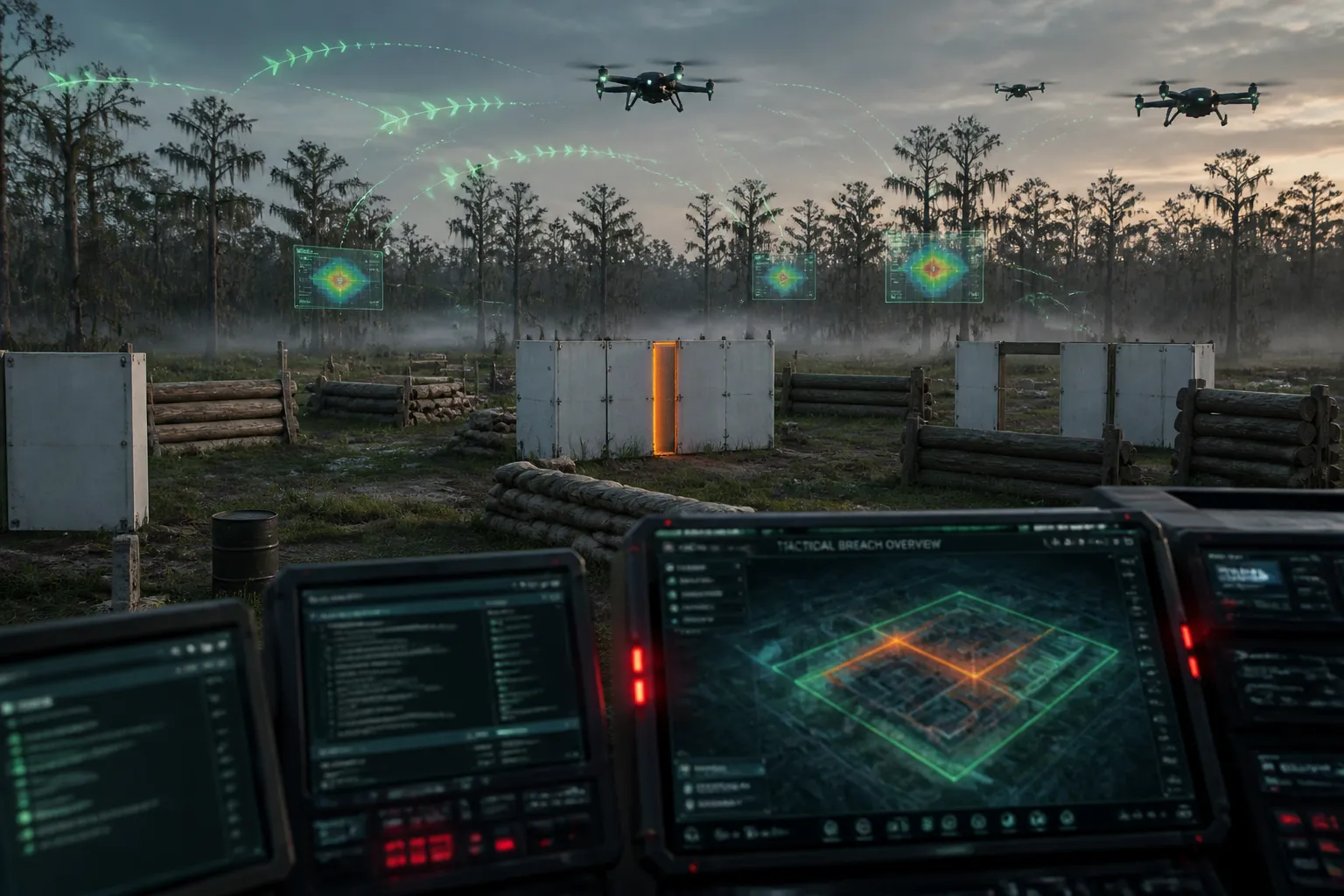
In April 2026, the 101st Airborne Division’s 3rd Mobile Brigade Combat Team (3rd MBCT) turned a field at Fort Polk’s Joint Readiness Training Center into a live‑action laboratory for unmanned warfare. Colonel Ryan Bell, the brigade’s commander, explained that the exercise employed 35 one‑way attack drones, two unmanned ground vehicles (UGVs), and 100 pounds of C4 explosives to breach a fortified position, allowing riflemen to advance without contest.
The 3rd MBCT coordinated a mix of aerial and ground assets to neutralise bunkers, machine‑gun nests, triple‑strand concertina wire, electronic‑warfare sensors, and jammers. The drones dropped smoke canisters to conceal the breach, while the UGVs carried C4 charges to clear remaining mine and wire obstacles. According to Bell, the operation required 35 drones and a little over 100 pounds of C4—an expense lower than three 155‑mm artillery barrages.
Unmanned systems were part of a broader push to weave robotics and artificial intelligence into planning and execution. The Multi‑Functional Reconnaissance Company flew drones, launched electronic‑warfare effects, and inserted onto the battlefield with Marine Corps V‑22 Ospreys, proving the Army’s tilt‑rotor capability. A UGV equipped with a machine gun protected an artillery battery, freeing soldiers to focus on offensive tasks.
AI tools also played a role. The brigade’s staff built bots that processed 25,000 battlefield reports, and large‑language models ingested doctrine to support mission analysis. Bell noted that AI helped identify gaps in courses of action and accelerate order production—sometimes generating directives in under half an hour—but was not used to shape commander intent or develop the overall course of action because the models lack an understanding of three‑dimensional space.
Drone production was handled by the 101st’s Robotics and Autonomous Integration Directorate (RAID). RAID supplied more than half of the 228 one‑way attack drones used in the exercise. The Attritable Battlefield Enabler (ABE) 1.01, a 3D‑printed drone, can be built in‑house for about $750 in some configurations. Bell said the division lacks the capacity to scale production and that industry must step in to meet the Army’s projected demand. Soldiers reportedly spent about a day to assemble two drones, and the designs were intended to be cheap, mass‑producible, and operable after extended periods of combat.
The exercise highlighted both the promise and the limits of unmanned and AI‑enabled systems. While the drones and UGVs created a “drone contact layer” that removed the need for engineers and sappers to clear the breach, Bell emphasized that technology should enable soldiers rather than replace them, insisting that the fundamentals of warfighting remain the focus.
At present, the 3rd MBCT continues to refine its use of unmanned systems and AI tools. The Army is working to expand production of the ABE 1.01 and to integrate AI more fully into planning workflows while maintaining human oversight.
The Fort Polk exercise provides a benchmark for future deployments, but questions remain about scaling production, ensuring reliability in contested environments, and balancing technological advantage with operational security.
The 3rd MBCT coordinated a mix of aerial and ground assets to neutralise bunkers, machine‑gun nests, triple‑strand concertina wire, electronic‑warfare sensors, and jammers. The drones dropped smoke canisters to conceal the breach, while the UGVs carried C4 charges to clear remaining mine and wire obstacles. According to Bell, the operation required 35 drones and a little over 100 pounds of C4—an expense lower than three 155‑mm artillery barrages.
Unmanned systems were part of a broader push to weave robotics and artificial intelligence into planning and execution. The Multi‑Functional Reconnaissance Company flew drones, launched electronic‑warfare effects, and inserted onto the battlefield with Marine Corps V‑22 Ospreys, proving the Army’s tilt‑rotor capability. A UGV equipped with a machine gun protected an artillery battery, freeing soldiers to focus on offensive tasks.
AI tools also played a role. The brigade’s staff built bots that processed 25,000 battlefield reports, and large‑language models ingested doctrine to support mission analysis. Bell noted that AI helped identify gaps in courses of action and accelerate order production—sometimes generating directives in under half an hour—but was not used to shape commander intent or develop the overall course of action because the models lack an understanding of three‑dimensional space.
Drone production was handled by the 101st’s Robotics and Autonomous Integration Directorate (RAID). RAID supplied more than half of the 228 one‑way attack drones used in the exercise. The Attritable Battlefield Enabler (ABE) 1.01, a 3D‑printed drone, can be built in‑house for about $750 in some configurations. Bell said the division lacks the capacity to scale production and that industry must step in to meet the Army’s projected demand. Soldiers reportedly spent about a day to assemble two drones, and the designs were intended to be cheap, mass‑producible, and operable after extended periods of combat.
The exercise highlighted both the promise and the limits of unmanned and AI‑enabled systems. While the drones and UGVs created a “drone contact layer” that removed the need for engineers and sappers to clear the breach, Bell emphasized that technology should enable soldiers rather than replace them, insisting that the fundamentals of warfighting remain the focus.
At present, the 3rd MBCT continues to refine its use of unmanned systems and AI tools. The Army is working to expand production of the ABE 1.01 and to integrate AI more fully into planning workflows while maintaining human oversight.
The Fort Polk exercise provides a benchmark for future deployments, but questions remain about scaling production, ensuring reliability in contested environments, and balancing technological advantage with operational security.





