Blab AI
BMW Group Deploys Next-Generation Figure 03 Humanoid Robot at Spartanburg Plant
In a quiet South Carolina plant, a humanoid robot is about to take the wheel.
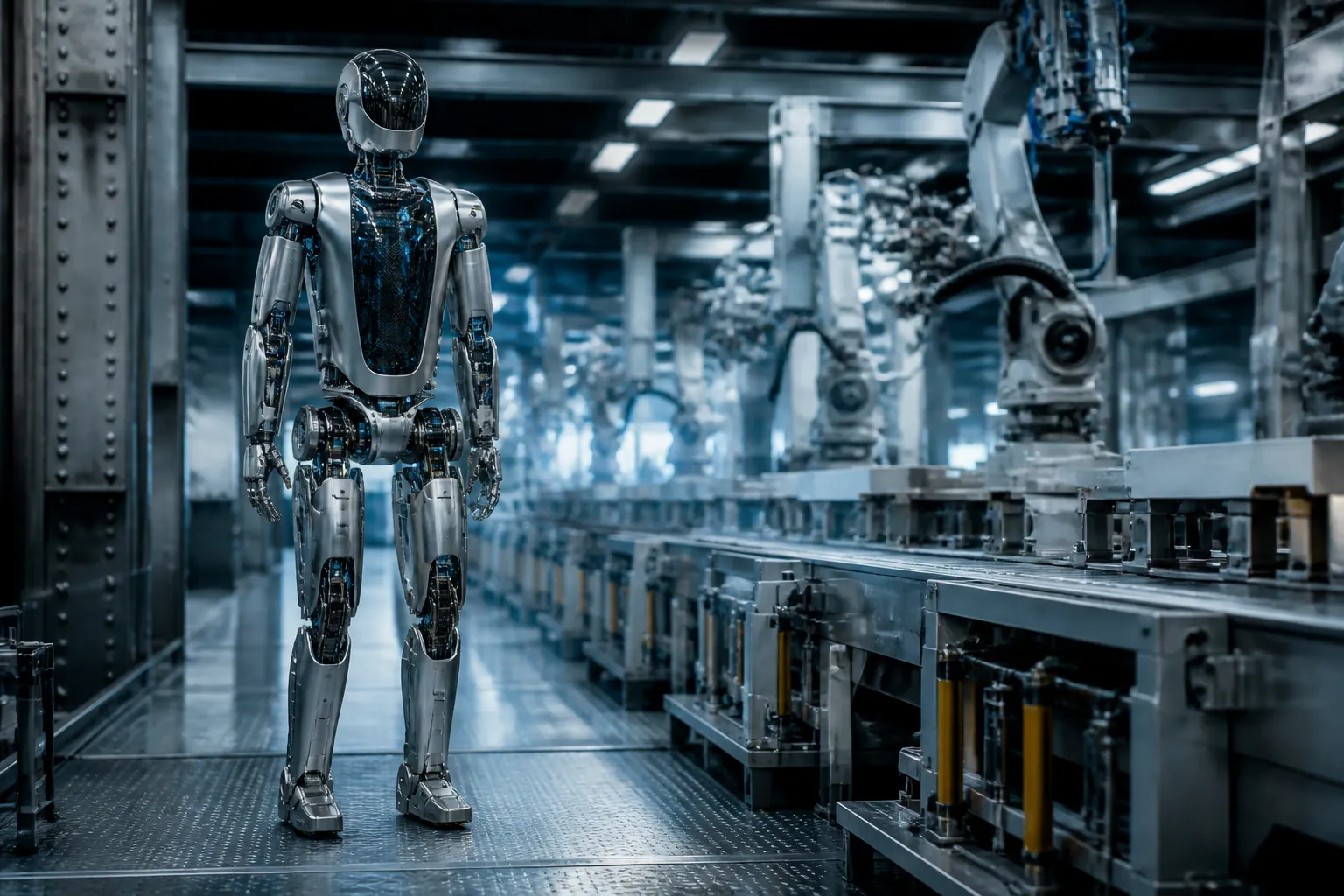
On 25 June 2026, BMW Group announced that its Spartanburg plant will begin operating the new Figure 03 humanoid robot from U.S. robotics firm Figure AI. The rollout is part of BMW’s Physical AI strategy, which links artificial intelligence models with real‑world machines to enable flexible, reliable production.
Figure 03 will assume a sequencing task in the plant’s logistics hall. Components that arrive in large, unsorted containers are first grabbed by the robot, sorted into a sequencing trolley, and then moved to a collection point. From there an automated tugger train or Smart Transport Robot carries the parts to the assembly line, where they are delivered to workers in the correct order. This operation, common in automotive logistics, will showcase the robot’s ability to handle complex, repetitive tasks.
The new machine builds on experience gained with its predecessor, Figure 02, which was deployed at Spartanburg in 2025. Over an 11‑month period, Figure 02 performed sheet‑metal part insertion in the body shop, supporting the production of more than 30 000 BMW X3 vehicles. The pilot demonstrated that humanoid robots can safely execute precise, repeatable steps in a live production environment.
According to the press release, Figure 03 introduces several new features. Its body incorporates soft components that improve safety, a wireless charging system that boosts availability, and audio hardware that enables speech‑to‑speech communication. Its hands are equipped with tactile sensors and palm cameras, designed to enhance precision and dexterity.
"Plant Spartanburg is the birthplace of humanoid robotics in BMW Manufacturing’s operational day‑to‑day activities. Having already successfully completed a pilot with Figure 02 in our body shop, we are now looking forward to deploying Figure 03 for a sequencing use case in logistics," said Ulrich Wieland, Vice President of Production Control and Logistics, BMW Manufacturing.
Brett Adcock, Founder and CEO of Figure AI, added, "Our 11‑month deployment of Figure 02 proved that humanoids are no longer lab experiments – they can be a valuable asset in establishing a flexible, reliable manufacturing workforce. We are excited to continue our work in Spartanburg as Figure tackles the complexity of the assembly and logistics hall."
The project is linked to BMW’s broader iFACTORY initiative, which integrates digital tools across the plant. Hall 52, where variants of the BMW X3 and the future electrified iX5 will be assembled, has been expanded and updated to support digital planning and simulation. Virtual 3‑D models are used before components arrive to optimise processes and reduce errors.
Quality inspection also benefits from AI. BMW’s AIQX system performs visual and acoustic checks on the line, providing immediate feedback to operators via smart devices. The company has made AIQX a standard and is exploring options to offer the system to suppliers.
Deploying Figure 03 at Spartanburg marks a significant step in BMW Group’s effort to expand its automation portfolio with Physical AI. Humanoid robots are positioned as a complement to existing automation, especially for tasks that are monotonous, ergonomically demanding, or safety‑critical. The goal is to protect employees while improving workplace efficiency.
The press release was issued by Benedikt Torka, BMW Group press contact, and is part of a series of announcements that also include a pilot project at BMW Group Plant Leipzig and the establishment of a Center of Competence for Physical AI in production.
As the automotive industry continues to adopt AI‑driven robotics, the Spartanburg deployment will provide a real‑world benchmark for how humanoid robots can be integrated into complex manufacturing workflows. The outcome of this project will inform future deployments at other BMW Group facilities and may influence the wider adoption of Physical AI in automotive production.
The current status is that Figure 03 has entered the first phase of deployment at Plant Spartanburg. The next milestones include full operational integration, performance evaluation, and potential expansion to additional logistics and assembly tasks. The project remains a key indicator of BMW Group’s commitment to digital transformation and advanced robotics in manufacturing.
On 25 June 2026, BMW Group announced that its Spartanburg plant will begin operating the new Figure 03 humanoid robot from U.S. robotics firm Figure AI. The rollout is part of BMW’s Physical AI strategy, which links artificial intelligence models with real‑world machines to enable flexible, reliable production.
Figure 03 will assume a sequencing task in the plant’s logistics hall. Components that arrive in large, unsorted containers are first grabbed by the robot, sorted into a sequencing trolley, and then moved to a collection point. From there an automated tugger train or Smart Transport Robot carries the parts to the assembly line, where they are delivered to workers in the correct order. This operation, common in automotive logistics, will showcase the robot’s ability to handle complex, repetitive tasks.
The new machine builds on experience gained with its predecessor, Figure 02, which was deployed at Spartanburg in 2025. Over an 11‑month period, Figure 02 performed sheet‑metal part insertion in the body shop, supporting the production of more than 30 000 BMW X3 vehicles. The pilot demonstrated that humanoid robots can safely execute precise, repeatable steps in a live production environment.
According to the press release, Figure 03 introduces several new features. Its body incorporates soft components that improve safety, a wireless charging system that boosts availability, and audio hardware that enables speech‑to‑speech communication. Its hands are equipped with tactile sensors and palm cameras, designed to enhance precision and dexterity.
"Plant Spartanburg is the birthplace of humanoid robotics in BMW Manufacturing’s operational day‑to‑day activities. Having already successfully completed a pilot with Figure 02 in our body shop, we are now looking forward to deploying Figure 03 for a sequencing use case in logistics," said Ulrich Wieland, Vice President of Production Control and Logistics, BMW Manufacturing.
Brett Adcock, Founder and CEO of Figure AI, added, "Our 11‑month deployment of Figure 02 proved that humanoids are no longer lab experiments – they can be a valuable asset in establishing a flexible, reliable manufacturing workforce. We are excited to continue our work in Spartanburg as Figure tackles the complexity of the assembly and logistics hall."
The project is linked to BMW’s broader iFACTORY initiative, which integrates digital tools across the plant. Hall 52, where variants of the BMW X3 and the future electrified iX5 will be assembled, has been expanded and updated to support digital planning and simulation. Virtual 3‑D models are used before components arrive to optimise processes and reduce errors.
Quality inspection also benefits from AI. BMW’s AIQX system performs visual and acoustic checks on the line, providing immediate feedback to operators via smart devices. The company has made AIQX a standard and is exploring options to offer the system to suppliers.
Deploying Figure 03 at Spartanburg marks a significant step in BMW Group’s effort to expand its automation portfolio with Physical AI. Humanoid robots are positioned as a complement to existing automation, especially for tasks that are monotonous, ergonomically demanding, or safety‑critical. The goal is to protect employees while improving workplace efficiency.
The press release was issued by Benedikt Torka, BMW Group press contact, and is part of a series of announcements that also include a pilot project at BMW Group Plant Leipzig and the establishment of a Center of Competence for Physical AI in production.
As the automotive industry continues to adopt AI‑driven robotics, the Spartanburg deployment will provide a real‑world benchmark for how humanoid robots can be integrated into complex manufacturing workflows. The outcome of this project will inform future deployments at other BMW Group facilities and may influence the wider adoption of Physical AI in automotive production.
The current status is that Figure 03 has entered the first phase of deployment at Plant Spartanburg. The next milestones include full operational integration, performance evaluation, and potential expansion to additional logistics and assembly tasks. The project remains a key indicator of BMW Group’s commitment to digital transformation and advanced robotics in manufacturing.





