Blab AI
Edmonton-Based Run With It Synthetics Uses AI-Generated Digital Twins to Model Disasters and Climate Scenarios
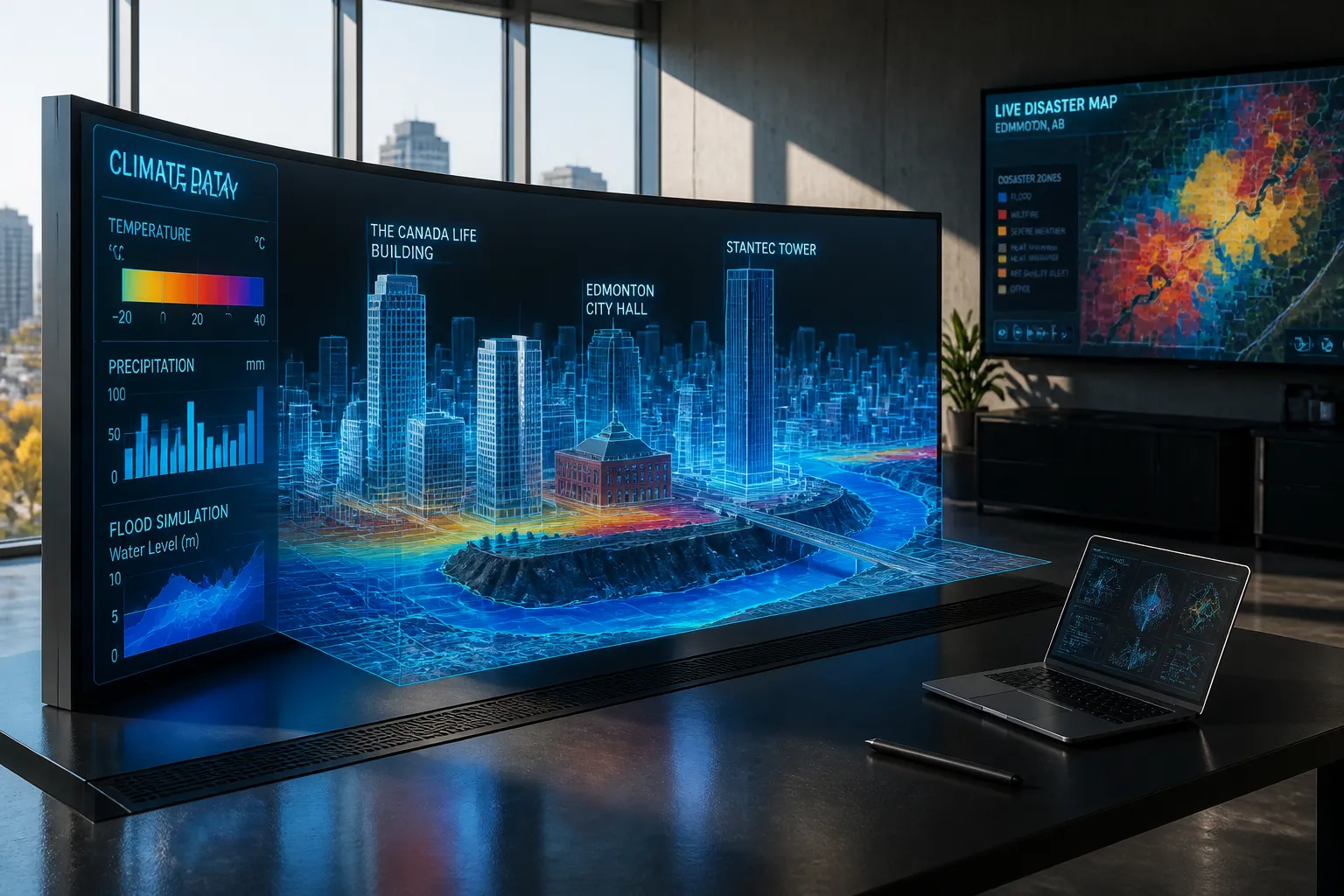
Run With It Synthetics (RWI), a technology firm headquartered in Edmonton, Alberta, is turning the future of emergency planning into a high‑resolution simulation. By weaving together artificial‑intelligence‑driven digital twins, the company models earthquakes, power outages and climate‑related hazards with unprecedented detail.
The firm first captured public imagination in 2019 when it staged a 6.7‑magnitude earthquake simulation of Santa Clara, California, at the Internet of Things World Expo. On a 180‑foot screen, a synthetic replica of the city sprang to life, populated with more than 100,000 AI‑generated agents that behaved like real residents. The simulation produced alerts, icons and status reports that mirrored the expected physical impacts of a real quake—collapsed buildings, gas line ruptures and fires. According to RWI, the event underscored the value of “understanding and experiencing things that haven’t happened” and became a turning point for founders Myrna and Dean Bittner.
The Bittners began developing the underlying technology in the 1990s while running Bittco Solutions from a rural Alberta home. Bittco’s first product, Co‑motion, was a groupware platform that combined video conferencing, voice calls and chat—features the founders later described as a precursor to modern SaaS chat tools. In the late 1990s, the company partnered with Optum Group Pty. Ltd., an Australian firm serving the oil and gas sector. Optum’s interest in applying machine‑learning to large, unstructured documents led to the creation of NeuralVR Technologies, a separate entity focused on synthetic intelligence environments.
NeuralVR’s research yielded intellectual property that the Bittners retained when they founded RWI in 2014. The company’s flagship platform, the HoloDeck, blends generative and agentic AI with a high‑fidelity, six‑dimensional GIS‑based map. HoloDeck can replicate real‑world infrastructure and generate demographically representative agents with behavioral patterns, psychologies and health predispositions. The resulting “living” synthetic environment can be tuned across metrics to model potential futures and deliver strategic insight.
After the Santa Clara demo, RWI joined the Electric Power Research Institute’s (EPRI) Incubatenergy Labs program. EPRI used RWI’s platform to run a “black sky” scenario that simulated a prolonged power grid failure in Phoenix, Arizona, during a summer heatwave. The simulation incorporated COVID‑19 lockdown effects on energy demand, requiring RWI to model changes in human behavior and mobility. The partnership demonstrated how synthetic populations could forecast load curves for specific addresses, informing utilities’ load‑purchasing decisions.
RWI’s portfolio now spans wildfire egress modeling, the workforce impact of a hydrogen transition in Alberta, tele‑health service expansion in rural Canada, graduation rate changes for at‑risk youth, and long‑term energy demand projections for Calgary. The company has also built synthetic twins of Canada and the entire Earth.
Clients include U.S. federal agencies such as the Department of Homeland Security, the Department of Energy, FEMA and NASA, as well as Canadian organizations like Innovation, Science and Economic Development Canada, the National Research Council’s Industrial Research Assistance Program. Private sector partners feature Toyota’s Mobility Foundation, Itron, ENMAX and the National Renewable Energy Laboratory.
In May 2026, RWI partnered with the University of Waterloo’s FamilyPsycle Lab to launch the Synthetic Waterloo Intelligent Futures Technology (SWIFT) hub, applying predictive modeling to mental‑health and population‑wellbeing research. Earlier that month, the company was selected for the MaRS Adaptech Accelerator 2026‑27, with a focus on climate‑change resilience.
The Bittners have chosen to concentrate on domestic projects in Canada, citing ethical and geopolitical considerations that led them to pause U.S. defense work. Myrna Bittner stated that the company’s expertise now directs toward Canadian sovereignty issues such as housing, nation‑building, climate and healthcare.
RWI’s technology sits within a broader market for strategic forecasting that Grand View Research estimates will grow from $49.5 billion in 2026 to $328.5 billion by 2033. The company’s blend of AI, GIS and agentic modeling places it among a small group of firms offering high‑resolution synthetic environments for decision‑making.
Looking ahead, RWI plans to further develop its HoloDeck platform, broaden its client base across public and private sectors, and deepen collaborations with academic institutions to apply synthetic modeling to emerging societal challenges.
The firm first captured public imagination in 2019 when it staged a 6.7‑magnitude earthquake simulation of Santa Clara, California, at the Internet of Things World Expo. On a 180‑foot screen, a synthetic replica of the city sprang to life, populated with more than 100,000 AI‑generated agents that behaved like real residents. The simulation produced alerts, icons and status reports that mirrored the expected physical impacts of a real quake—collapsed buildings, gas line ruptures and fires. According to RWI, the event underscored the value of “understanding and experiencing things that haven’t happened” and became a turning point for founders Myrna and Dean Bittner.
The Bittners began developing the underlying technology in the 1990s while running Bittco Solutions from a rural Alberta home. Bittco’s first product, Co‑motion, was a groupware platform that combined video conferencing, voice calls and chat—features the founders later described as a precursor to modern SaaS chat tools. In the late 1990s, the company partnered with Optum Group Pty. Ltd., an Australian firm serving the oil and gas sector. Optum’s interest in applying machine‑learning to large, unstructured documents led to the creation of NeuralVR Technologies, a separate entity focused on synthetic intelligence environments.
NeuralVR’s research yielded intellectual property that the Bittners retained when they founded RWI in 2014. The company’s flagship platform, the HoloDeck, blends generative and agentic AI with a high‑fidelity, six‑dimensional GIS‑based map. HoloDeck can replicate real‑world infrastructure and generate demographically representative agents with behavioral patterns, psychologies and health predispositions. The resulting “living” synthetic environment can be tuned across metrics to model potential futures and deliver strategic insight.
After the Santa Clara demo, RWI joined the Electric Power Research Institute’s (EPRI) Incubatenergy Labs program. EPRI used RWI’s platform to run a “black sky” scenario that simulated a prolonged power grid failure in Phoenix, Arizona, during a summer heatwave. The simulation incorporated COVID‑19 lockdown effects on energy demand, requiring RWI to model changes in human behavior and mobility. The partnership demonstrated how synthetic populations could forecast load curves for specific addresses, informing utilities’ load‑purchasing decisions.
RWI’s portfolio now spans wildfire egress modeling, the workforce impact of a hydrogen transition in Alberta, tele‑health service expansion in rural Canada, graduation rate changes for at‑risk youth, and long‑term energy demand projections for Calgary. The company has also built synthetic twins of Canada and the entire Earth.
Clients include U.S. federal agencies such as the Department of Homeland Security, the Department of Energy, FEMA and NASA, as well as Canadian organizations like Innovation, Science and Economic Development Canada, the National Research Council’s Industrial Research Assistance Program. Private sector partners feature Toyota’s Mobility Foundation, Itron, ENMAX and the National Renewable Energy Laboratory.
In May 2026, RWI partnered with the University of Waterloo’s FamilyPsycle Lab to launch the Synthetic Waterloo Intelligent Futures Technology (SWIFT) hub, applying predictive modeling to mental‑health and population‑wellbeing research. Earlier that month, the company was selected for the MaRS Adaptech Accelerator 2026‑27, with a focus on climate‑change resilience.
The Bittners have chosen to concentrate on domestic projects in Canada, citing ethical and geopolitical considerations that led them to pause U.S. defense work. Myrna Bittner stated that the company’s expertise now directs toward Canadian sovereignty issues such as housing, nation‑building, climate and healthcare.
RWI’s technology sits within a broader market for strategic forecasting that Grand View Research estimates will grow from $49.5 billion in 2026 to $328.5 billion by 2033. The company’s blend of AI, GIS and agentic modeling places it among a small group of firms offering high‑resolution synthetic environments for decision‑making.
Looking ahead, RWI plans to further develop its HoloDeck platform, broaden its client base across public and private sectors, and deepen collaborations with academic institutions to apply synthetic modeling to emerging societal challenges.





