Blab AI
UC Berkeley Robot BRETT Learns Motor Tasks by Trial and Error Using Deep Reinforcement Learning
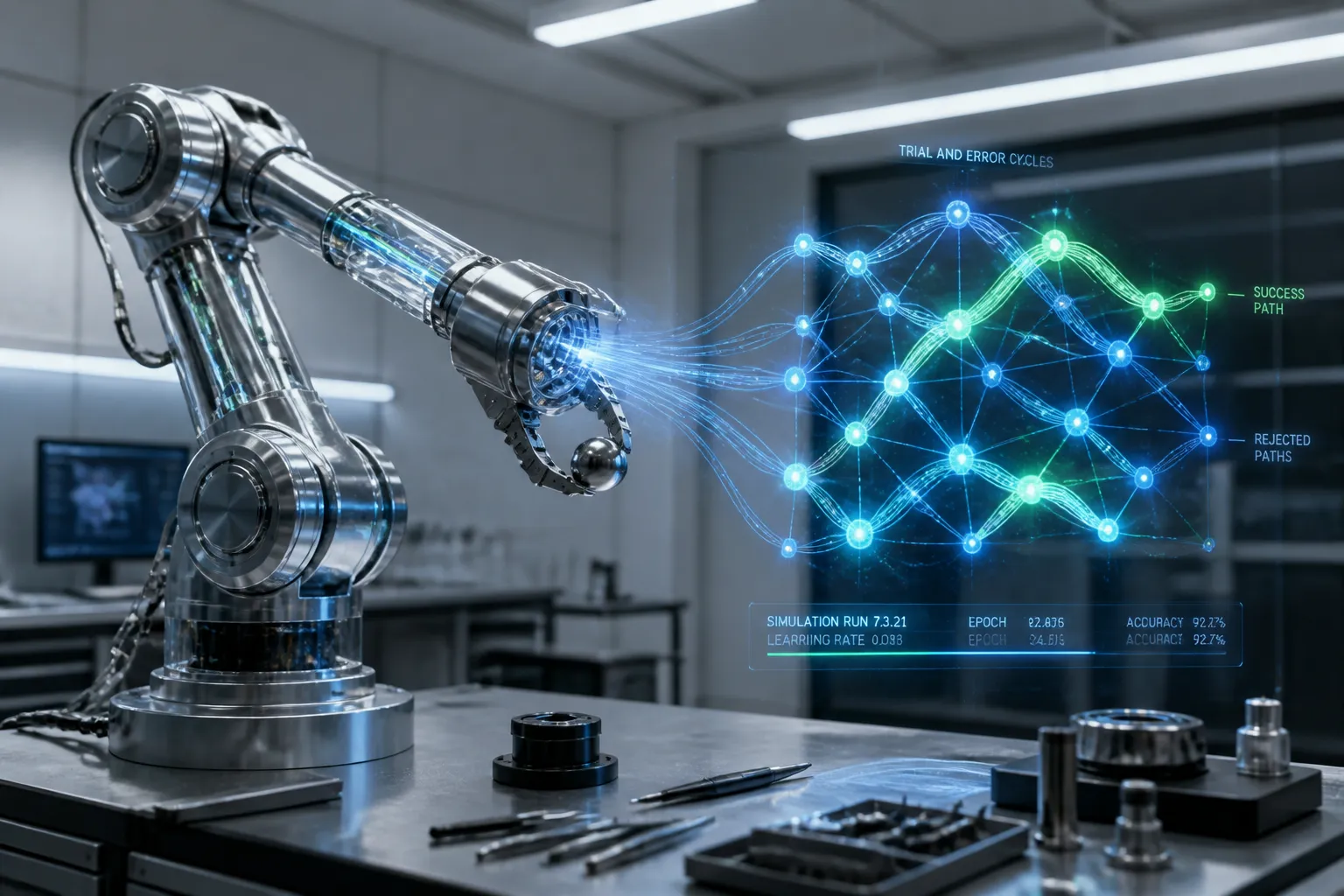
In 2015, a UC Berkeley team demonstrated that a robot named BRETT—short for Berkeley Robot for the Elimination of Tedious Tasks—could acquire a suite of physical skills without any task‑specific programming. The robot used deep reinforcement learning to explore its surroundings, tweak its motions, and receive instant feedback until it reached a target score.
BRETT was built on the Personal Robot 2 platform from Clearpath Robotics and worked in a controlled lab at Berkeley’s Center for Information Technology Research in the Interest of Society (CITRIS). The project falls under CITRIS’s People + Robots program, which seeks AI and robotics solutions that benefit society.
The learning loop relies on a neural‑network algorithm that fuses data from BRETT’s cameras, touch sensors, and joint encoders. Each attempt at a task is scored by the network based on how close the robot’s actions bring it to the desired outcome. That score feeds back into the network, allowing the robot to refine its control policy over thousands of trials. When the robot is given the initial and final positions of the objects, it can master most tasks in roughly ten minutes. When it must learn perception and control simultaneously, the learning time extends to about three hours.
In the original demonstration, BRETT tackled five distinct tasks: placing a clothes hanger on a pole, stacking wooden donuts on a pole, assembling a toy airplane, screwing a cap onto a water bottle, and inserting a shaped peg into a matching hole. In each case the robot started with no knowledge of the objects’ shapes or positions.
"What we’re showing in this project is a new approach to enable a robot to learn," said UC Berkeley professor Pieter Abbeel. "The key is that when a robot is faced with something new, we won’t have to re‑program it. The same AI software enables the robot to learn all the different tasks we gave it."
"Most robotic applications happen in controlled environments—where physical objects are in predictable positions in the surroundings. The challenge of putting robots in real‑life settings—like homes, offices, or transported to new or unknown facilities—is that those environments are constantly changing. The robot must be able to sense and adapt to its surroundings. That’s what we’re doing with BRETT," added professor Trevor Darrell.
Professor Sergey Levine added that humans acquire new skills through experience rather than pre‑programmed instructions. "Humans are not born with a repertoire of behaviors that can be deployed like a Swiss army knife. And we don’t need to be pre‑programmed to do activities. People learn new skills over time—from experience and by watching other humans," he said.
The study shows that a robot can develop motor skills by interacting with its environment, a capability that could reduce the need for extensive manual programming in future service robots. While the research was conducted in a controlled lab, the underlying algorithm is general and could be applied to robots operating in dynamic, unstructured settings.
At present, BRETT remains a research prototype. The team has not announced plans for commercial deployment, and the learning times reported in the study are measured in laboratory conditions. Future work will likely focus on scaling the approach to more complex tasks, improving sample efficiency, and testing the system in real‑world environments.
The 2015 experiment remains a reference point for researchers exploring autonomous learning in robotics. It illustrates how deep reinforcement learning can enable a robot to acquire new motor skills without explicit programming—a step toward more flexible and adaptable robotic systems.
BRETT was built on the Personal Robot 2 platform from Clearpath Robotics and worked in a controlled lab at Berkeley’s Center for Information Technology Research in the Interest of Society (CITRIS). The project falls under CITRIS’s People + Robots program, which seeks AI and robotics solutions that benefit society.
The learning loop relies on a neural‑network algorithm that fuses data from BRETT’s cameras, touch sensors, and joint encoders. Each attempt at a task is scored by the network based on how close the robot’s actions bring it to the desired outcome. That score feeds back into the network, allowing the robot to refine its control policy over thousands of trials. When the robot is given the initial and final positions of the objects, it can master most tasks in roughly ten minutes. When it must learn perception and control simultaneously, the learning time extends to about three hours.
In the original demonstration, BRETT tackled five distinct tasks: placing a clothes hanger on a pole, stacking wooden donuts on a pole, assembling a toy airplane, screwing a cap onto a water bottle, and inserting a shaped peg into a matching hole. In each case the robot started with no knowledge of the objects’ shapes or positions.
"What we’re showing in this project is a new approach to enable a robot to learn," said UC Berkeley professor Pieter Abbeel. "The key is that when a robot is faced with something new, we won’t have to re‑program it. The same AI software enables the robot to learn all the different tasks we gave it."
"Most robotic applications happen in controlled environments—where physical objects are in predictable positions in the surroundings. The challenge of putting robots in real‑life settings—like homes, offices, or transported to new or unknown facilities—is that those environments are constantly changing. The robot must be able to sense and adapt to its surroundings. That’s what we’re doing with BRETT," added professor Trevor Darrell.
Professor Sergey Levine added that humans acquire new skills through experience rather than pre‑programmed instructions. "Humans are not born with a repertoire of behaviors that can be deployed like a Swiss army knife. And we don’t need to be pre‑programmed to do activities. People learn new skills over time—from experience and by watching other humans," he said.
The study shows that a robot can develop motor skills by interacting with its environment, a capability that could reduce the need for extensive manual programming in future service robots. While the research was conducted in a controlled lab, the underlying algorithm is general and could be applied to robots operating in dynamic, unstructured settings.
At present, BRETT remains a research prototype. The team has not announced plans for commercial deployment, and the learning times reported in the study are measured in laboratory conditions. Future work will likely focus on scaling the approach to more complex tasks, improving sample efficiency, and testing the system in real‑world environments.
The 2015 experiment remains a reference point for researchers exploring autonomous learning in robotics. It illustrates how deep reinforcement learning can enable a robot to acquire new motor skills without explicit programming—a step toward more flexible and adaptable robotic systems.





