Blab AI
AI-Driven Workforce Cuts Surge as CEOs Plan Headcount Reductions, Employees Grow Anxious
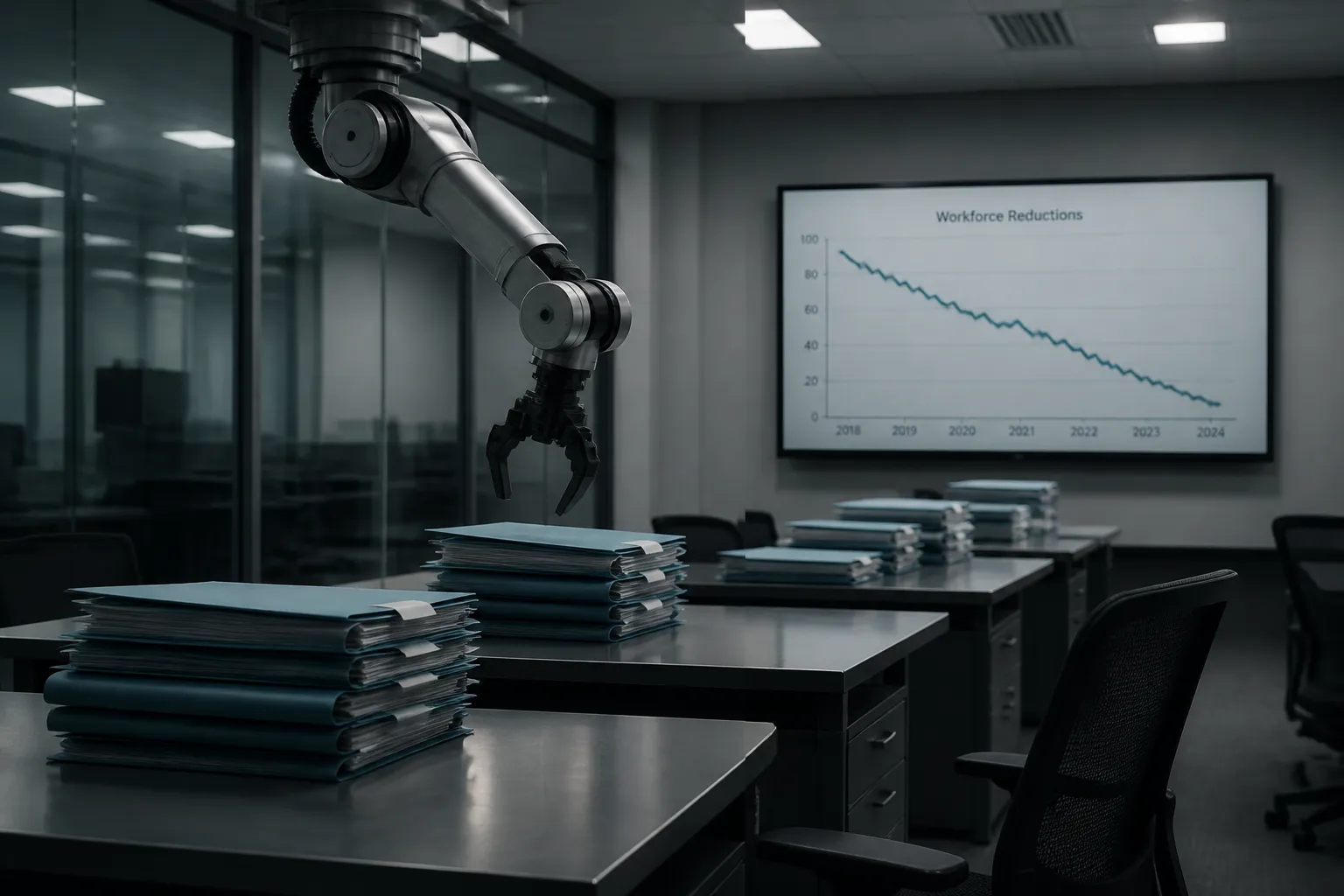
A Mercer survey of 825 chief‑executives revealed that 99 % of CEOs expect artificial intelligence (AI) to trigger at least some headcount reduction within the next two years, signaling a shift from AI as a productivity tool to a driver of workforce restructuring.
Released in early June 2026 as part of Mercer’s 2026 Global Talent Trends report, the study shows executives are increasingly confident that AI can replace or diminish certain categories of work. The findings arrive amid growing employee anxiety: the same report notes that the proportion of workers who feel they are “thriving” fell from 66 % in 2024 to 44 % in 2026, while 40 % now fear losing their jobs because of AI.
The data also mirror real‑world job‑cutting activity. Challenger, Gray & Christmas reported that employers announced more than 97,000 job cuts in May 2026 – the highest monthly total since 2020. Roughly 40 % of those employers cited AI as the primary factor behind the reductions. A Harvard Business Review analysis found that nearly 40 % of organizations made low‑to‑moderate headcount cuts in anticipation of AI, reinforcing the pattern.
For employees, the concern is not simply whether jobs disappear but whether they can clearly demonstrate value in a labor market where routine tasks are increasingly automated. Personal‑finance expert Suze Orman has warned that many workers underestimate the risk of routine‑task automation. The Mercer findings suggest that corporate leaders are moving beyond the idea of AI as a cost‑saving tool toward a broader strategy of workforce redesign.
The shift is already visible in hiring patterns. In the first half of 2026, the number of entry‑level openings in technology and support roles fell by 12 % compared with the same period in 2025, according to U.S. Bureau of Labor Statistics data. Meanwhile, companies that have invested in generative‑AI platforms report a 15 % reduction in manual data‑entry staff, while hiring for AI‑related roles has risen by 22 %. These figures illustrate the dual effect of AI: it displaces routine work while creating new opportunities that require higher‑level skills.
Industry analysts caution that the productivity gains from AI‑driven headcount cuts have yet to be fully realized. A 2026 Gartner report noted that roughly 80 % of large organizations used AI initiatives to reduce headcount, but the reductions did not yet translate into measurable return on investment. The same report highlighted that companies focusing solely on cost reduction risk losing institutional knowledge and long‑term innovation capacity.
The broader implications for the labor market are significant. Mercer’s survey, which covered nearly 12,000 executives across 16 countries and 16 industries, indicates that 99 % of CEOs plan AI‑driven workforce reductions within two years. Two thirds of those executives target cuts of 1–10 %, while nearly one third plan reductions of 11–20 %. The data suggest that the AI‑driven restructuring wave is not limited to the United States but is a global phenomenon.
In conclusion, the evidence points to a rapid acceleration of AI‑driven workforce cuts. Executives are planning reductions, employees are growing anxious, and the job market is already adjusting to the new reality. While AI promises increased efficiency, the transition is reshaping employment patterns, requiring both employers and workers to adapt to a future where routine tasks are increasingly automated.
The current situation remains fluid. Companies are still evaluating the balance between cost savings and talent retention, and regulatory bodies are monitoring the impact on employment. No major product launches or policy changes have been announced that would alter the trajectory of AI‑driven workforce restructuring in the near term.
Released in early June 2026 as part of Mercer’s 2026 Global Talent Trends report, the study shows executives are increasingly confident that AI can replace or diminish certain categories of work. The findings arrive amid growing employee anxiety: the same report notes that the proportion of workers who feel they are “thriving” fell from 66 % in 2024 to 44 % in 2026, while 40 % now fear losing their jobs because of AI.
The data also mirror real‑world job‑cutting activity. Challenger, Gray & Christmas reported that employers announced more than 97,000 job cuts in May 2026 – the highest monthly total since 2020. Roughly 40 % of those employers cited AI as the primary factor behind the reductions. A Harvard Business Review analysis found that nearly 40 % of organizations made low‑to‑moderate headcount cuts in anticipation of AI, reinforcing the pattern.
For employees, the concern is not simply whether jobs disappear but whether they can clearly demonstrate value in a labor market where routine tasks are increasingly automated. Personal‑finance expert Suze Orman has warned that many workers underestimate the risk of routine‑task automation. The Mercer findings suggest that corporate leaders are moving beyond the idea of AI as a cost‑saving tool toward a broader strategy of workforce redesign.
The shift is already visible in hiring patterns. In the first half of 2026, the number of entry‑level openings in technology and support roles fell by 12 % compared with the same period in 2025, according to U.S. Bureau of Labor Statistics data. Meanwhile, companies that have invested in generative‑AI platforms report a 15 % reduction in manual data‑entry staff, while hiring for AI‑related roles has risen by 22 %. These figures illustrate the dual effect of AI: it displaces routine work while creating new opportunities that require higher‑level skills.
Industry analysts caution that the productivity gains from AI‑driven headcount cuts have yet to be fully realized. A 2026 Gartner report noted that roughly 80 % of large organizations used AI initiatives to reduce headcount, but the reductions did not yet translate into measurable return on investment. The same report highlighted that companies focusing solely on cost reduction risk losing institutional knowledge and long‑term innovation capacity.
The broader implications for the labor market are significant. Mercer’s survey, which covered nearly 12,000 executives across 16 countries and 16 industries, indicates that 99 % of CEOs plan AI‑driven workforce reductions within two years. Two thirds of those executives target cuts of 1–10 %, while nearly one third plan reductions of 11–20 %. The data suggest that the AI‑driven restructuring wave is not limited to the United States but is a global phenomenon.
In conclusion, the evidence points to a rapid acceleration of AI‑driven workforce cuts. Executives are planning reductions, employees are growing anxious, and the job market is already adjusting to the new reality. While AI promises increased efficiency, the transition is reshaping employment patterns, requiring both employers and workers to adapt to a future where routine tasks are increasingly automated.
The current situation remains fluid. Companies are still evaluating the balance between cost savings and talent retention, and regulatory bodies are monitoring the impact on employment. No major product launches or policy changes have been announced that would alter the trajectory of AI‑driven workforce restructuring in the near term.





