Blab AI
UCLA Researchers Combine AI and Diffractive Optics to Project 3-D Images in a Single Shot
A team of engineers at the University of California, Los Angeles has demonstrated a new method for creating three‑dimensional images that could bring holographic displays closer to reality. The system uses a neural‑network encoder to compress a stack of depth‑resolved images into a single phase pattern, which is then decoded by a passive diffractive optical surface. In computer simulations the prototype can render 28 distinct depth layers with separations on the order of a single wavelength of light, and a physical prototype has been built that works with visible red light.
Traditional holographic displays have struggled with diffraction‑induced cross‑talk, a phenomenon in which light from adjacent depth layers bleeds into one another. Conventional solutions have relied on heavy computation or time‑sequential scanning that builds a volume slice by slice, both of which limit real‑time performance and increase power consumption. The UCLA approach sidesteps these bottlenecks by splitting the workload between a digital encoder and a physical decoder.
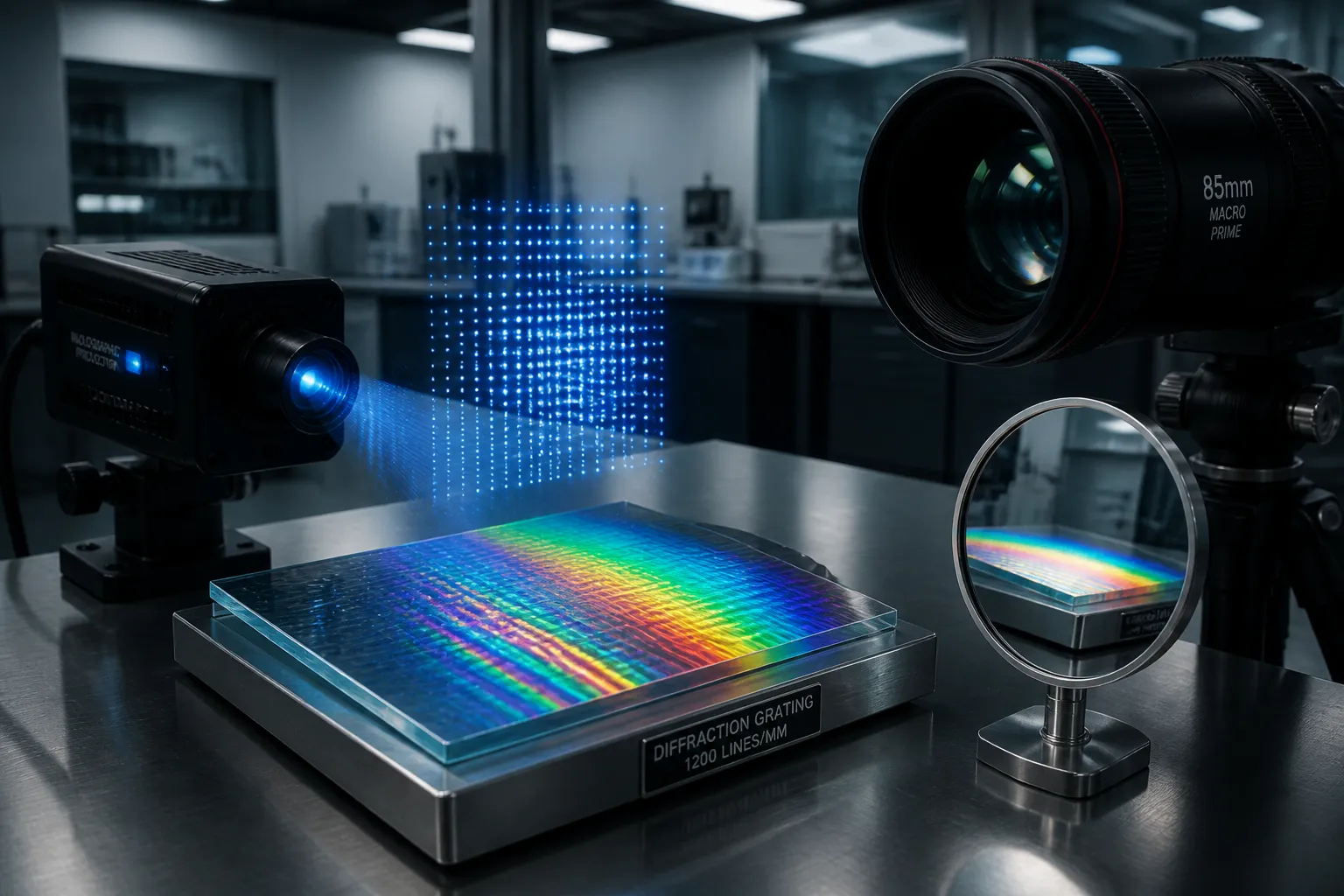
The encoder is a neural network that processes the target scene in the frequency domain. It extracts features at multiple scales, tags each depth slice with its axial position, and compresses the entire stack into one phase pattern that can be displayed on a spatial light modulator. The decoder is a stack of engineered diffractive surfaces whose structure was optimized with machine learning. As light passes through the decoder, the surfaces steer each encoded plane to its designated depth and reduce the bleed between adjacent layers. The researchers found that adding more resolution to the encoder alone was insufficient; the learned optical decoder was essential for separating nearby depths.
In numerical experiments the system scaled to 28 depth slices, with layer separations as small as a single wavelength. Fidelity decreased slightly for slices buried in the middle of the stack, but the overall quality remained high. The prototype, which operates at 650 nm, used a single‑layer decoder to project two depth planes. Captured intensity patterns matched the simulations and outperformed a free‑space setup that lacked a decoder. Because the decoder is entirely passive, it does not draw power and shifts computational work from the processor to the optics. The team noted a trade‑off: increasing brightness improves diffraction efficiency but can reintroduce speckle and cross‑talk, requiring a balance between clarity and illumination.
The light‑programming framework could enable compact near‑eye displays for augmented and virtual reality, volumetric microscopy, and real‑time 3‑D visualization. The researchers emphasize that the current work is a proof of concept; future steps include multi‑layer fabrication, full‑color operation, and the development of viewer‑facing systems. Until those milestones are reached, the technology remains a laboratory demonstration, but it illustrates a promising direction for holographic imaging that reduces computational and energy demands.
The UCLA team’s publication appears in the journal Optics Express and is accompanied by a detailed technical report on the university’s engineering department website. The work builds on prior research in diffractive optical communication and super‑resolution display, and it represents a significant step toward practical, high‑resolution holographic displays.
Traditional holographic displays have struggled with diffraction‑induced cross‑talk, a phenomenon in which light from adjacent depth layers bleeds into one another. Conventional solutions have relied on heavy computation or time‑sequential scanning that builds a volume slice by slice, both of which limit real‑time performance and increase power consumption. The UCLA approach sidesteps these bottlenecks by splitting the workload between a digital encoder and a physical decoder.
The encoder is a neural network that processes the target scene in the frequency domain. It extracts features at multiple scales, tags each depth slice with its axial position, and compresses the entire stack into one phase pattern that can be displayed on a spatial light modulator. The decoder is a stack of engineered diffractive surfaces whose structure was optimized with machine learning. As light passes through the decoder, the surfaces steer each encoded plane to its designated depth and reduce the bleed between adjacent layers. The researchers found that adding more resolution to the encoder alone was insufficient; the learned optical decoder was essential for separating nearby depths.
In numerical experiments the system scaled to 28 depth slices, with layer separations as small as a single wavelength. Fidelity decreased slightly for slices buried in the middle of the stack, but the overall quality remained high. The prototype, which operates at 650 nm, used a single‑layer decoder to project two depth planes. Captured intensity patterns matched the simulations and outperformed a free‑space setup that lacked a decoder. Because the decoder is entirely passive, it does not draw power and shifts computational work from the processor to the optics. The team noted a trade‑off: increasing brightness improves diffraction efficiency but can reintroduce speckle and cross‑talk, requiring a balance between clarity and illumination.
The light‑programming framework could enable compact near‑eye displays for augmented and virtual reality, volumetric microscopy, and real‑time 3‑D visualization. The researchers emphasize that the current work is a proof of concept; future steps include multi‑layer fabrication, full‑color operation, and the development of viewer‑facing systems. Until those milestones are reached, the technology remains a laboratory demonstration, but it illustrates a promising direction for holographic imaging that reduces computational and energy demands.
The UCLA team’s publication appears in the journal Optics Express and is accompanied by a detailed technical report on the university’s engineering department website. The work builds on prior research in diffractive optical communication and super‑resolution display, and it represents a significant step toward practical, high‑resolution holographic displays.





