Blab AI
Sungkyunkwan University develops light-controlled synapse for low-power AI chips
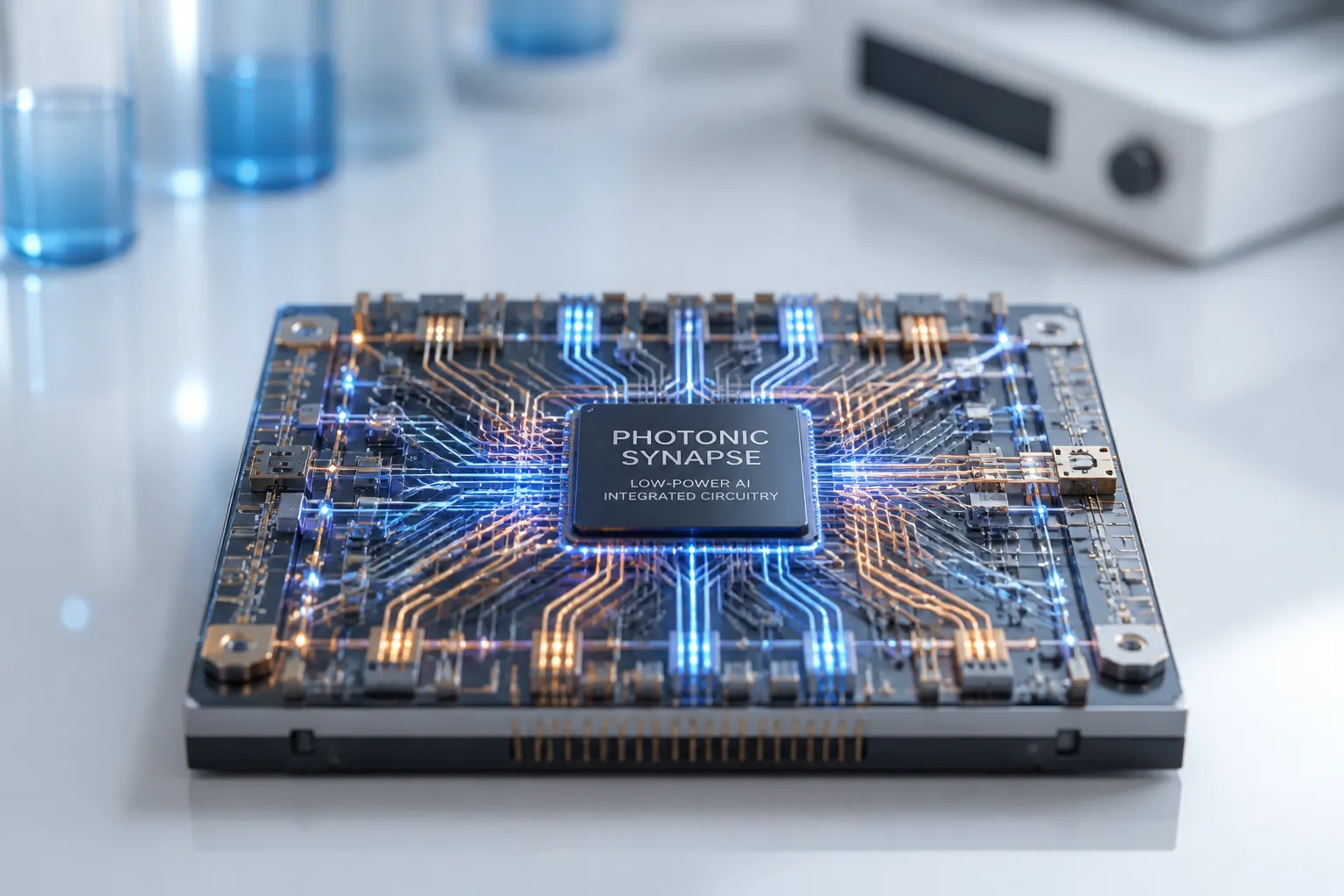
A team at Sungkyunkwan University (SKKU) has engineered an artificial synapse that remembers or forgets at the flick of a light’s hue. The device, unveiled on 18 May 2026 in Nature Communications, turns the silver bismuth sulfide (AgBiS2) crystal’s intrinsic disorder into a homeostatic learning element that can be tuned with visible light.
Led by Professors Jo Sae‑byeok and Yang Woo‑seok of SKKU’s School of Chemical Engineering, the researchers built an AgBiS2 heterostructure that produces a non‑equilibrium photocurrent redistribution. This photogenerated current mimics the brain’s ability to keep learning balanced, allowing the synaptic weight to be strengthened or weakened simply by changing the wavelength of light that illuminates it. “Knowing how to forget is as important as knowing how to remember. The essence of this work is that we separated those two functions by the color of light, and revived what was considered a defect into a self‑balancing learning function for AI hardware,” Professor Jo said.
Unlike conventional memory technologies that rely on charge storage or magnetic states, the light‑controlled synapse exploits the microscopic arrangement of ions within the AgBiS2 lattice. By deliberately introducing a controlled level of disorder—normally viewed as a defect—the team turned this imperfection into a functional feature. When illuminated with a specific color, the device’s photocurrent shifts, altering the local electric field and thereby changing the synaptic weight. The effect is reversible and can be cycled many times, enabling the synapse to adapt during training.
The authors stress that the approach is not limited to AgBiS2. All processing steps use low‑temperature, ink‑based solution methods that are compatible with existing semiconductor manufacturing lines, meaning the technology could be integrated into current chip fabrication workflows without costly new equipment.
Potential applications highlighted by the team include light‑based neuromorphic computing, low‑power AI accelerators, in‑sensor computing, and machine‑vision systems for artificial retinas that can both see and remember. By using light to modulate synaptic weights, the device could reduce the energy required for weight updates—a major bottleneck in today’s deep‑learning hardware.
The research received funding from South Korea’s Ministry of Science and ICT and the Ministry of Education. Its publication in Nature Communications marks the first demonstration of disorder‑mediated homeostatic conditioning in a semiconductor synapse.
Current AI accelerators typically rely on SRAM or DRAM for weight storage, consuming significant power during training and inference. The SKKU device offers a fundamentally different paradigm, where optical signals directly influence the synaptic state. If scalable, this could shift the design of future AI chips toward optoelectronic architectures that combine photonic and electronic components.
While the study shows promising proof‑of‑concept results, the authors note that further work is needed to assess the device’s endurance, variability across large arrays, and integration with other circuit elements. Nonetheless, the work provides a new route for leveraging semiconductor defects—traditionally a challenge—to create adaptive, low‑power learning hardware.
In sum, SKKU’s light‑controlled AgBiS2 synapse demonstrates a novel way to emulate the brain’s balance of remembering and forgetting using optical control. The technology could pave the way for energy‑efficient AI accelerators and neuromorphic systems that operate directly on sensor data, bringing the field one step closer to brain‑like computing.
Led by Professors Jo Sae‑byeok and Yang Woo‑seok of SKKU’s School of Chemical Engineering, the researchers built an AgBiS2 heterostructure that produces a non‑equilibrium photocurrent redistribution. This photogenerated current mimics the brain’s ability to keep learning balanced, allowing the synaptic weight to be strengthened or weakened simply by changing the wavelength of light that illuminates it. “Knowing how to forget is as important as knowing how to remember. The essence of this work is that we separated those two functions by the color of light, and revived what was considered a defect into a self‑balancing learning function for AI hardware,” Professor Jo said.
Unlike conventional memory technologies that rely on charge storage or magnetic states, the light‑controlled synapse exploits the microscopic arrangement of ions within the AgBiS2 lattice. By deliberately introducing a controlled level of disorder—normally viewed as a defect—the team turned this imperfection into a functional feature. When illuminated with a specific color, the device’s photocurrent shifts, altering the local electric field and thereby changing the synaptic weight. The effect is reversible and can be cycled many times, enabling the synapse to adapt during training.
The authors stress that the approach is not limited to AgBiS2. All processing steps use low‑temperature, ink‑based solution methods that are compatible with existing semiconductor manufacturing lines, meaning the technology could be integrated into current chip fabrication workflows without costly new equipment.
Potential applications highlighted by the team include light‑based neuromorphic computing, low‑power AI accelerators, in‑sensor computing, and machine‑vision systems for artificial retinas that can both see and remember. By using light to modulate synaptic weights, the device could reduce the energy required for weight updates—a major bottleneck in today’s deep‑learning hardware.
The research received funding from South Korea’s Ministry of Science and ICT and the Ministry of Education. Its publication in Nature Communications marks the first demonstration of disorder‑mediated homeostatic conditioning in a semiconductor synapse.
Current AI accelerators typically rely on SRAM or DRAM for weight storage, consuming significant power during training and inference. The SKKU device offers a fundamentally different paradigm, where optical signals directly influence the synaptic state. If scalable, this could shift the design of future AI chips toward optoelectronic architectures that combine photonic and electronic components.
While the study shows promising proof‑of‑concept results, the authors note that further work is needed to assess the device’s endurance, variability across large arrays, and integration with other circuit elements. Nonetheless, the work provides a new route for leveraging semiconductor defects—traditionally a challenge—to create adaptive, low‑power learning hardware.
In sum, SKKU’s light‑controlled AgBiS2 synapse demonstrates a novel way to emulate the brain’s balance of remembering and forgetting using optical control. The technology could pave the way for energy‑efficient AI accelerators and neuromorphic systems that operate directly on sensor data, bringing the field one step closer to brain‑like computing.





