Blab AI
U.S. Military Deploys Autonomous Bulldozers to Build and Repair Infrastructure Under Fire
A bulldozer that can operate without a human operator is no longer a concept; it is now a field‑ready asset for the U.S. Department of Defense (DoD). The shift echoes Admiral William F. Halsey’s 1947 observation that bulldozers were decisive in the Pacific, a sentiment that once guided Seabee construction battalions in World II’s island‑hopping campaign.
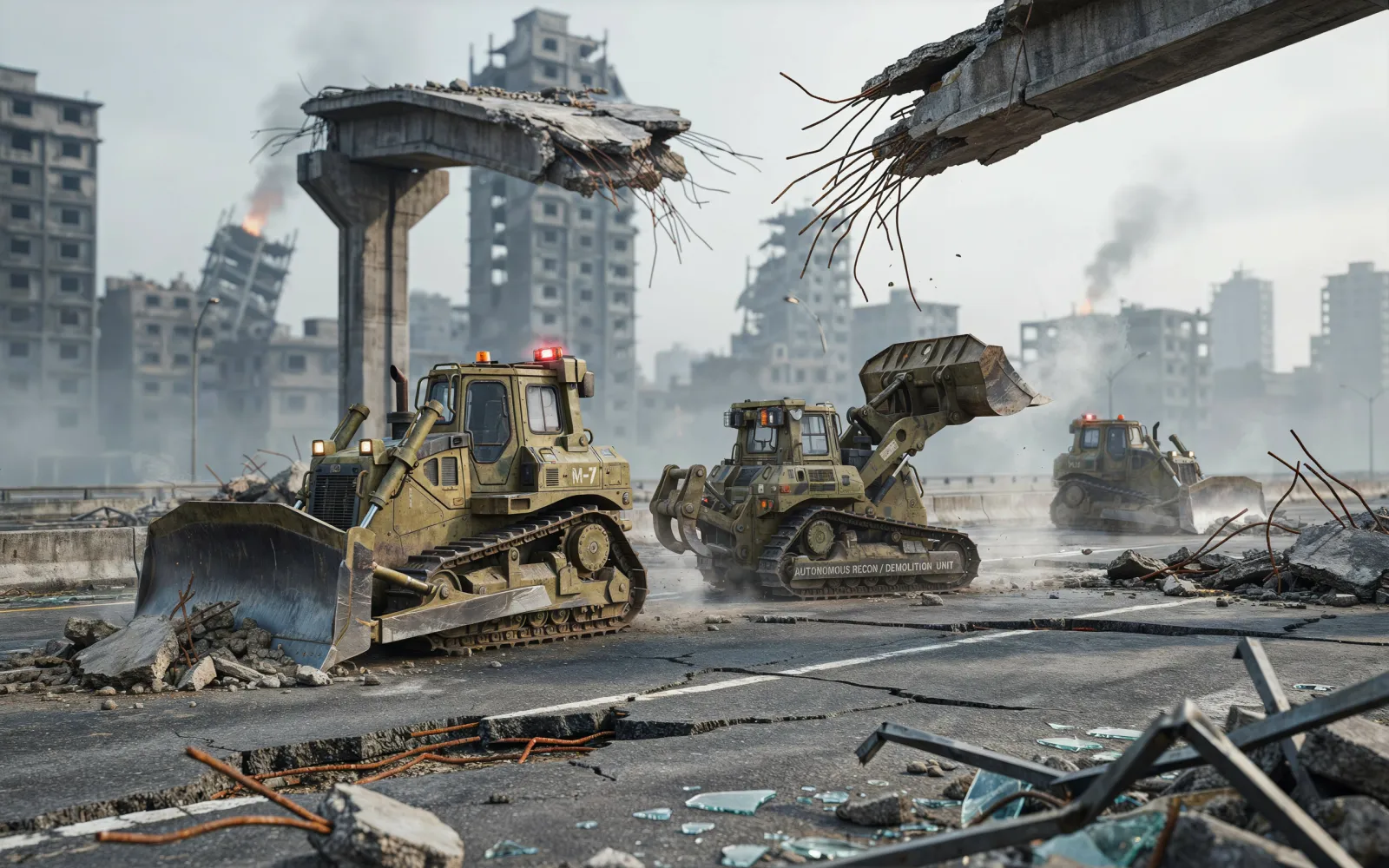
Today the DoD has turned that legacy into a modern reality with a fleet of autonomous earth‑moving machines capable of clearing minefields, repairing runways, and building forward bases while keeping soldiers out of harm’s way. The systems are not prototypes. According to the DoD, autonomous earthmoving has reached technology readiness level 9 and is already in production. Existing bulldozers, excavators, and loaders are retrofitted with an autonomous control kit that adds rugged cameras, LiDAR, and on‑board artificial intelligence. The kit generates 3‑D terrain maps in real time and steers the vehicle around obstacles.
In March 2024 the Army’s 20th Engineer Brigade, part of the XVIIIth Airborne Corps, showcased a D7 Dozer fitted with the kit at the Joint Readiness Training Center in Fort Johnson, Louisiana. During a live‑fire mine‑clearing exercise that included the detonation of a live minefield, the autonomous Dozer dug a breach lane at a speed far exceeding manual methods and completed the task without any human operator on board.
Earlier in February, the U.S. Air Force awarded a $4.9 million contract to AIM Intelligent Machines to deploy autonomous bulldozers for rapid airfield damage recovery (RADR). The contract calls for machines that can be airdropped into remote locations, assess damage, and clear debris and ordnance to restore runway functionality. This effort supports the Air Force’s Agile Combat Employment strategy, which demands rapid establishment of austere bases in contested zones.
The autonomous systems are designed to operate without GPS or internet connectivity, making them immune to jamming or hacking. They rely on local sensors to create real‑time 3‑D maps and adjust movements in response to changing terrain. The machines can work day or night, in dust storms, heavy rain, or extreme temperatures, and they can continue operating for extended periods because they do not need rest.
Field data from three years of operation show that the systems have worked in Arctic cold, desert heat, and the humid jungles of Southeast Asia. The DoD reports that the machines have reduced the number of soldiers required for mine‑clearing and runway repair missions, thereby lowering casualty risk.
The DoD is now focused on scaling the technology. The autonomous earthmoving platform is being evaluated for use by the Navy, Marine Corps, and in humanitarian assistance missions. The Army’s Engineer Research & Development Center is studying integration into its logistics chain, while the Air Force explores additional uses for rapid base construction.
At present, the autonomous bulldozers are deployed in training units and limited operational roles. The next steps involve expanding production, integrating the systems into broader DoD procurement programs, and refining the AI models with data collected in the field. The technology’s proven performance and its potential to reduce warfighter exposure make it a key component of the DoD’s strategy to maintain logistical advantage in contested environments.
Today the DoD has turned that legacy into a modern reality with a fleet of autonomous earth‑moving machines capable of clearing minefields, repairing runways, and building forward bases while keeping soldiers out of harm’s way. The systems are not prototypes. According to the DoD, autonomous earthmoving has reached technology readiness level 9 and is already in production. Existing bulldozers, excavators, and loaders are retrofitted with an autonomous control kit that adds rugged cameras, LiDAR, and on‑board artificial intelligence. The kit generates 3‑D terrain maps in real time and steers the vehicle around obstacles.
In March 2024 the Army’s 20th Engineer Brigade, part of the XVIIIth Airborne Corps, showcased a D7 Dozer fitted with the kit at the Joint Readiness Training Center in Fort Johnson, Louisiana. During a live‑fire mine‑clearing exercise that included the detonation of a live minefield, the autonomous Dozer dug a breach lane at a speed far exceeding manual methods and completed the task without any human operator on board.
Earlier in February, the U.S. Air Force awarded a $4.9 million contract to AIM Intelligent Machines to deploy autonomous bulldozers for rapid airfield damage recovery (RADR). The contract calls for machines that can be airdropped into remote locations, assess damage, and clear debris and ordnance to restore runway functionality. This effort supports the Air Force’s Agile Combat Employment strategy, which demands rapid establishment of austere bases in contested zones.
The autonomous systems are designed to operate without GPS or internet connectivity, making them immune to jamming or hacking. They rely on local sensors to create real‑time 3‑D maps and adjust movements in response to changing terrain. The machines can work day or night, in dust storms, heavy rain, or extreme temperatures, and they can continue operating for extended periods because they do not need rest.
Field data from three years of operation show that the systems have worked in Arctic cold, desert heat, and the humid jungles of Southeast Asia. The DoD reports that the machines have reduced the number of soldiers required for mine‑clearing and runway repair missions, thereby lowering casualty risk.
The DoD is now focused on scaling the technology. The autonomous earthmoving platform is being evaluated for use by the Navy, Marine Corps, and in humanitarian assistance missions. The Army’s Engineer Research & Development Center is studying integration into its logistics chain, while the Air Force explores additional uses for rapid base construction.
At present, the autonomous bulldozers are deployed in training units and limited operational roles. The next steps involve expanding production, integrating the systems into broader DoD procurement programs, and refining the AI models with data collected in the field. The technology’s proven performance and its potential to reduce warfighter exposure make it a key component of the DoD’s strategy to maintain logistical advantage in contested environments.





