Blab AI
Army AI Tool Detects Blood Loss Before Vital Signs Change
A team of researchers at the Uniformed Services University of the Health Sciences (USU) and the U.S. Army Institute of Surgical Research has created an artificial‑intelligence system that can identify the onset of hemorrhagic shock before conventional monitors show any abnormality. The system, called compensatory reserve measurement (CRM), uses a deep convolutional neural network (CNN) to analyze arterial pulse waveforms and produce a real‑time score that reflects the body’s remaining capacity to compensate for blood loss.
Hemorrhagic shock is the leading cause of preventable death in both civilian trauma and battlefield scenarios. Traditional vital signs—heart rate and blood pressure—often remain within normal ranges until the patient is already in decompensated shock, at which point rapid intervention is more difficult. The CRM tool was designed to provide an earlier warning.
The algorithm was trained on data collected from healthy volunteers who underwent controlled reductions in central blood volume using Lower Body Negative Pressure (LBNP). LBNP is a laboratory technique that safely simulates hemorrhagic stress by pulling blood away from the upper body through a vacuum chamber. While the volunteers were exposed to progressive LBNP levels, a finger cuff recorded continuous blood pressure waveforms. From each 20‑second segment of the waveform, the CNN extracted 57 physiological features that change as the body adapts to decreasing blood volume.
Once trained, the model can evaluate a new patient’s pulse waveform in real time, identify subtle warning signs, and calculate a CRM score ranging from 100 % (full compensatory reserve) to 0 % (decompensated shock). The score is displayed as a color‑coded bar—green for 100 % to 75 %, amber for 75 % to 40 %, and red for 40 % to 0 %—so that medics can quickly assess a patient’s status.
According to the researchers, the algorithm’s accuracy is high, with a correlation coefficient of 0.95 or greater when estimating compensatory reserve at any point in time, even while standard vital signs remain unchanged. This precision, they say, makes the approach clinically viable.
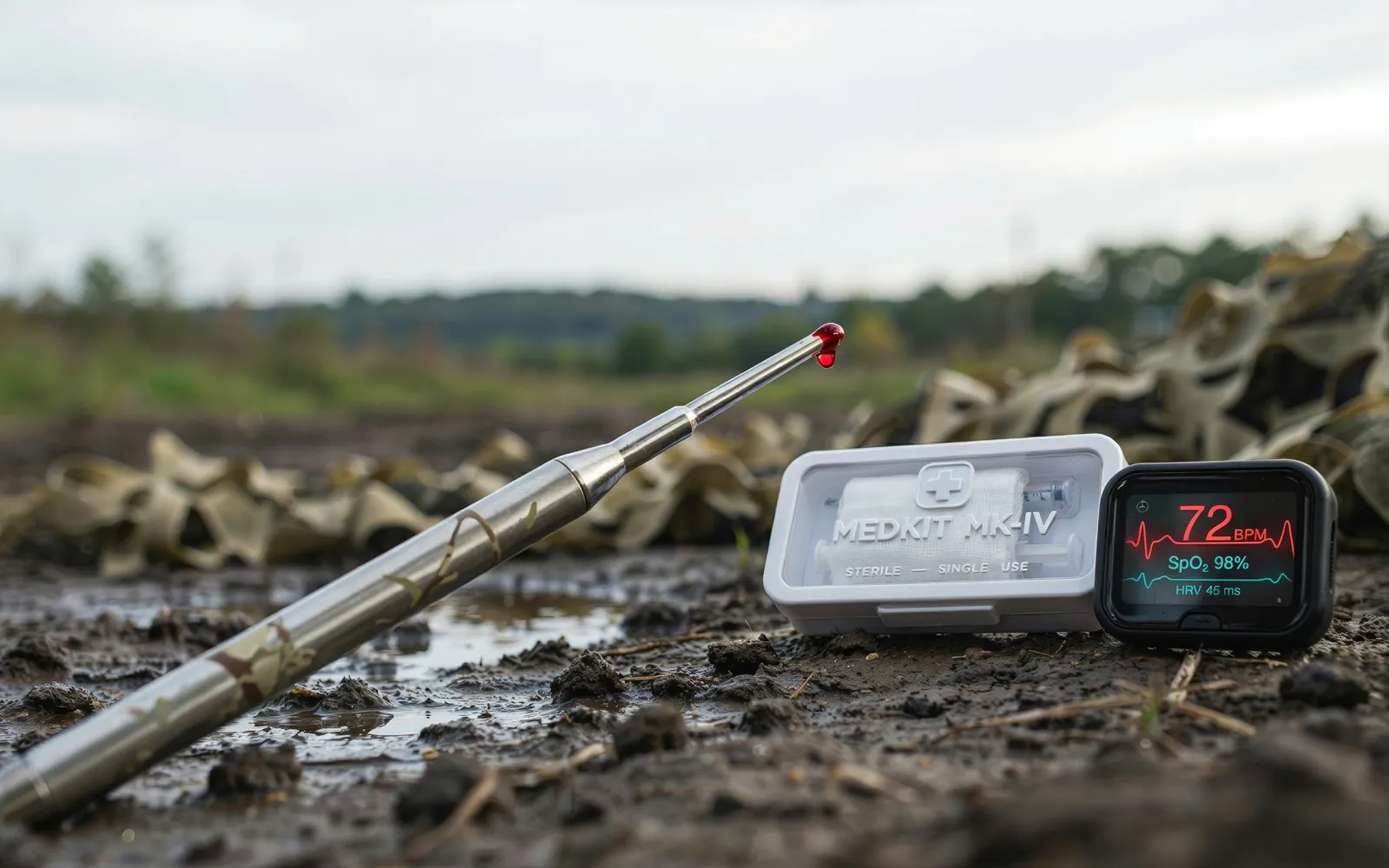
The Army Medical Department’s Future Capabilities Directorate has already mandated that the CRM system be integrated into a wearable medical trauma sensor currently under development. In practice, a medic treating a blast casualty could read a patient’s compensatory reserve from a wrist‑worn device and begin resuscitation before any vital sign crosses a clinical threshold, potentially closing the narrow window for effective intervention.
Dr. Victor Convertino, an adjunct faculty member in the Department of Medicine at USU and a senior scientist for Combat Casualty Care at the Army Institute, led the study. He explained that vital signs are lagging indicators because they reflect secondary effects of bleeding rather than the primary compensatory mechanisms that the body uses to maintain perfusion.
The technology builds on the same class of machine‑learning architecture that powers facial‑recognition systems, but it is applied to physiological data rather than images. By training on a broad dataset of healthy volunteers, the model learns to generalize to patients it has never seen before.
The Army’s integration of CRM into a wearable platform represents a significant step toward real‑time, data‑driven triage in the field. If the system proves effective in operational testing, it could also be adapted for civilian emergency medical services, where early detection of hemorrhagic shock can reduce mortality.
The development of CRM follows a growing trend of applying AI to monitor subtle physiological changes that precede overt clinical deterioration. Similar approaches have been explored in other contexts, such as non‑invasive cerebral perfusion monitoring and the use of compensatory reserve indices in hospital settings.
In summary, the Army’s AI‑based CRM system offers a promising tool for detecting hemorrhagic shock before vital signs change, potentially improving outcomes for both soldiers and civilians. The next phase will involve field trials of the wearable sensor and further validation of the algorithm’s performance across diverse patient populations.
Hemorrhagic shock is the leading cause of preventable death in both civilian trauma and battlefield scenarios. Traditional vital signs—heart rate and blood pressure—often remain within normal ranges until the patient is already in decompensated shock, at which point rapid intervention is more difficult. The CRM tool was designed to provide an earlier warning.
The algorithm was trained on data collected from healthy volunteers who underwent controlled reductions in central blood volume using Lower Body Negative Pressure (LBNP). LBNP is a laboratory technique that safely simulates hemorrhagic stress by pulling blood away from the upper body through a vacuum chamber. While the volunteers were exposed to progressive LBNP levels, a finger cuff recorded continuous blood pressure waveforms. From each 20‑second segment of the waveform, the CNN extracted 57 physiological features that change as the body adapts to decreasing blood volume.
Once trained, the model can evaluate a new patient’s pulse waveform in real time, identify subtle warning signs, and calculate a CRM score ranging from 100 % (full compensatory reserve) to 0 % (decompensated shock). The score is displayed as a color‑coded bar—green for 100 % to 75 %, amber for 75 % to 40 %, and red for 40 % to 0 %—so that medics can quickly assess a patient’s status.
According to the researchers, the algorithm’s accuracy is high, with a correlation coefficient of 0.95 or greater when estimating compensatory reserve at any point in time, even while standard vital signs remain unchanged. This precision, they say, makes the approach clinically viable.
The Army Medical Department’s Future Capabilities Directorate has already mandated that the CRM system be integrated into a wearable medical trauma sensor currently under development. In practice, a medic treating a blast casualty could read a patient’s compensatory reserve from a wrist‑worn device and begin resuscitation before any vital sign crosses a clinical threshold, potentially closing the narrow window for effective intervention.
Dr. Victor Convertino, an adjunct faculty member in the Department of Medicine at USU and a senior scientist for Combat Casualty Care at the Army Institute, led the study. He explained that vital signs are lagging indicators because they reflect secondary effects of bleeding rather than the primary compensatory mechanisms that the body uses to maintain perfusion.
The technology builds on the same class of machine‑learning architecture that powers facial‑recognition systems, but it is applied to physiological data rather than images. By training on a broad dataset of healthy volunteers, the model learns to generalize to patients it has never seen before.
The Army’s integration of CRM into a wearable platform represents a significant step toward real‑time, data‑driven triage in the field. If the system proves effective in operational testing, it could also be adapted for civilian emergency medical services, where early detection of hemorrhagic shock can reduce mortality.
The development of CRM follows a growing trend of applying AI to monitor subtle physiological changes that precede overt clinical deterioration. Similar approaches have been explored in other contexts, such as non‑invasive cerebral perfusion monitoring and the use of compensatory reserve indices in hospital settings.
In summary, the Army’s AI‑based CRM system offers a promising tool for detecting hemorrhagic shock before vital signs change, potentially improving outcomes for both soldiers and civilians. The next phase will involve field trials of the wearable sensor and further validation of the algorithm’s performance across diverse patient populations.





