Blab AI
Voyager Technologies Uses Agentic AI to Cut Circuit-Board Production Time from Years to Weeks in Long Beach
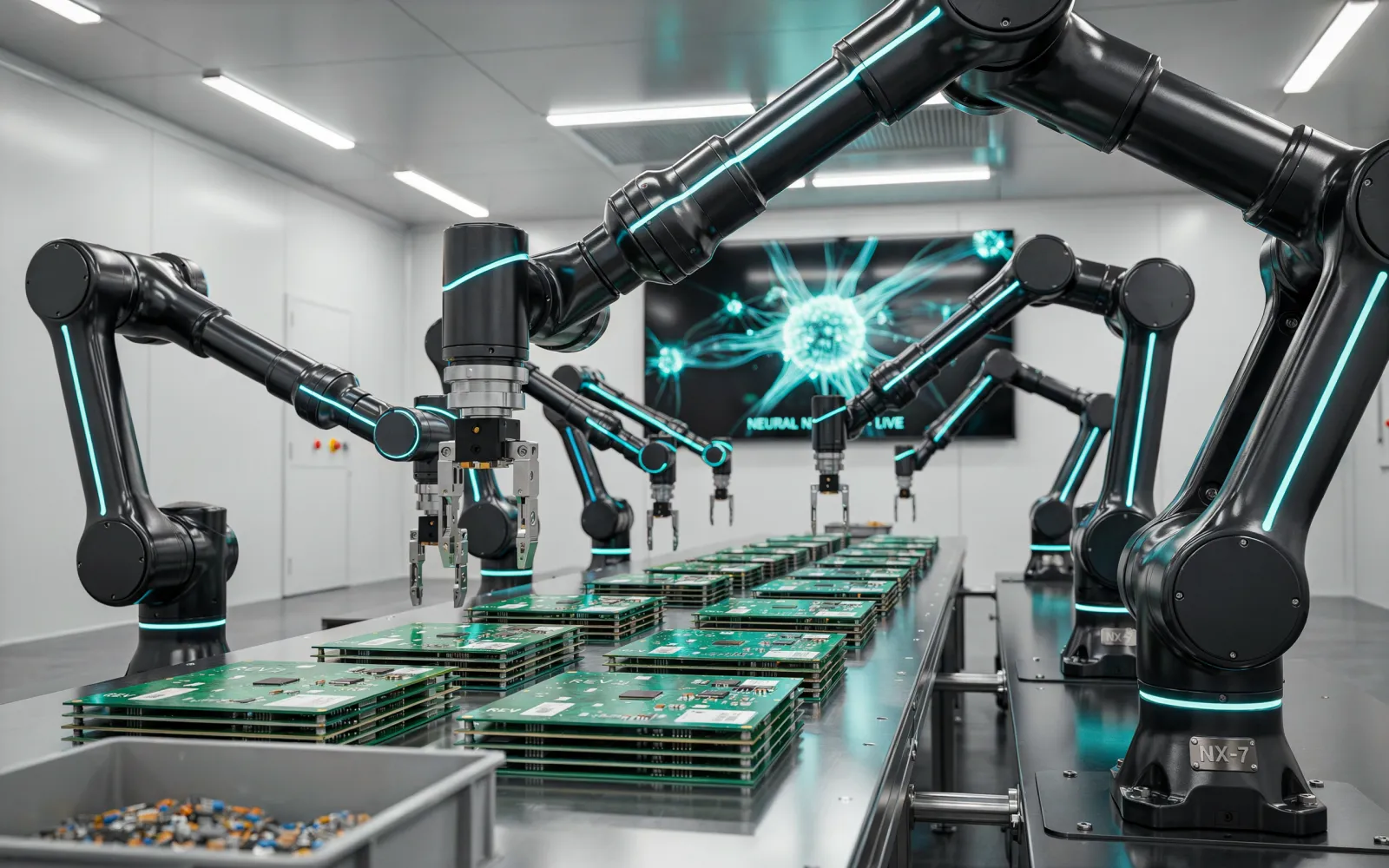
When Voyager Technologies opened its 140,000‑square‑foot plant in Long Beach, California, on March 12, 2026, the company announced a bold promise: to shrink the journey from defense‑electronics design to a working circuit board from years to weeks. The new facility, built on the same level of precision that ships the nation’s most advanced weapons systems, will use agentic artificial intelligence to rewrite the production playbook.
Agentic AI is not a single‑task automation tool; it is a digital collaborator that can design, iterate, and qualify a board in a fraction of the time a human engineer would need. In practice, the system drafts compliance paperwork, runs thousands of simulation variations in parallel, and coordinates supply‑chain decisions—all while a small cadre of engineers review and approve the AI’s output. The result is a design‑to‑board cycle that now takes weeks instead of the traditional multi‑year timeline.
Voyager’s Long Beach expansion is part of a broader push. Earlier this year, the company opened a 150,000‑square‑foot complex in Pueblo, Colorado, to focus on missile defense and tactical munitions. Matt Magaña, Voyager’s president for space, defense and national security, warned that the “traditional process for mission electronics takes years and years, and that is the bottleneck.” He added that the company’s use of AI can bring “speed of relevance” to the design‑to‑board cycle.
The shift is driven in large part by a chronic shortage of qualified engineers. At the ASCEND conference in Washington, Clay Mowry, chief executive of the American Institute of Aeronautics and Astronautics, noted that some firms are attempting to lift production “by a factor of four.” AIAA’s Aerospace America report, based on Deloitte and McKinsey analyses, finds that roughly one‑third of aerospace and defense manufacturing and engineering roles are held by workers 55 or older, and the sector’s retirement and attrition rate is nearly 10 percent above the national average.
The federal workforce shrank by about 220,000 people through November 2025, a 10 percent cut, according to Office of Personnel Management data analyzed by the New York Times. Congress added nearly $34 billion above the president’s fiscal 2026 defense request for research and procurement programs, but appropriations do not create qualified engineers. Voyager’s Long Beach plant therefore turns to agentic AI to fill the talent gap.
Unlike traditional rule‑based automation that handles a single repetitive task, agentic AI is designed to manage the entire production cycle. It performs design iteration, generates compliance paperwork, coordinates supply chains, and plans production. The AI drafts documentation, runs early trade studies, and handles routine compliance work that previously consumed hours of an engineer’s time. Engineers at the plant now act as reviewers and decision makers rather than producers of paperwork, a role that has earned the AI the nickname “the junior staff that cannot be hired.”
Space‑grade circuit boards must survive launch loads, extreme temperature swings, and a radiation environment that can corrupt ordinary electronics. The AI can run thousands of simulation variations in parallel, assemble qualification documentation, and flag design choices that would fail in a physical test. The compression is achieved in the thinking process rather than in the manufacturing process.
A regulatory challenge remains. Human engineer sign‑offs have a clear chain of accountability that traces back through years of training and licensure. When an AI drafts a compliance package or proposes a design change, that chain becomes harder to trace. Qualification regimes for space and defense hardware were built around human reviewers checking human work. Adapting those regimes to AI‑generated artifacts is a regulatory problem that has not yet been solved.
For now, the shortage of talent is forcing the decision to use AI. Boards are coming off the line in weeks, but whether they meet the rigorous qualification standards will be tested in orbit and on the ranges. The Long Beach plant represents a new model in aerospace manufacturing, but the industry still faces unresolved questions about accountability, regulation, and long‑term reliability.
The current situation shows Voyager’s Long Beach facility producing boards in weeks, AI accelerating the design cycle, and a workforce shortage that drives the experiment. Upcoming product launches and further AI deployments will test whether the accelerated process can match the reliability required for space and defense missions. The outcome of those tests remains to be seen.
Agentic AI is not a single‑task automation tool; it is a digital collaborator that can design, iterate, and qualify a board in a fraction of the time a human engineer would need. In practice, the system drafts compliance paperwork, runs thousands of simulation variations in parallel, and coordinates supply‑chain decisions—all while a small cadre of engineers review and approve the AI’s output. The result is a design‑to‑board cycle that now takes weeks instead of the traditional multi‑year timeline.
Voyager’s Long Beach expansion is part of a broader push. Earlier this year, the company opened a 150,000‑square‑foot complex in Pueblo, Colorado, to focus on missile defense and tactical munitions. Matt Magaña, Voyager’s president for space, defense and national security, warned that the “traditional process for mission electronics takes years and years, and that is the bottleneck.” He added that the company’s use of AI can bring “speed of relevance” to the design‑to‑board cycle.
The shift is driven in large part by a chronic shortage of qualified engineers. At the ASCEND conference in Washington, Clay Mowry, chief executive of the American Institute of Aeronautics and Astronautics, noted that some firms are attempting to lift production “by a factor of four.” AIAA’s Aerospace America report, based on Deloitte and McKinsey analyses, finds that roughly one‑third of aerospace and defense manufacturing and engineering roles are held by workers 55 or older, and the sector’s retirement and attrition rate is nearly 10 percent above the national average.
The federal workforce shrank by about 220,000 people through November 2025, a 10 percent cut, according to Office of Personnel Management data analyzed by the New York Times. Congress added nearly $34 billion above the president’s fiscal 2026 defense request for research and procurement programs, but appropriations do not create qualified engineers. Voyager’s Long Beach plant therefore turns to agentic AI to fill the talent gap.
Unlike traditional rule‑based automation that handles a single repetitive task, agentic AI is designed to manage the entire production cycle. It performs design iteration, generates compliance paperwork, coordinates supply chains, and plans production. The AI drafts documentation, runs early trade studies, and handles routine compliance work that previously consumed hours of an engineer’s time. Engineers at the plant now act as reviewers and decision makers rather than producers of paperwork, a role that has earned the AI the nickname “the junior staff that cannot be hired.”
Space‑grade circuit boards must survive launch loads, extreme temperature swings, and a radiation environment that can corrupt ordinary electronics. The AI can run thousands of simulation variations in parallel, assemble qualification documentation, and flag design choices that would fail in a physical test. The compression is achieved in the thinking process rather than in the manufacturing process.
A regulatory challenge remains. Human engineer sign‑offs have a clear chain of accountability that traces back through years of training and licensure. When an AI drafts a compliance package or proposes a design change, that chain becomes harder to trace. Qualification regimes for space and defense hardware were built around human reviewers checking human work. Adapting those regimes to AI‑generated artifacts is a regulatory problem that has not yet been solved.
For now, the shortage of talent is forcing the decision to use AI. Boards are coming off the line in weeks, but whether they meet the rigorous qualification standards will be tested in orbit and on the ranges. The Long Beach plant represents a new model in aerospace manufacturing, but the industry still faces unresolved questions about accountability, regulation, and long‑term reliability.
The current situation shows Voyager’s Long Beach facility producing boards in weeks, AI accelerating the design cycle, and a workforce shortage that drives the experiment. Upcoming product launches and further AI deployments will test whether the accelerated process can match the reliability required for space and defense missions. The outcome of those tests remains to be seen.





