Blab AI
CMR-CLIP AI Model Achieves High Accuracy in Cardiac MRI Diagnosis, Outperforms Existing Tools
A new artificial‑intelligence framework called CMR‑CLIP (Cardiovascular Magnetic Resonance‑Contrastive Language Image Pretraining) has shown strong diagnostic performance on cardiac magnetic resonance (CMR) scans, according to a study published in Nature Communications on 21 May 2026. The model was developed by researchers from Carnegie Mellon University and Cleveland Clinic’s Cardiovascular Innovation Research Center and was evaluated on real‑world clinical data from the United States and France.
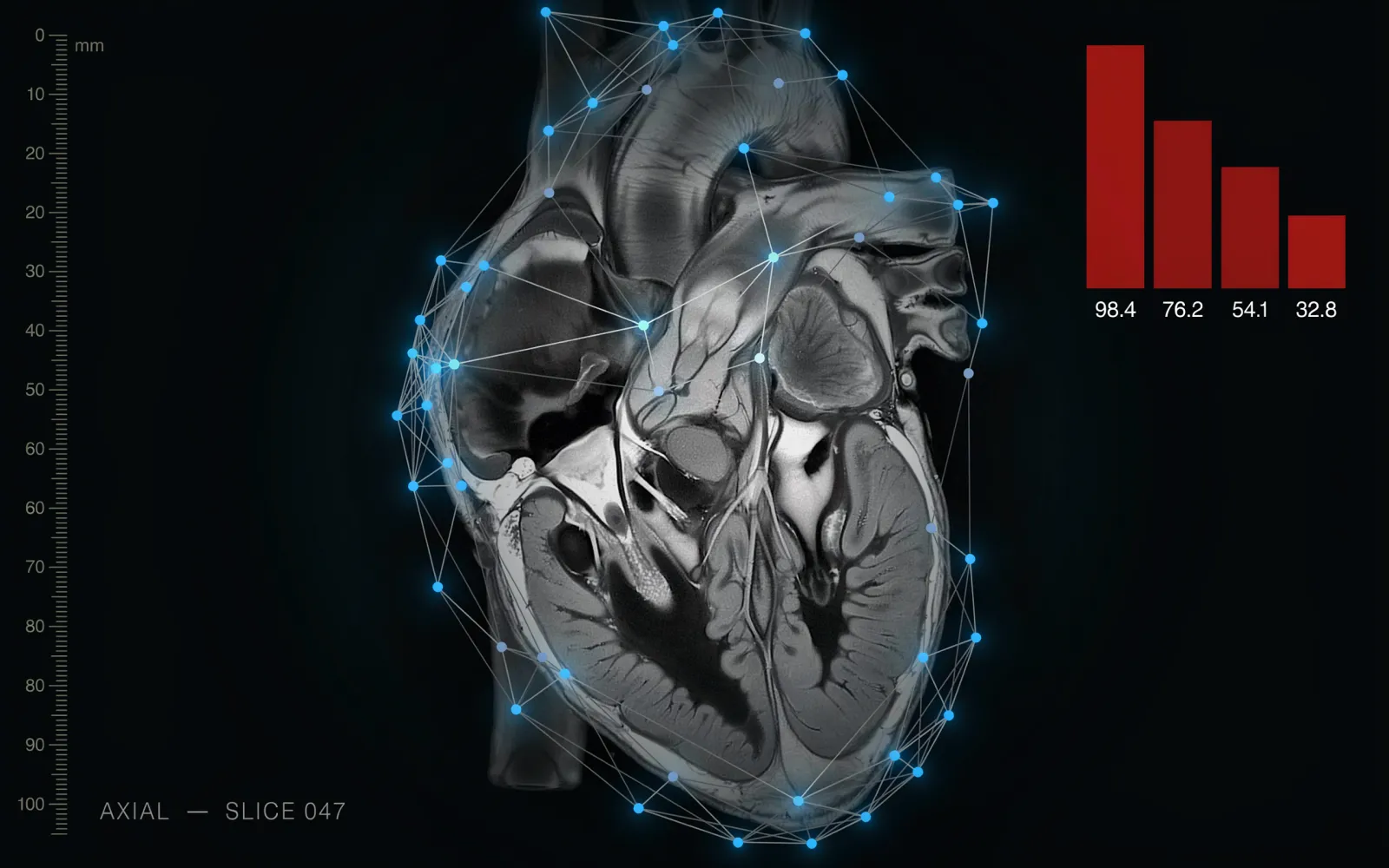
CMR is the reference technique for assessing heart structure and function, but interpreting the rich image data typically takes a specialist 40 minutes or more. The new system learns directly from the images and the accompanying clinical impressions written by cardiologists, enabling it to perform image analysis and disease classification without manual labeling.
In the study, CMR‑CLIP was trained on more than 13,000 CMR studies performed at Cleveland Clinic between 2008 and 2022, which provided over a million images and hundreds of thousands of motion sequences. The text component focused on the impression section of each report, summarizing key findings and recommendations.
When tested on two independent datasets—one from the University Hospital of Dijon, France, and another from Cleveland Clinic Florida—the model achieved the following accuracy rates relative to expert readers:
88.5 % for non‑ischemic cardiomyopathy 88.0 % for ischemic cardiomyopathy 96.2 % for cardiac amyloidosis 98.6 % for hypertrophic cardiomyopathy
These results were reported by the authors as outperforming two other CLIP‑based systems on common pathologies such as myocardial fibrosis and left‑ventricular hypertrophy by 32 % or more. In addition, CMR‑CLIP reached comparable performance using a single example (one‑shot) while the competing models required 32 examples (32‑shot).
According to the paper, the model’s ability to perform zero‑shot classification—recognizing conditions it was not explicitly trained on—could support clinicians in settings where expert readers are scarce. “CMR‑CLIP could be immensely important in automating and standardizing reports, providing greater clarity to clinicians for determining next steps for patient care,” said cardiologist Deborah Kwon, MD, director of Cardiac MRI at Cleveland Clinic and co‑author of the study.
The authors note that the framework is still a research prototype. It will need continuous learning to remain current, a broader mix of diagnoses to widen its scope, and further validation on additional datasets to confirm generalizability. Integration into hospital workflow also remains to be explored.
The CMR‑CLIP codebase is publicly available on GitHub (github.com/Makiya11/CMRCLIP), allowing other researchers to experiment with the model and contribute to its development.
While the study demonstrates promising performance, the authors caution that the system is not yet ready for clinical deployment. Future work will focus on expanding the training data, testing in diverse clinical environments, and evaluating how the tool could fit into existing reporting pipelines.
The research highlights the potential of vision‑language models to accelerate and standardize cardiac imaging interpretation, a step that could broaden access to high‑quality CMR assessment beyond major academic centers.
CMR is the reference technique for assessing heart structure and function, but interpreting the rich image data typically takes a specialist 40 minutes or more. The new system learns directly from the images and the accompanying clinical impressions written by cardiologists, enabling it to perform image analysis and disease classification without manual labeling.
In the study, CMR‑CLIP was trained on more than 13,000 CMR studies performed at Cleveland Clinic between 2008 and 2022, which provided over a million images and hundreds of thousands of motion sequences. The text component focused on the impression section of each report, summarizing key findings and recommendations.
When tested on two independent datasets—one from the University Hospital of Dijon, France, and another from Cleveland Clinic Florida—the model achieved the following accuracy rates relative to expert readers:
88.5 % for non‑ischemic cardiomyopathy 88.0 % for ischemic cardiomyopathy 96.2 % for cardiac amyloidosis 98.6 % for hypertrophic cardiomyopathy
These results were reported by the authors as outperforming two other CLIP‑based systems on common pathologies such as myocardial fibrosis and left‑ventricular hypertrophy by 32 % or more. In addition, CMR‑CLIP reached comparable performance using a single example (one‑shot) while the competing models required 32 examples (32‑shot).
According to the paper, the model’s ability to perform zero‑shot classification—recognizing conditions it was not explicitly trained on—could support clinicians in settings where expert readers are scarce. “CMR‑CLIP could be immensely important in automating and standardizing reports, providing greater clarity to clinicians for determining next steps for patient care,” said cardiologist Deborah Kwon, MD, director of Cardiac MRI at Cleveland Clinic and co‑author of the study.
The authors note that the framework is still a research prototype. It will need continuous learning to remain current, a broader mix of diagnoses to widen its scope, and further validation on additional datasets to confirm generalizability. Integration into hospital workflow also remains to be explored.
The CMR‑CLIP codebase is publicly available on GitHub (github.com/Makiya11/CMRCLIP), allowing other researchers to experiment with the model and contribute to its development.
While the study demonstrates promising performance, the authors caution that the system is not yet ready for clinical deployment. Future work will focus on expanding the training data, testing in diverse clinical environments, and evaluating how the tool could fit into existing reporting pipelines.
The research highlights the potential of vision‑language models to accelerate and standardize cardiac imaging interpretation, a step that could broaden access to high‑quality CMR assessment beyond major academic centers.





