Blab AI
Cedarville University Students Build Autonomous Robot to Guide Campus Visitors
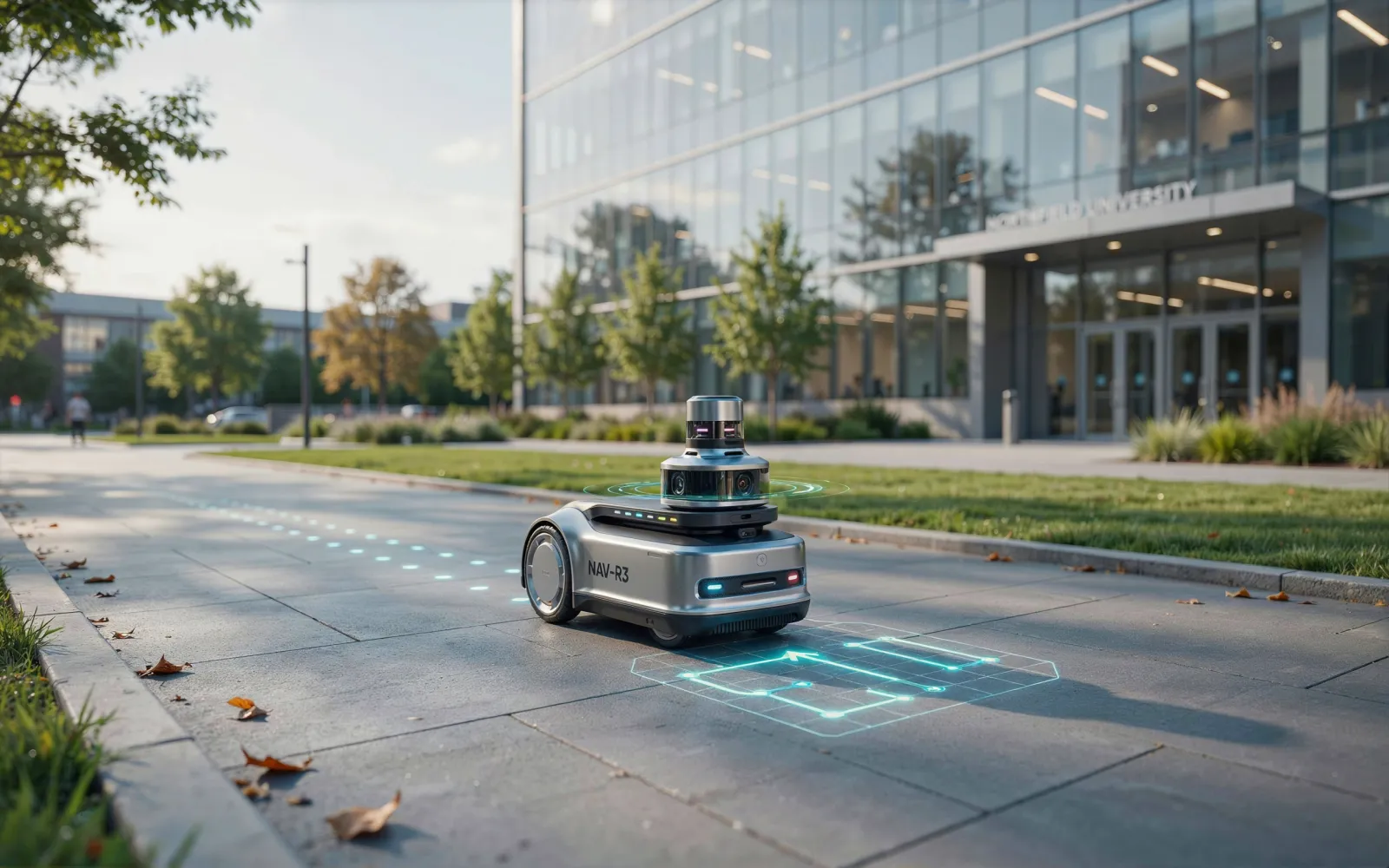
In 2026, engineering students at Cedarville University in Cedarville, Ohio, introduced an autonomous robot that guides visitors through the university’s Engineering and Science Center. The robot, called the Campus Engagement and Directional Assistance Rover (CEDAR), is designed to provide real‑time information about engineering programs, courses, and campus events while navigating the building independently.
CEDAR’s core functions combine navigation, communication, and information delivery. The robot uses a 3‑dimensional map of the first floor to locate key points of interest and to plan routes that avoid obstacles. A large language model serves as the robot’s “brain,” enabling it to interpret visitor questions, retrieve accurate answers from Cedarville’s course catalog and website, and generate natural‑language responses. The system can adjust its path and conversation in real time, allowing it to fill gaps when human tour guides are unavailable.
The project was led by seniors Mark Freier and Alan Golden, both electrical‑engineering majors, and Gregory Rose and Nathan Steenwyk, computer‑engineering seniors. According to the students, the team had to experiment with a variety of approaches because no single solution worked from the start. “There hasn’t been a single part of the project that went as expected,” Steenwyk said. “We had to try ideas, see what worked and build something completely our own.”
Technically, CEDAR integrates several contemporary AI and robotics techniques. The 3‑D mapping component builds a geometric scaffold of the environment, while the language model processes natural‑language input and generates context‑appropriate replies. The robot’s navigation system uses the map to localize itself and to plan collision‑free paths. By combining these modules, the robot demonstrates a level of autonomy that goes beyond simple conversational agents.
The project illustrates how large language models can support real‑world decision making in physical settings. “The possibilities with AI are endless, especially when you start applying it to systems beyond simple conversation,” Steenwyk added. The team’s work shows that AI can be embedded in robots to perform complex behaviors without requiring extensive custom programming.
CEDAR is currently deployed on the first floor of the Engineering and Science Center, where it assists visitors during high‑traffic visitation days. The robot is intended to provide a consistent, accessible, and interactive tour experience. While the system is still in a developmental phase, the students plan to refine its navigation accuracy, expand its knowledge base, and evaluate user interactions in a broader range of campus areas.
The initiative reflects a growing trend in engineering education to incorporate hands‑on AI and robotics projects. By building a functional robot that serves a real campus need, the Cedarville team demonstrates how students can apply theoretical knowledge to tangible problems. The project also highlights the potential for AI‑powered robots to support campus operations, visitor services, and educational outreach.
At present, CEDAR remains a prototype that operates within a controlled environment. The students have not announced plans for wider deployment or commercialization, and no external funding has been disclosed. Future updates will likely focus on improving the robot’s autonomy, expanding its conversational topics, and gathering feedback from visitors.
In summary, Cedarville University’s student‑led CEDAR project showcases the integration of large language models and 3‑D mapping in an autonomous robot that assists campus visitors. The work underscores the feasibility of applying AI to practical, real‑world tasks and points to new opportunities for engineering students to develop AI‑enabled systems that serve community needs.
CEDAR’s core functions combine navigation, communication, and information delivery. The robot uses a 3‑dimensional map of the first floor to locate key points of interest and to plan routes that avoid obstacles. A large language model serves as the robot’s “brain,” enabling it to interpret visitor questions, retrieve accurate answers from Cedarville’s course catalog and website, and generate natural‑language responses. The system can adjust its path and conversation in real time, allowing it to fill gaps when human tour guides are unavailable.
The project was led by seniors Mark Freier and Alan Golden, both electrical‑engineering majors, and Gregory Rose and Nathan Steenwyk, computer‑engineering seniors. According to the students, the team had to experiment with a variety of approaches because no single solution worked from the start. “There hasn’t been a single part of the project that went as expected,” Steenwyk said. “We had to try ideas, see what worked and build something completely our own.”
Technically, CEDAR integrates several contemporary AI and robotics techniques. The 3‑D mapping component builds a geometric scaffold of the environment, while the language model processes natural‑language input and generates context‑appropriate replies. The robot’s navigation system uses the map to localize itself and to plan collision‑free paths. By combining these modules, the robot demonstrates a level of autonomy that goes beyond simple conversational agents.
The project illustrates how large language models can support real‑world decision making in physical settings. “The possibilities with AI are endless, especially when you start applying it to systems beyond simple conversation,” Steenwyk added. The team’s work shows that AI can be embedded in robots to perform complex behaviors without requiring extensive custom programming.
CEDAR is currently deployed on the first floor of the Engineering and Science Center, where it assists visitors during high‑traffic visitation days. The robot is intended to provide a consistent, accessible, and interactive tour experience. While the system is still in a developmental phase, the students plan to refine its navigation accuracy, expand its knowledge base, and evaluate user interactions in a broader range of campus areas.
The initiative reflects a growing trend in engineering education to incorporate hands‑on AI and robotics projects. By building a functional robot that serves a real campus need, the Cedarville team demonstrates how students can apply theoretical knowledge to tangible problems. The project also highlights the potential for AI‑powered robots to support campus operations, visitor services, and educational outreach.
At present, CEDAR remains a prototype that operates within a controlled environment. The students have not announced plans for wider deployment or commercialization, and no external funding has been disclosed. Future updates will likely focus on improving the robot’s autonomy, expanding its conversational topics, and gathering feedback from visitors.
In summary, Cedarville University’s student‑led CEDAR project showcases the integration of large language models and 3‑D mapping in an autonomous robot that assists campus visitors. The work underscores the feasibility of applying AI to practical, real‑world tasks and points to new opportunities for engineering students to develop AI‑enabled systems that serve community needs.





