Blab AI
Artist Felicity Hammonds Two-Year AI Mining Project Blurs Lines Between Data Extraction and Painting
For two years, British artist and academic Felicity Hammond turned a steel plate into a living archive, turning the act of data mining into a visual ritual.
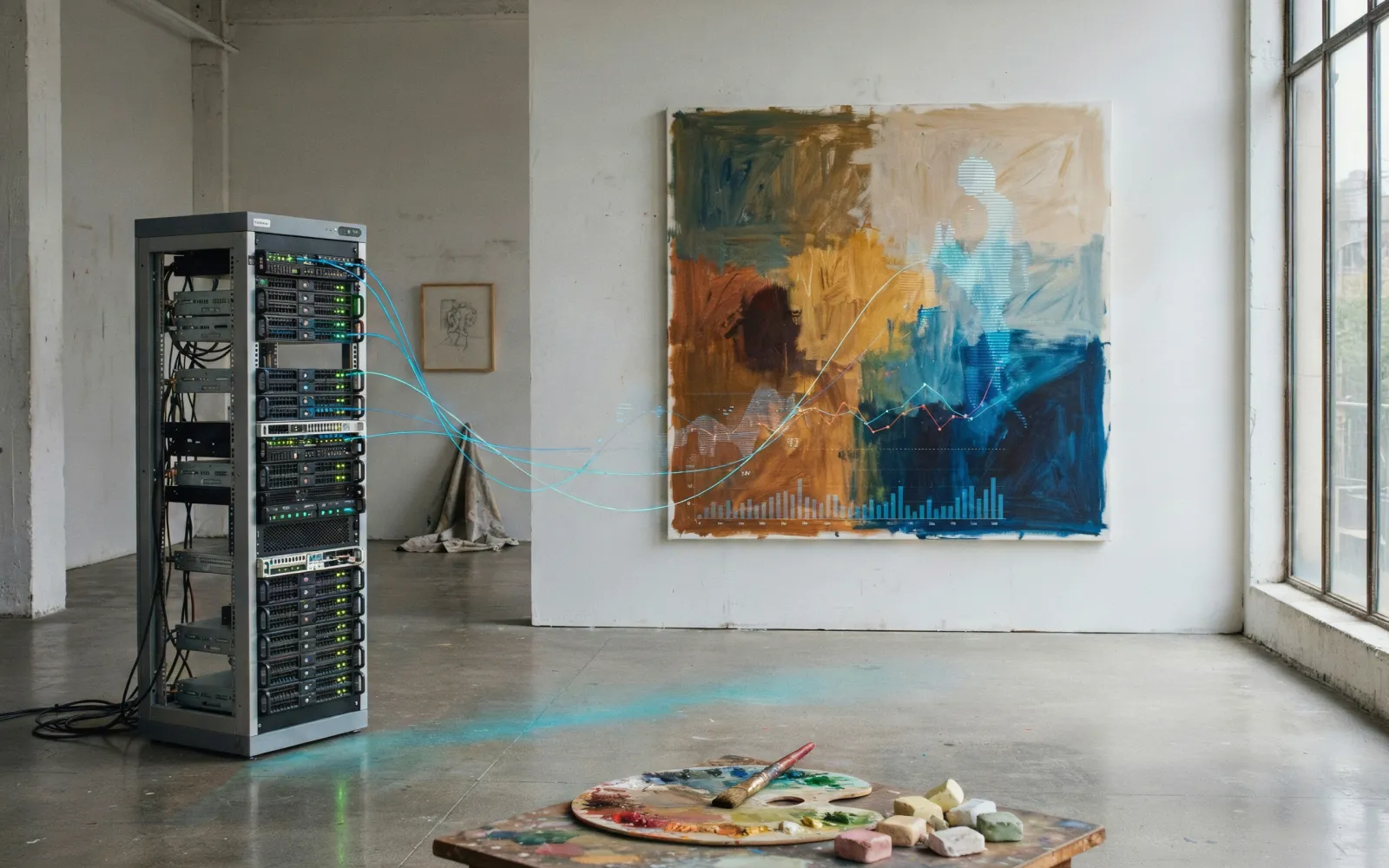
Hammond began with a single square‑meter image generated from an AI prompt. She enlarged that image, casting it onto a 3‑metre‑wide orange steel plate that became a recording machine. The machine’s camera faced a mirror opposite it, photographing visitors and the machine itself. Each photo was fed back into the AI, which re‑rendered the image with a more painterly style as it tried to smooth out imperfections.
From those machine‑generated frames, Hammond produced 42 life‑size panels that she hand‑painted. She photographed each panel and assembled the images into a large C‑shaped print that captured the iterative loop of creation and correction.
The project culminated in an “end‑of‑life service” held in Edinburgh: a funeral procession for the dismantled machine parts, which were then consigned to a repository. The ceremony underscored the transient nature of technology and the ongoing dialogue about its role in contemporary art.
Hammond explains that the process mirrors how data extraction and geological mining both involve intrusive extraction. She argues that AI has shifted power from governments, who historically used photography for control, to individual image‑makers and social‑media platforms that profit from viral propagation. Citing Hito Steyerl’s essay Mean Images, she notes that the AI process ultimately produces an “average,” a fact she sees as both a limitation and a source of insight.
Her work sits within the broader context of generative AI’s rise in the 2020s. Platforms such as DALL‑E, Midjourney, and Stable Diffusion appeared in 2021, sparking debates about the status of AI imagery in art and photography. The proliferation of these tools has raised questions about copyright, deception, and the impact on traditional artists.
In her own words, Hammond does not fear the future of AI. Instead, she is struck by how the technology’s iterative process mirrors the extraction of data and the mining of minerals. Her installation demonstrates how AI can act as both a creative collaborator and a mirror that reflects back the imperfections of its own output.
The project has been exhibited in gallery spaces and has attracted attention from curators interested in the intersection of technology and visual art. While no formal awards have been announced for this specific work, Hammond’s broader practice has been recognized in contexts that celebrate art created with technology.
Hammond’s exploration raises questions about the ethical and practical implications of using AI as a creative tool, highlighting the tension between the democratizing potential of generative models and concerns about the quality and originality of the images they produce.
As AI continues to evolve, artists like Hammond push the boundaries of how machine learning can be integrated into the artistic process, prompting both admiration and critical scrutiny. The project’s final act—a funeral procession for the machine—serves as a poignant reminder of technology’s fleeting presence in the creative landscape.
Hammond began with a single square‑meter image generated from an AI prompt. She enlarged that image, casting it onto a 3‑metre‑wide orange steel plate that became a recording machine. The machine’s camera faced a mirror opposite it, photographing visitors and the machine itself. Each photo was fed back into the AI, which re‑rendered the image with a more painterly style as it tried to smooth out imperfections.
From those machine‑generated frames, Hammond produced 42 life‑size panels that she hand‑painted. She photographed each panel and assembled the images into a large C‑shaped print that captured the iterative loop of creation and correction.
The project culminated in an “end‑of‑life service” held in Edinburgh: a funeral procession for the dismantled machine parts, which were then consigned to a repository. The ceremony underscored the transient nature of technology and the ongoing dialogue about its role in contemporary art.
Hammond explains that the process mirrors how data extraction and geological mining both involve intrusive extraction. She argues that AI has shifted power from governments, who historically used photography for control, to individual image‑makers and social‑media platforms that profit from viral propagation. Citing Hito Steyerl’s essay Mean Images, she notes that the AI process ultimately produces an “average,” a fact she sees as both a limitation and a source of insight.
Her work sits within the broader context of generative AI’s rise in the 2020s. Platforms such as DALL‑E, Midjourney, and Stable Diffusion appeared in 2021, sparking debates about the status of AI imagery in art and photography. The proliferation of these tools has raised questions about copyright, deception, and the impact on traditional artists.
In her own words, Hammond does not fear the future of AI. Instead, she is struck by how the technology’s iterative process mirrors the extraction of data and the mining of minerals. Her installation demonstrates how AI can act as both a creative collaborator and a mirror that reflects back the imperfections of its own output.
The project has been exhibited in gallery spaces and has attracted attention from curators interested in the intersection of technology and visual art. While no formal awards have been announced for this specific work, Hammond’s broader practice has been recognized in contexts that celebrate art created with technology.
Hammond’s exploration raises questions about the ethical and practical implications of using AI as a creative tool, highlighting the tension between the democratizing potential of generative models and concerns about the quality and originality of the images they produce.
As AI continues to evolve, artists like Hammond push the boundaries of how machine learning can be integrated into the artistic process, prompting both admiration and critical scrutiny. The project’s final act—a funeral procession for the machine—serves as a poignant reminder of technology’s fleeting presence in the creative landscape.





