Blab AI
US Public Opposes Local AI Data Centers, Threatening National Compute Lead
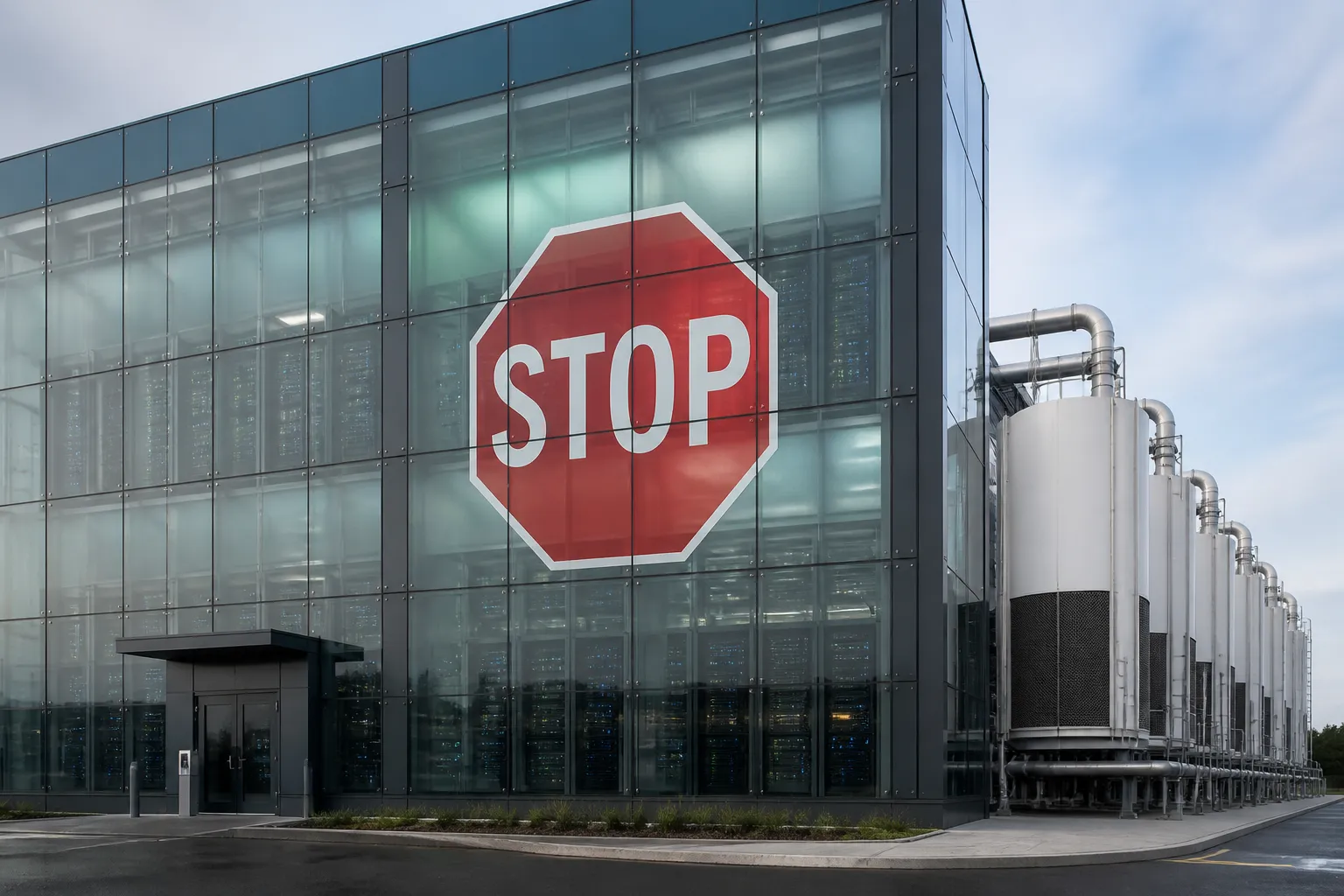
A Gallup poll released last month shows that more than 70 % of Americans oppose building artificial‑intelligence (AI) data centers near their homes, and 48 % are strongly opposed. The level of local resistance exceeds that for new nuclear power plants, according to the poll. The finding matters because the United States currently holds a roughly seven‑month lead over China in frontier AI capability, a margin that depends almost entirely on domestic compute power supplied by GPUs, megawatts of electricity, and cooling infrastructure.
Local opposition is already visible in several states. In northwest Georgia, residents have held public meetings to protest proposed data‑center projects. Bradley County’s commission approved strict rules that make it difficult for developers to obtain permits. In Charlottesville, Virginia, a 550,000‑square‑foot hyperscale facility sits along Interstate 66. The plant’s cooling system can consume several million gallons of water each day, and the state’s rate design forces all customers—including retirees—to share the cost of new transmission and generation that serves the data center.
Industry estimates for 2030 call for hundreds of billions of dollars in new domestic data‑center buildout to meet the growing demand for AI. If permitting fights add five extra years, the U.S. compute advantage could disappear. The problem is not only the cost of new infrastructure but also the political reality that a federal system cannot override local objections. A developer can win a zoning fight in one county, but it is unlikely to win thousands of similar battles across the country.
The industry’s current contracts do not address the most significant local concerns. U.S. electric grids are designed to meet peak demand in the late afternoon on hot summer days; the rest of the year, much of that capacity sits idle. A data‑center contract that obliges the operator to throttle power or switch to on‑site battery storage during the few hundred hours of peak demand would allow utilities to spread the cost of new infrastructure across a larger customer base, lowering bills for everyone. Closed‑loop water‑cooling systems can reduce water use by 80 % to 95 %, but local zoning codes rarely require them.
Rate design also plays a role. New transmission, substations, and generation built specifically to serve a data center should be paid for by the operator, not by residential ratepayers. When the new infrastructure creates system‑wide savings, those savings should flow back to local households. A handful of states are experimenting with “large‑load tariff” reform, but no state has yet adopted a model that would become a national template.
Community benefits can also shift public opinion. Loudoun County, Virginia, the world’s largest concentration of data centers, collects roughly $890 million in annual data‑center tax revenue—about 38 % of its general fund. That revenue has allowed the county to lower its residential property‑tax rate for a decade. In other counties, residents see only the cooling towers.
The industry’s choice is between addressing these local concerns and risking a loss of its competitive edge to China, or continuing to treat opposition as a public‑relations nuisance. Beijing is not waiting for planning commissions to adjourn.
The current situation is that local opposition has already stalled or delayed approximately $64 billion in U.S. data‑center projects since 2024, according to a report by EdgeN. No definitive policy framework has yet been adopted to reconcile the need for domestic compute capacity with the legitimate concerns of communities that will host the facilities. The next steps will involve state‑level tariff reforms, contractual standards for interruptible load and closed‑loop cooling, and clearer guidelines for community benefit sharing.
The outcome will determine whether the United States can maintain its lead in AI compute and whether the industry can continue to grow without alienating the very communities that will host its infrastructure.
Local opposition is already visible in several states. In northwest Georgia, residents have held public meetings to protest proposed data‑center projects. Bradley County’s commission approved strict rules that make it difficult for developers to obtain permits. In Charlottesville, Virginia, a 550,000‑square‑foot hyperscale facility sits along Interstate 66. The plant’s cooling system can consume several million gallons of water each day, and the state’s rate design forces all customers—including retirees—to share the cost of new transmission and generation that serves the data center.
Industry estimates for 2030 call for hundreds of billions of dollars in new domestic data‑center buildout to meet the growing demand for AI. If permitting fights add five extra years, the U.S. compute advantage could disappear. The problem is not only the cost of new infrastructure but also the political reality that a federal system cannot override local objections. A developer can win a zoning fight in one county, but it is unlikely to win thousands of similar battles across the country.
The industry’s current contracts do not address the most significant local concerns. U.S. electric grids are designed to meet peak demand in the late afternoon on hot summer days; the rest of the year, much of that capacity sits idle. A data‑center contract that obliges the operator to throttle power or switch to on‑site battery storage during the few hundred hours of peak demand would allow utilities to spread the cost of new infrastructure across a larger customer base, lowering bills for everyone. Closed‑loop water‑cooling systems can reduce water use by 80 % to 95 %, but local zoning codes rarely require them.
Rate design also plays a role. New transmission, substations, and generation built specifically to serve a data center should be paid for by the operator, not by residential ratepayers. When the new infrastructure creates system‑wide savings, those savings should flow back to local households. A handful of states are experimenting with “large‑load tariff” reform, but no state has yet adopted a model that would become a national template.
Community benefits can also shift public opinion. Loudoun County, Virginia, the world’s largest concentration of data centers, collects roughly $890 million in annual data‑center tax revenue—about 38 % of its general fund. That revenue has allowed the county to lower its residential property‑tax rate for a decade. In other counties, residents see only the cooling towers.
The industry’s choice is between addressing these local concerns and risking a loss of its competitive edge to China, or continuing to treat opposition as a public‑relations nuisance. Beijing is not waiting for planning commissions to adjourn.
The current situation is that local opposition has already stalled or delayed approximately $64 billion in U.S. data‑center projects since 2024, according to a report by EdgeN. No definitive policy framework has yet been adopted to reconcile the need for domestic compute capacity with the legitimate concerns of communities that will host the facilities. The next steps will involve state‑level tariff reforms, contractual standards for interruptible load and closed‑loop cooling, and clearer guidelines for community benefit sharing.
The outcome will determine whether the United States can maintain its lead in AI compute and whether the industry can continue to grow without alienating the very communities that will host its infrastructure.





