Blab AI
Global AI Robot Market Set to Surge to $194 Billion by 2035, Driven by Automation and Edge Computing
The global artificial‑intelligence (AI) robot market is poised to explode, rising from a 2025 valuation of $8.77 billion to an estimated $194.36 billion by 2035—an annual growth rate of 29.46 % over the 2026‑2035 period.
In the United States, the market is projected to grow from $2.85 billion in 2025 to $58.40 billion in 2035. Europe is expected to expand from $2.18 billion to $44.96 billion in the same timeframe.
The surge is driven by mounting investment in industrial automation, tightening labor‑market pressures, and the expanding commercial viability of AI‑enabled autonomous systems. AI robots are shifting from niche prototypes to essential operational infrastructure across manufacturing, logistics, and defense, delivering measurable gains in productivity and efficiency.
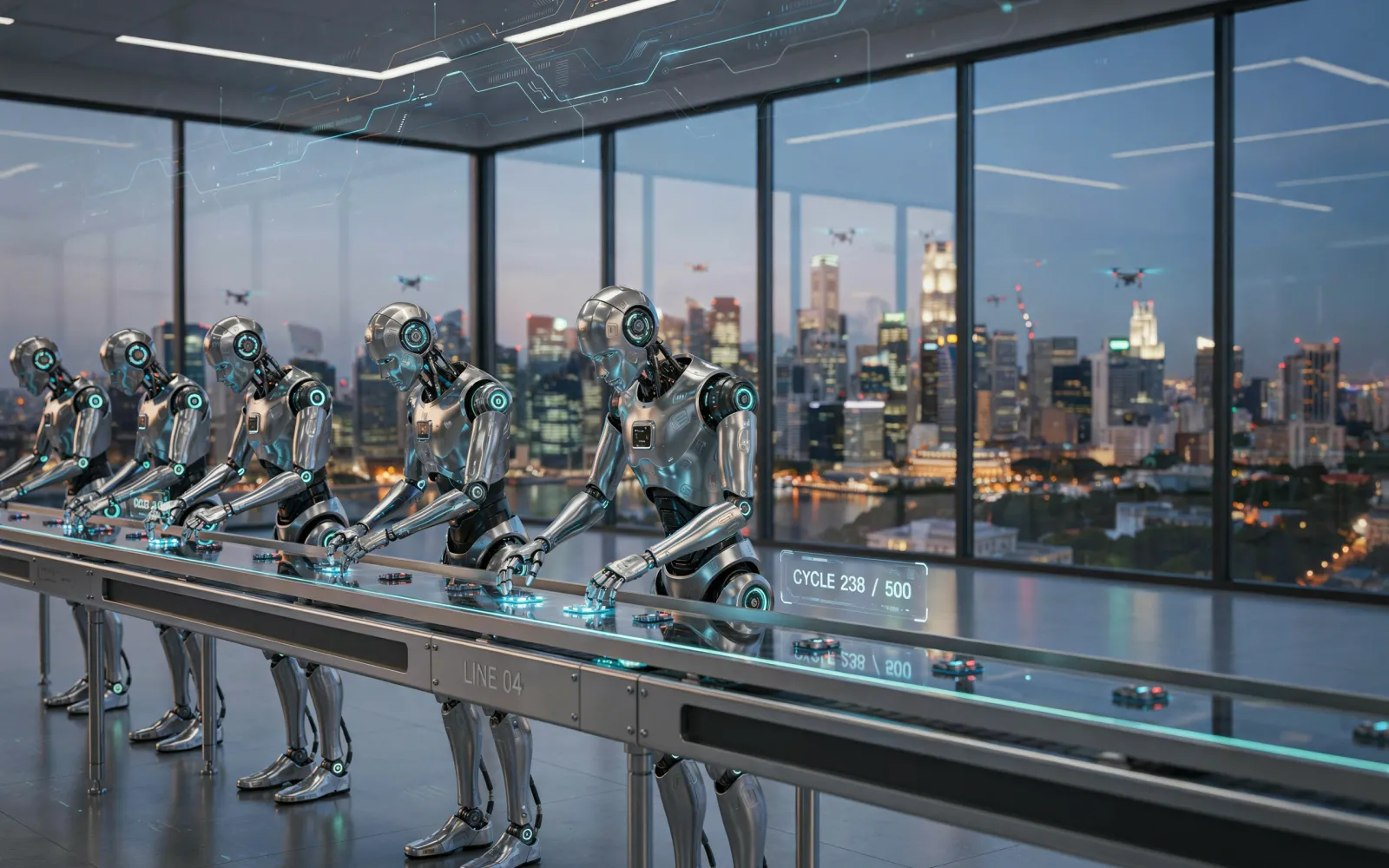
Key technology trends broaden the reach of AI robots. Collaborative robots (cobots) that safely work beside humans are becoming staples on assembly lines. Humanoid robots are gaining ground in mobility and manipulation, while edge‑computing integration cuts latency and lets robots process data locally. Cloud‑robotics platforms are expanding, enabling remote monitoring, software updates, and data analytics.
Market segmentation data shows that hardware dominated the AI robot industry in 2025, as every robotic system requires sensors, actuators, controllers, and computing units. Software, however, is expected to grow fastest between 2026 and 2035, propelled by advances in AI algorithms, machine‑learning frameworks, and cloud services that enhance what robots can sense, decide, and act.
Major players highlighted in the report include NVIDIA, ABB, Intel, Google, IBM, Hanson Robotics, Boston Dynamics, Xilinx, Fanuc, KUKA, Blue Frog Robotics, Promobot, Vicarious FPC, Neurala, Veo Robotics, and Miso Robotics. These companies supply a mix of hardware platforms, software stacks, and end‑to‑end solutions that serve industrial, commercial, and defense customers.
The report also examines competitive dynamics, regional analysis, and a SWOT assessment of the industry. While the U.S. and European markets remain the largest segments, the Asia‑Pacific region is projected to experience the highest growth rate, thanks to rapid industrialization and a robust robotics manufacturing base.
Today, the AI robot market is in a rapid expansion phase, with new deployments appearing in warehouses, automotive manufacturing, and autonomous delivery. Upcoming product launches and software updates are expected to lower entry barriers for small and medium‑sized enterprises. Regulatory developments around data privacy, safety standards, and export controls are shaping the market, though no definitive policy changes have been announced yet.
In short, the AI robot market is set for significant growth, powered by automation investment, technological advances, and a shift toward software‑centric solutions. The industry will continue to evolve as hardware becomes more affordable and software capabilities expand, but the pace of change will hinge on regulatory clarity and the ability of firms to deliver reliable, safe robotic systems at scale.
In the United States, the market is projected to grow from $2.85 billion in 2025 to $58.40 billion in 2035. Europe is expected to expand from $2.18 billion to $44.96 billion in the same timeframe.
The surge is driven by mounting investment in industrial automation, tightening labor‑market pressures, and the expanding commercial viability of AI‑enabled autonomous systems. AI robots are shifting from niche prototypes to essential operational infrastructure across manufacturing, logistics, and defense, delivering measurable gains in productivity and efficiency.
Key technology trends broaden the reach of AI robots. Collaborative robots (cobots) that safely work beside humans are becoming staples on assembly lines. Humanoid robots are gaining ground in mobility and manipulation, while edge‑computing integration cuts latency and lets robots process data locally. Cloud‑robotics platforms are expanding, enabling remote monitoring, software updates, and data analytics.
Market segmentation data shows that hardware dominated the AI robot industry in 2025, as every robotic system requires sensors, actuators, controllers, and computing units. Software, however, is expected to grow fastest between 2026 and 2035, propelled by advances in AI algorithms, machine‑learning frameworks, and cloud services that enhance what robots can sense, decide, and act.
Major players highlighted in the report include NVIDIA, ABB, Intel, Google, IBM, Hanson Robotics, Boston Dynamics, Xilinx, Fanuc, KUKA, Blue Frog Robotics, Promobot, Vicarious FPC, Neurala, Veo Robotics, and Miso Robotics. These companies supply a mix of hardware platforms, software stacks, and end‑to‑end solutions that serve industrial, commercial, and defense customers.
The report also examines competitive dynamics, regional analysis, and a SWOT assessment of the industry. While the U.S. and European markets remain the largest segments, the Asia‑Pacific region is projected to experience the highest growth rate, thanks to rapid industrialization and a robust robotics manufacturing base.
Today, the AI robot market is in a rapid expansion phase, with new deployments appearing in warehouses, automotive manufacturing, and autonomous delivery. Upcoming product launches and software updates are expected to lower entry barriers for small and medium‑sized enterprises. Regulatory developments around data privacy, safety standards, and export controls are shaping the market, though no definitive policy changes have been announced yet.
In short, the AI robot market is set for significant growth, powered by automation investment, technological advances, and a shift toward software‑centric solutions. The industry will continue to evolve as hardware becomes more affordable and software capabilities expand, but the pace of change will hinge on regulatory clarity and the ability of firms to deliver reliable, safe robotic systems at scale.





