Blab AI
Ann Arbors AI Momentum Accelerates as Oracle-OpenAI Data Center Breaks Ground
In the heart of Michigan’s tech corridor, a new giant is taking shape. The city of Ann Arbor is fast becoming a magnet for artificial‑intelligence (AI) activity, a trend that the local economic‑development organization SPARK confirmed in its early‑2026 annual report. The study found that firms operating in the 2025 fiscal year were increasingly turning to AI tools to streamline their processes, signaling a growing appetite for high‑performance computing in the region.
SPARK’s chief operating officer, Phil Santer, said the momentum is poised to accelerate as county businesses rally behind new data‑center infrastructure. He highlighted energy‑efficiency and automation as key selling points that make the area attractive for large‑scale projects.
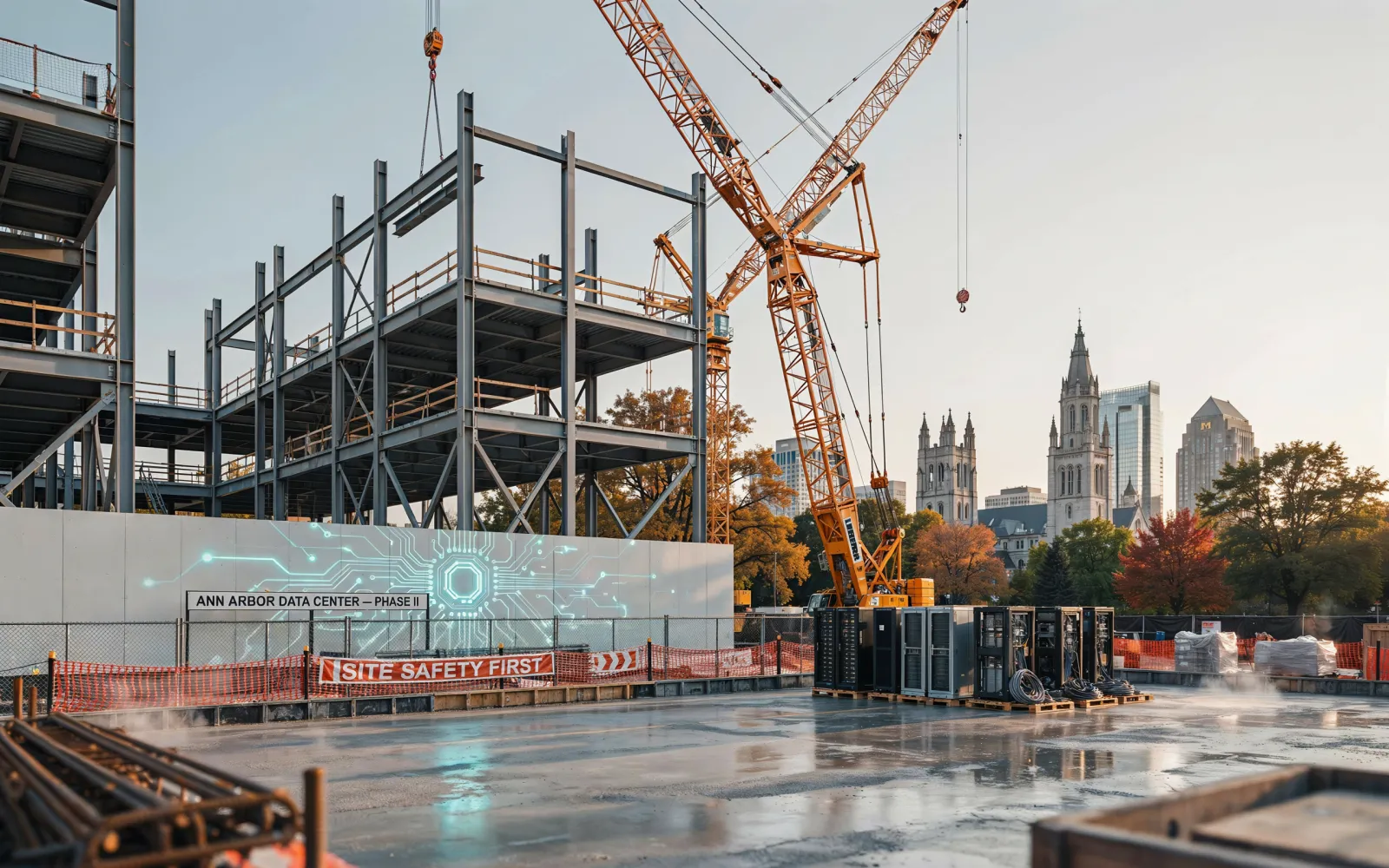
A landmark milestone arrived in October 2025 with the announcement of a 250‑acre hyperscale data‑center project in Saline Township, just south of Ann Arbor. The venture, a partnership between Oracle and OpenAI, will occupy roughly 2.2 million square feet and is billed as the largest investment in Michigan’s history. The facility is slated to power AI workloads and represents a broader push to expand the state’s high‑tech infrastructure.
The project has sparked debate among local residents and community groups. A 31‑October 2025 article in the Mlive newspaper reported that rural residents expressed concern over the construction of the massive complex on farmland. County meetings have since focused on the potential impacts on traffic, water usage, and the rural landscape.
Despite these worries, SPARK’s data show that Ann Arbor’s AI adoption metrics—firm AI use, data readiness, cloud readiness, and the proportion of jobs exposed to generative AI—compare favorably with larger cities such as Chicago, Austin, and Dallas. The city’s vibrant startup ecosystem, fueled by research from the University of Michigan, is credited as a major driver of this performance.
Among the firms highlighted in the report are Utilidata, a local company that has integrated AI into its operations, and Torc Robotics, an autonomous‑truck subsidiary of Daimler Truck with an Ann Arbor office. Torc’s work on autonomous vehicle technology dovetails with the region’s focus on automation and advanced manufacturing.
Santer cautioned that global economic uncertainty could temper hiring and investment as the new fiscal year begins. He added that startups will be competing for leverage in the rapidly evolving AI sector, creating a competitive environment for talent and capital.
The data‑center is expected to bring significant infrastructure benefits to the area. Oracle and OpenAI have indicated that the facility will incorporate advanced cooling systems and renewable‑energy sources to reduce its environmental footprint. The project is also anticipated to create jobs in construction, operations, and support services.
Together, a robust local AI ecosystem, the arrival of a hyperscale data center, and the presence of companies like Utilidata and Torc Robotics position Ann Arbor as a notable node in Michigan’s broader AI cluster. Continued emphasis on energy efficiency and automation may help the city attract additional AI‑related investment.
As the region moves forward, stakeholders will likely monitor how the new data center integrates with local supply chains, its effects on the city’s energy grid, and whether the promised economic benefits materialize. The outcomes of these developments will inform future decisions by businesses, investors, and policymakers in the Ann Arbor area.
The SPARK report underscores that while the city’s AI trajectory is promising, it remains subject to broader economic conditions and community responses to large infrastructure projects.
SPARK’s chief operating officer, Phil Santer, said the momentum is poised to accelerate as county businesses rally behind new data‑center infrastructure. He highlighted energy‑efficiency and automation as key selling points that make the area attractive for large‑scale projects.
A landmark milestone arrived in October 2025 with the announcement of a 250‑acre hyperscale data‑center project in Saline Township, just south of Ann Arbor. The venture, a partnership between Oracle and OpenAI, will occupy roughly 2.2 million square feet and is billed as the largest investment in Michigan’s history. The facility is slated to power AI workloads and represents a broader push to expand the state’s high‑tech infrastructure.
The project has sparked debate among local residents and community groups. A 31‑October 2025 article in the Mlive newspaper reported that rural residents expressed concern over the construction of the massive complex on farmland. County meetings have since focused on the potential impacts on traffic, water usage, and the rural landscape.
Despite these worries, SPARK’s data show that Ann Arbor’s AI adoption metrics—firm AI use, data readiness, cloud readiness, and the proportion of jobs exposed to generative AI—compare favorably with larger cities such as Chicago, Austin, and Dallas. The city’s vibrant startup ecosystem, fueled by research from the University of Michigan, is credited as a major driver of this performance.
Among the firms highlighted in the report are Utilidata, a local company that has integrated AI into its operations, and Torc Robotics, an autonomous‑truck subsidiary of Daimler Truck with an Ann Arbor office. Torc’s work on autonomous vehicle technology dovetails with the region’s focus on automation and advanced manufacturing.
Santer cautioned that global economic uncertainty could temper hiring and investment as the new fiscal year begins. He added that startups will be competing for leverage in the rapidly evolving AI sector, creating a competitive environment for talent and capital.
The data‑center is expected to bring significant infrastructure benefits to the area. Oracle and OpenAI have indicated that the facility will incorporate advanced cooling systems and renewable‑energy sources to reduce its environmental footprint. The project is also anticipated to create jobs in construction, operations, and support services.
Together, a robust local AI ecosystem, the arrival of a hyperscale data center, and the presence of companies like Utilidata and Torc Robotics position Ann Arbor as a notable node in Michigan’s broader AI cluster. Continued emphasis on energy efficiency and automation may help the city attract additional AI‑related investment.
As the region moves forward, stakeholders will likely monitor how the new data center integrates with local supply chains, its effects on the city’s energy grid, and whether the promised economic benefits materialize. The outcomes of these developments will inform future decisions by businesses, investors, and policymakers in the Ann Arbor area.
The SPARK report underscores that while the city’s AI trajectory is promising, it remains subject to broader economic conditions and community responses to large infrastructure projects.





