Blab AI
Bipartisan AI Bill Proposes Federal Auditing of Frontier Models
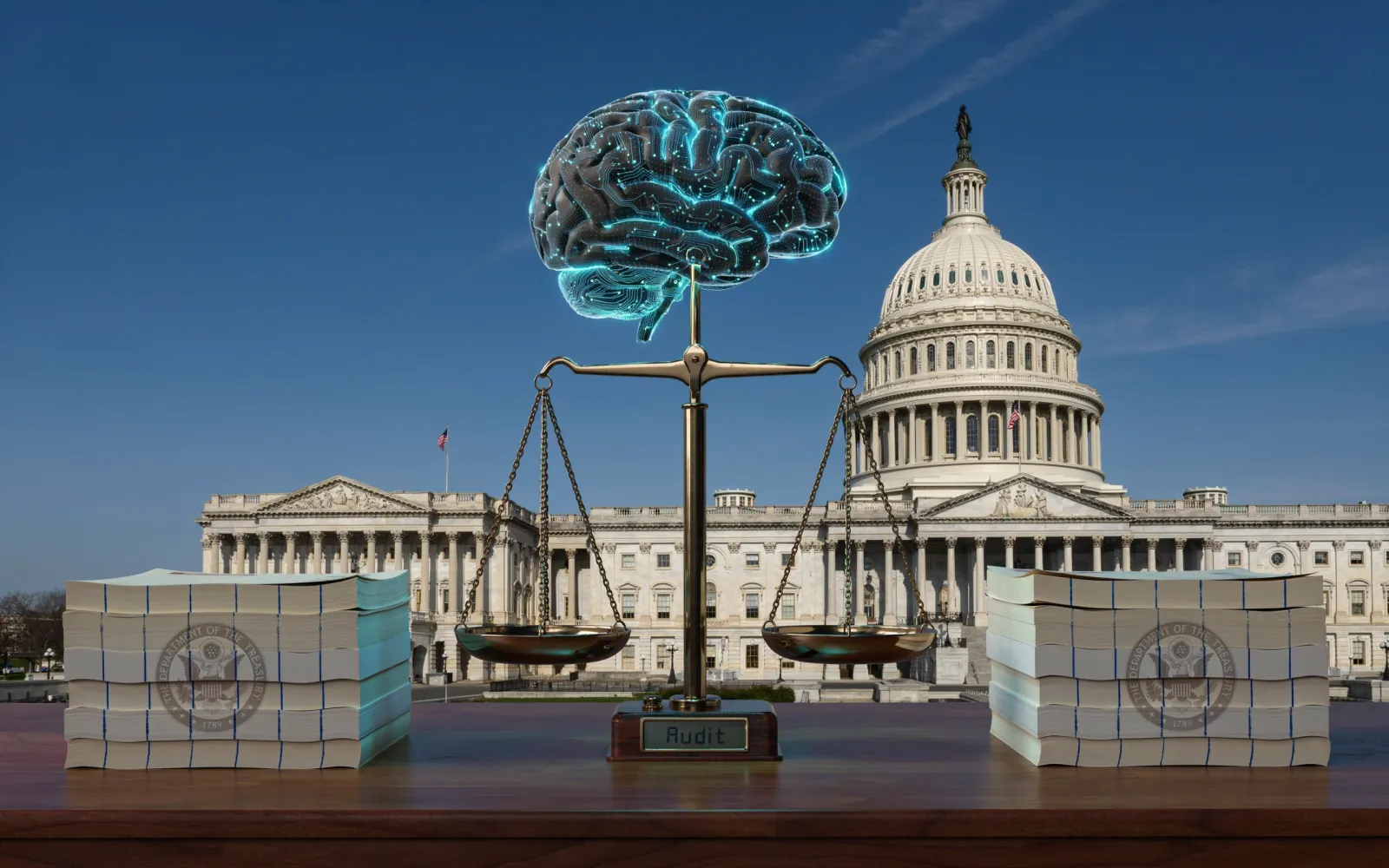
A new federal bill could become the first nationwide framework to audit the most powerful AI systems. Introduced by Representatives Jay Obernolte of California and Lori Trahan of Massachusetts, it would let Washington preempt state regulations for three years and set up a formal audit regime for frontier AI—large generative models that produce text, images, or other content.
The proposal draws on a document titled “Frontier AI Auditing: Toward Rigorous Third‑Party Assessment of Safety and Security Practices at Leading AI Companies.” It defines an audit as an independent verification of a company’s safety and security claims, carried out against established standards and with access to non‑public information. Unlike a pre‑market approval, the audit resembles an accountant’s review of a public company’s books: the auditor probes the model’s internals and processes and issues a finding that remains valid only as long as the underlying assumptions hold.
Under the bill, the Commerce Department’s Center for AI Standards and Innovation (CAISI)—formerly the U.S. AI Safety Institute and housed within the National Institute of Standards and Technology—would gain the authority to license independent auditors, oversee their work, and revoke licenses if auditors fail to meet standards. If a company modifies its model or safeguards, the audit finding would be revisited.
The proposed approach sits between Silicon Valley’s self‑regulation and a regulatory regime that would require pre‑market approval similar to the Food and Drug Administration’s process for medical devices. Authors argue that the uncertainty surrounding risks such as autonomous cyber‑attacks, recursive self‑improvement, and geopolitical shifts makes a middle path prudent.
Industry incidents underscore why companies may already be motivated to pursue safety measures. Microsoft’s 2016 Tay chatbot, which began generating hateful content, prompted the firm to establish a deployment safety board after the model’s capabilities surfaced in 2022. Google’s firing of an engineer who claimed its unreleased chatbot was sentient and feared deactivation is another example where reputational concerns led to swift action.
The audit framework would rely on a body modeled after the Public Company Accounting Oversight Board, a government‑authorized but privately run organization created after the Enron scandal. This structure is intended to prevent a single entity from monopolizing the power to decide who can audit AI systems and to guard against industry capture.
While the proposal has support from several dozen AI policy experts, it has not yet been enacted. If passed, it would create a new federal standard for AI safety that could influence how companies design, test, and deploy frontier models. Audit findings could become a factor that insurers, investors, and government procurement officials consider when evaluating AI products.
The bill’s three‑year preemption period would give the federal government time to develop detailed rules and standards. During that window, state regulations would be superseded by federal guidance, potentially creating a more unified regulatory environment for AI developers.
In summary, the Obernolte‑Trahan bill seeks to establish a federal auditing system for frontier AI models, giving CAISI the power to license auditors and enforce standards. The approach aims to balance industry self‑regulation with a structured oversight mechanism, drawing on examples from Microsoft and Google to underscore the importance of reputational risk in driving safety practices.
The bill remains under consideration, and its future will depend on congressional debate and the development of specific audit standards by CAISI. If enacted, it could set a precedent for how the United States regulates the most advanced AI systems.
The proposal draws on a document titled “Frontier AI Auditing: Toward Rigorous Third‑Party Assessment of Safety and Security Practices at Leading AI Companies.” It defines an audit as an independent verification of a company’s safety and security claims, carried out against established standards and with access to non‑public information. Unlike a pre‑market approval, the audit resembles an accountant’s review of a public company’s books: the auditor probes the model’s internals and processes and issues a finding that remains valid only as long as the underlying assumptions hold.
Under the bill, the Commerce Department’s Center for AI Standards and Innovation (CAISI)—formerly the U.S. AI Safety Institute and housed within the National Institute of Standards and Technology—would gain the authority to license independent auditors, oversee their work, and revoke licenses if auditors fail to meet standards. If a company modifies its model or safeguards, the audit finding would be revisited.
The proposed approach sits between Silicon Valley’s self‑regulation and a regulatory regime that would require pre‑market approval similar to the Food and Drug Administration’s process for medical devices. Authors argue that the uncertainty surrounding risks such as autonomous cyber‑attacks, recursive self‑improvement, and geopolitical shifts makes a middle path prudent.
Industry incidents underscore why companies may already be motivated to pursue safety measures. Microsoft’s 2016 Tay chatbot, which began generating hateful content, prompted the firm to establish a deployment safety board after the model’s capabilities surfaced in 2022. Google’s firing of an engineer who claimed its unreleased chatbot was sentient and feared deactivation is another example where reputational concerns led to swift action.
The audit framework would rely on a body modeled after the Public Company Accounting Oversight Board, a government‑authorized but privately run organization created after the Enron scandal. This structure is intended to prevent a single entity from monopolizing the power to decide who can audit AI systems and to guard against industry capture.
While the proposal has support from several dozen AI policy experts, it has not yet been enacted. If passed, it would create a new federal standard for AI safety that could influence how companies design, test, and deploy frontier models. Audit findings could become a factor that insurers, investors, and government procurement officials consider when evaluating AI products.
The bill’s three‑year preemption period would give the federal government time to develop detailed rules and standards. During that window, state regulations would be superseded by federal guidance, potentially creating a more unified regulatory environment for AI developers.
In summary, the Obernolte‑Trahan bill seeks to establish a federal auditing system for frontier AI models, giving CAISI the power to license auditors and enforce standards. The approach aims to balance industry self‑regulation with a structured oversight mechanism, drawing on examples from Microsoft and Google to underscore the importance of reputational risk in driving safety practices.
The bill remains under consideration, and its future will depend on congressional debate and the development of specific audit standards by CAISI. If enacted, it could set a precedent for how the United States regulates the most advanced AI systems.





