Blab AI
AI Rally Adds $4.1 Trillion to Global Markets Amid Middle East Conflict
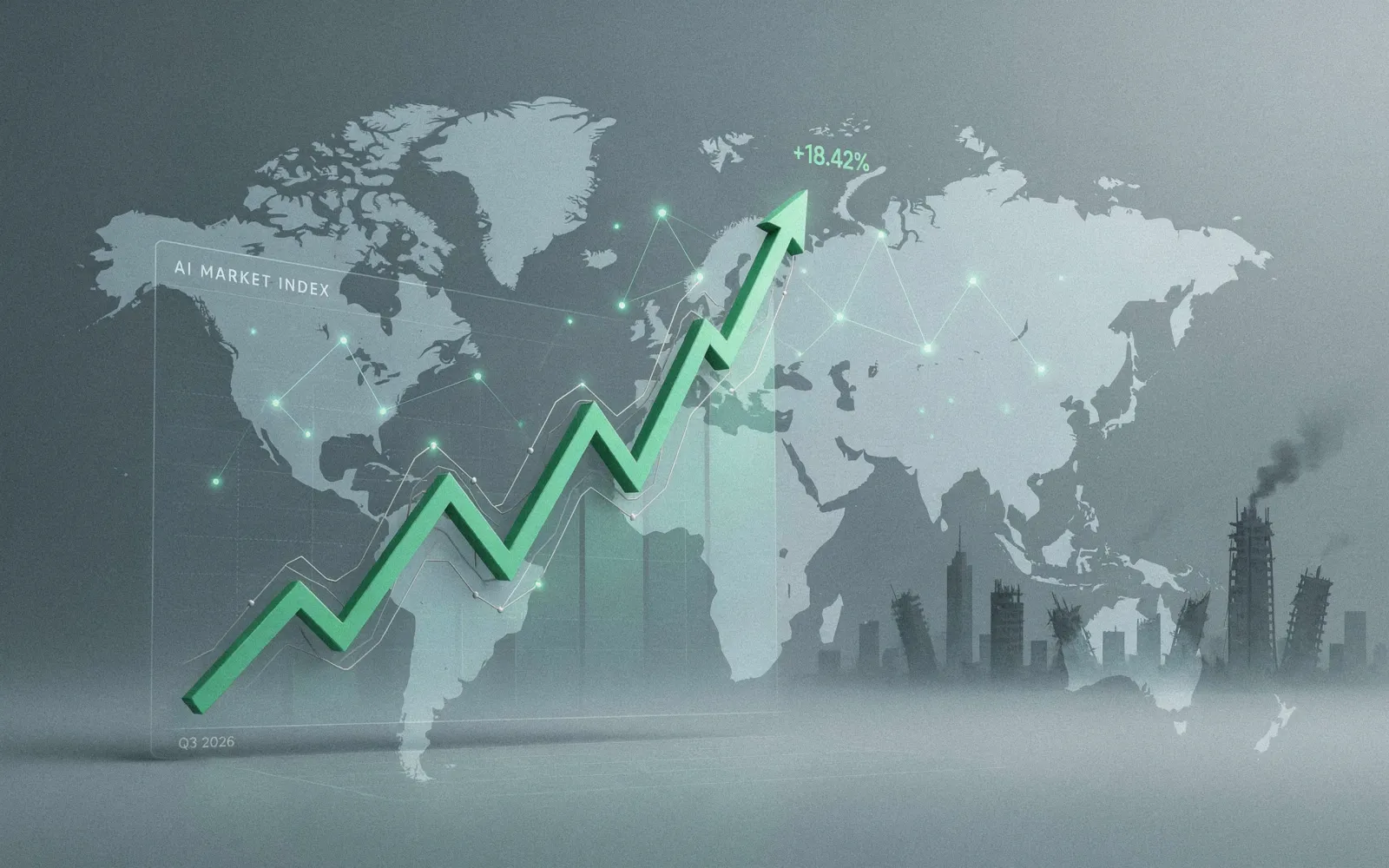
When a war flared in the Middle East, the world’s markets found a different kind of fire: an AI‑led surge that added more than $4 trillion to global equity value.
In the first 100 days of the U.S.–Israel–Iran conflict that began on 28 February 2026, listed companies worldwide climbed to a record $161.1 trillion in market capitalization, eclipsing the volatility generated by the conflict.
The rally is concentrated in technology and semiconductor firms. Nvidia, the industry’s leading AI chipmaker, posted first‑quarter revenue of $81.6 billion for its 2027 fiscal year, an 85 % jump from a year earlier. CEO Jensen Huang said the company’s new Blackwell and Rubin GPU lines would generate at least $1 trillion in revenue by the end of 2027, a figure that helped lift the broader market.
With the war keeping energy markets on edge—Brent crude spiked to $114 per barrel on 9 March before easing to around $90—investors have turned their attention to AI’s long‑term growth prospects. The surge in AI stocks has outweighed concerns about supply‑chain disruptions and inflation.
South Korea’s Kospi index surged 22.7 %, the biggest gain among major global indices. In the United States, the Nasdaq Composite rose 13.4 %, the S&P 500 7.3 %, and the Dow Jones Industrial Average 3.9 %. Japan’s Nikkei 225 increased 8.5 %, and Italy’s FTSE MIB climbed 5.7 %. In contrast, Europe’s DAX 40 fell 2.1 %, France’s CAC 40 4.2 %, Spain’s IBEX 35 0.8 %, and the UK’s FTSE 100 4.9 %. Asian markets were mixed: China’s Shanghai Composite fell 4.5 %, and Hong Kong’s Hang Seng dropped 7.4 %.
Volatility, measured by the VIX, climbed 8.3 % to 19.8 during the period, reflecting heightened uncertainty. Bond markets felt pressure. The U.S. 10‑year Treasury yield hit 4.69 % on 19 May, the highest intraday level since January 2025. European yields climbed, with Germany’s 10‑year at 3.19 % (highest since May 2011), France’s 3.88 % (highest since June 2009), and the UK’s 5.19 % (highest since August 2007). China’s 10‑year bond fell to 1.72 %, a decline of about seven basis points, as the People’s Bank of China is seen unlikely to tighten policy amid deflationary risks.
The AI‑driven rally has underscored the sector’s resilience amid geopolitical shocks. Nvidia’s earnings and forward guidance, combined with broader corporate earnings growth, have reinforced investor confidence in AI as a long‑term growth engine. A temporary ceasefire on 8 April and ongoing diplomatic talks have offered some relief, but energy prices remain elevated, sustaining inflation concerns that keep the Federal Reserve and other central banks cautious about cutting rates.
In sum, the first 100 days of the U.S.–Israel–Iran conflict have added $4.1 trillion to global markets, largely driven by AI‑related companies. Nvidia’s strong earnings and projected revenue from Blackwell and Rubin chips have been key drivers. While geopolitical risk continues to influence energy prices and bond yields, the AI sector’s performance has outpaced regional market volatility, underscoring its growing importance in global finance.
In the first 100 days of the U.S.–Israel–Iran conflict that began on 28 February 2026, listed companies worldwide climbed to a record $161.1 trillion in market capitalization, eclipsing the volatility generated by the conflict.
The rally is concentrated in technology and semiconductor firms. Nvidia, the industry’s leading AI chipmaker, posted first‑quarter revenue of $81.6 billion for its 2027 fiscal year, an 85 % jump from a year earlier. CEO Jensen Huang said the company’s new Blackwell and Rubin GPU lines would generate at least $1 trillion in revenue by the end of 2027, a figure that helped lift the broader market.
With the war keeping energy markets on edge—Brent crude spiked to $114 per barrel on 9 March before easing to around $90—investors have turned their attention to AI’s long‑term growth prospects. The surge in AI stocks has outweighed concerns about supply‑chain disruptions and inflation.
South Korea’s Kospi index surged 22.7 %, the biggest gain among major global indices. In the United States, the Nasdaq Composite rose 13.4 %, the S&P 500 7.3 %, and the Dow Jones Industrial Average 3.9 %. Japan’s Nikkei 225 increased 8.5 %, and Italy’s FTSE MIB climbed 5.7 %. In contrast, Europe’s DAX 40 fell 2.1 %, France’s CAC 40 4.2 %, Spain’s IBEX 35 0.8 %, and the UK’s FTSE 100 4.9 %. Asian markets were mixed: China’s Shanghai Composite fell 4.5 %, and Hong Kong’s Hang Seng dropped 7.4 %.
Volatility, measured by the VIX, climbed 8.3 % to 19.8 during the period, reflecting heightened uncertainty. Bond markets felt pressure. The U.S. 10‑year Treasury yield hit 4.69 % on 19 May, the highest intraday level since January 2025. European yields climbed, with Germany’s 10‑year at 3.19 % (highest since May 2011), France’s 3.88 % (highest since June 2009), and the UK’s 5.19 % (highest since August 2007). China’s 10‑year bond fell to 1.72 %, a decline of about seven basis points, as the People’s Bank of China is seen unlikely to tighten policy amid deflationary risks.
The AI‑driven rally has underscored the sector’s resilience amid geopolitical shocks. Nvidia’s earnings and forward guidance, combined with broader corporate earnings growth, have reinforced investor confidence in AI as a long‑term growth engine. A temporary ceasefire on 8 April and ongoing diplomatic talks have offered some relief, but energy prices remain elevated, sustaining inflation concerns that keep the Federal Reserve and other central banks cautious about cutting rates.
In sum, the first 100 days of the U.S.–Israel–Iran conflict have added $4.1 trillion to global markets, largely driven by AI‑related companies. Nvidia’s strong earnings and projected revenue from Blackwell and Rubin chips have been key drivers. While geopolitical risk continues to influence energy prices and bond yields, the AI sector’s performance has outpaced regional market volatility, underscoring its growing importance in global finance.





